In a first, Bitcoin developers have done something amazing amid the criticism over the lightning network and issues associated with it. A team of developers has made an international payment using the radio … Continue reading International payment using the radio waves→
My inspiration for this page was given to me by my new aquired friend, a fellow Truth Seeker – Joris and to whom I dedicate this page… Wish you… as well as to … Continue reading Discipline Quotes→
Bitcoin white paper turns 15 and the Legacy of Satoshi Nakamoto lives on. “I’ve been working on a new electronic cash system that’s fully peer-to-peer, with no trusted third party,” Satoshi Oct. 31, … Continue reading Bitcoin White Paper turn 15→
In a first, Bitcoin developers have done something amazing amid the criticism over the lightning network and issues associated with it. A team of developers has made an international payment using the radio … Continue reading International payment using the radio waves→
My inspiration for this page was given to me by my new aquired friend, a fellow Truth Seeker – Joris and to whom I dedicate this page… Wish you… as well as to … Continue reading Discipline Quotes→
Bitcoin white paper turns 15 and the Legacy of Satoshi Nakamoto lives on. “I’ve been working on a new electronic cash system that’s fully peer-to-peer, with no trusted third party,” Satoshi Oct. 31, … Continue reading Bitcoin White Paper turn 15→
A short list of active contributors to Bitcoin, ordered by first name.
Andreas Schildbach – original developer of Bitcoin Wallet for Android (Google Code Project).
Amir Taaki aka genjix – creator of the BIP process, Libbitcoin C++ developer toolkit, Obelisk blockchain server (later BS), SX bitcoin command line tool (later BX), Darkwallet, Darkmarket (later OpenBazaar), Darkleaks, Freecoin and well as inactive/defunct projects such as the Britcoin exchange, Intersango exchange, Spesmilo RPC client, Bitcoin Consultancy, Bitcoin Media Blog (author), Vibanko web wallet provider, GLBSE exchange client, Kartludox Bitcoin poker client, Pastecoinand Python bindings for Bitcoin.
Art Forz – developed the first GPU miner and at one time his GPU mining farm (the ArtFarm) was mining over a third of all blocks.
Gavin Andresen – Former Satoshi client maintainer. He previously worked at Silicon Graphics and now runs his own company.
Hal Finney – one of the creators of PGP and one of the earliest contributors to the Bitcoin project. First to identify a type of double-spending attack that now bears his name — the Finney attack.
James McCarthy aka Nefario – creator of the first bitcoin stock exchange GLBSE
Jed McCaleb – cofounder of Stellar.org and original developer of MtGox. Previously created eDonkey2000.
Jeff Garzik – Satoshi client core developer, GPU poold software and the founder of Bitcoin Watch. Works for BitPay.
Luke Dashjr aka Luke-Jr – Eligius founder, maintains BFGMiner and maintainer of bitcoind/Bitcoin-Qt stable branches.
Mark Karpeles – aka MagicalTux – Former owner of MtGox.
Martti Malmi aka Sirius – Former Bitcoin developer. Operates the domain names bitcoin.org and bitcointalk.org.
Matt Corallo aka BlueMatt – Satoshi clientand Bitcoinj developer.
Michael Hendrix aka mndrix – creator of the now defunct CoinPal and CoinCard services
Nils Schneider aka tcatm – Bitcoin developer, owner of BitcoinWatch, creator and owner of BitcoinCharts, GPU mining software and JS web interface.
Patrick McFarland aka Diablo-D3 – DiabloMiner author, and former BitcoinTalk forum moderator.
Patrick Strateman aka phantomcircuit – Bitcoin developer, creator of Intersango, member of Bitcoin Consultancy and creator of Python Bitcoin implementation.
Peter Todd – Bitcoin developer. Involved with Bitcoin related startup Coinkite and DarkWallet.
Pieter Wuille aka sipa – Satoshi clientdeveloper and maintainer of the network graphs http://bitcoin.sipa.be
Stefan Thomas aka justmoon – creator of the (We Use Coins) site/video and WebCoin.
Tamas Blummer aka grau – author of Bits of Proof, the enterprise-ready implementation of the Bitcoin protocol. http://bitsofproof.com
Trace Mayer – Host of the (Bitcoin Knowledge Podcast) where the top people in Bitcoin are interviewed
Vladimir Marchenko – runs Marchenko Ltd which sells mining contracts, previously developed the figator.org search engine.
Mining capability is measured in the number of attempts to find a block a miner can perform.
Each attempt consists of creating a unique block candidate, and creating a digest of the block candidate by means of the SHA-256d, a cryptographic hashing function.
Or, in short, a hash. Since this is a continuous effort, we speak of hashes per second or [H/s].
Hash rate denominations
1 kH/s is 1,000 (one thousand) hashes per second
1 MH/s is 1,000,000 (one million) hashes per second.
1 GH/s is 1,000,000,000 (one billion) hashes per second.
1 TH/s is 1,000,000,000,000 (one trillion) hashes per second.
1 PH/s is 1,000,000,000,000,000 (one quadrillion) hashes per second.
1 EH/s is 1,000,000,000,000,000,000 (one quintillion) hashes per second.
1 ZH/s is 1,000,000,000,000,000,000,000 (one sextillion) hashes per second.
The denomination of hash rates follows the International System of Units (SI).
Hereby, the prefixes kilo, mega, giga, tera, peta, exa, and zetta each translate to an increase by a factor of one thousand.
Please note, that the symbol for kilo is a lower-case “k”. As “K” is the symbol for kelvin, the unit of thermodynamic temperature.
Inconsistency of kilobyte, megabyte, and gigabyte
The computer industry’s use of kilobyte, megabyte, and gigabyte is inconsistent with the SI.
The Joint Electron Device Engineering Council (JEDEC) has redefined the prefixes kilo, mega and giga in relation with bit and byte as powers of 1024 instead of 1000.
Higher prefixes were not redefined by JEDEC.
In order to avoid this inconsistency, the International Electrotechnical Commission (IEC) has proposed the binary prefix which uses kibi[Ki], mebi [Mi], and gibi [Gi] for 1024¹, 1024², and 1024³ respectively.
” Privacy is necessary for an open society in the electronic age.
Privacy is not secrecy.
A private matter is something one doesn’t want the whole world to know, but a secret matter is something one doesn’t want anybody to know.
Privacy is the power to selectively reveal oneself to the world.
If two parties have some sort of dealings, then each has a memory of their interaction.
Each party can speak about their own memory of this; how could anyone prevent it?
One could pass laws against it, but the freedom of speech, even more than privacy, is fundamental to an open society; we seek not to restrict any speech at all.
If many parties speak together in the same forum, each can speak to all the others and aggregate together knowledge about individuals and other parties.
The power of electronic communications has enabled such group speech, and it will not go away merely because we might want it to.
Since we desire privacy, we must ensure that each party to a transaction have knowledge only of that which is directly necessary for that transaction.
Since any information can be spoken of, we must ensure that we reveal as little as possible.
In most cases personal identity is not salient. When I purchase a magazine at a store and hand cash to the clerk, there is no need to know who I am.
When I ask my electronic mail provider to send and receive messages, my provider need not know to whom I am speaking or what I am saying or what others are saying to me; my provider only need know how to get the message there and how much I owe them in fees.
When my identity is revealed by the underlying mechanism of the transaction, I have no privacy. I cannot here selectively reveal myself; I must always reveal myself.
Therefore, privacy in an open society requires anonymous transaction systems.
Until now, cash has been the primary such system.
An anonymous transaction system is not a secret transaction system.
An anonymous system empowers individuals to reveal their identity when desired and only when desired; this is the essence of privacy.
Privacy in an open society also requires cryptography.
If I say something, I want it heard only by those for whom I intend it.
If the content of my speech is available to the world, I have no privacy.
To encrypt is to indicate the desire for privacy, and to encrypt with weak cryptography is to indicate not too much desire for privacy.
Furthermore, to reveal one’s identity with assurance when the default is anonymity requires the cryptographic signature.
We cannot expect governments, corporations, or other large, faceless organizations to grant us privacy out of their beneficence.
It is to their advantage to speak of us, and we should expect that they will speak.
To try to prevent their speech is to fight against the realities of information.
Information does not just want to be free, it longs to be free.
Information expands to fill the available storage space.
Information is Rumor’s younger, stronger cousin;
Information is fleeter of foot, has more eyes, knows more, and understands less than Rumor.
We must defend our own privacy if we expect to have any.
We must come together and create systems which allow anonymous transactions to take place.
People have been defending their own privacy for centuries with whispers, darkness, envelopes, closed doors, secret handshakes, and couriers.
The technologies of the past did not allow for strong privacy, but electronic technologies do.
We the Cypherpunks are dedicated to building anonymous systems.
We are defending our privacy with cryptography, with anonymous mail forwarding systems, with digital signatures, and with electronic money.
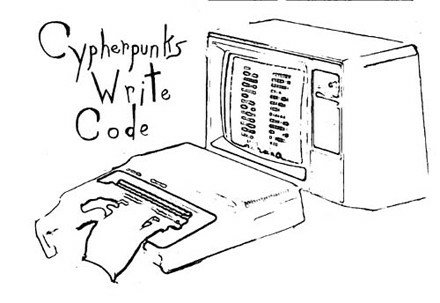
Cypherpunks write code.
We know that someone has to write software to defend privacy, and since we can’t get privacy unless we all do, we’re going to write it.
We publish our code so that our fellow Cypherpunks may practice and play with it. Our code is free for all to use, worldwide.
We don’t much care if you don’t approve of the software we write.
We know that software can’t be destroyed and that a widely dispersed system can’t be shut down.
Cypherpunks deplore regulations on cryptography, for encryption is fundamentally a private act.
The act of encryption, in fact, removes information from the public realm.
Even laws against cryptography reach only so far as a nation’s border and the arm of its violence.
Cryptography will ineluctably spread over the whole globe, and with it the anonymous transactions systems that it makes possible.
For privacy to be widespread it must be part of a social contract.
People must come and together deploy these systems for the common good. Privacy only extends so far as the cooperation of one’s fellows in society.
We the Cypherpunks seek your questions and your concerns and hope we may engage you so that we do not deceive ourselves.
We will not, however, be moved out of our course because some may disagree with our goals.
The Cypherpunks are actively engaged in making the networks safer for privacy. Let us proceed together apace.
In a first, Bitcoin developers have done something amazing amid the criticism over the lightning network and issues associated with it. A team of developers has made an international payment using the radio … Continue reading International payment using the radio waves→
My inspiration for this page was given to me by my new aquired friend, a fellow Truth Seeker – Joris and to whom I dedicate this page… Wish you… as well as to … Continue reading Discipline Quotes→
Bitcoin white paper turns 15 and the Legacy of Satoshi Nakamoto lives on. “I’ve been working on a new electronic cash system that’s fully peer-to-peer, with no trusted third party,” Satoshi Oct. 31, … Continue reading Bitcoin White Paper turn 15→
” How do people get new ideas? Presumably, the process of creativity, whatever it is, is essentially the same in all its branches and varieties, so that the evolution of a new art form, a new gadget, a new scientific principle, all involve common factors.
We are most interested in the “creation” of a new scientific principle or a new application of an old one, but we can be general here.
One way of investigating the problem is to consider the great ideas of the past and see just how they were generated. Unfortunately, the method of generation is never clear even to the “generators” themselves.
But what if the same earth-shaking idea occurred to two men, simultaneously and independently? Perhaps, the common factors involved would be illuminating.
Consider the theory of evolution by natural selection, independently created by Charles Darwin and Alfred Wallace.
There is a great deal in common there. Both traveled to far places, observing strange species of plants and animals and the manner in which they varied from place to place. Both were keenly interested in finding an explanation for this, and both failed until each happened to read Malthus’s “Essay on Population.”
Both then saw how the notion of overpopulation and weeding out (which Malthus had applied to human beings) would fit into the doctrine of evolution by natural selection (if applied to species generally).
Obviously, then, what is needed is not only people with a good background in a particular field, but also people capable of making a connection between item 1 and item 2 which might not ordinarily seem connected.
Undoubtedly in the first half of the 19th century, a great many naturalists had studied the manner in which species were differentiated among themselves.
A great many people had read Malthus. Perhaps some both studied species and read Malthus. But what you needed was someone who studied species, read Malthus, and had the ability to make a cross-connection.
That is the crucial point that is the rare characteristic that must be found. Once the cross-connection is made, it becomes obvious. Thomas H. Huxley is supposed to have exclaimed after reading On the Origin of Species, “How stupid of me not to have thought of this.”
But why didn’t he think of it? The history of human thought would make it seem that there is difficulty in thinking of an idea even when all the facts are on the table.
Making the cross-connection requires a certain daring. It must, for any cross-connection that does not require daring is performed at once by many and develops not as a “new idea,” but as a mere “corollary of an old idea.”
It is only afterward that a new idea seems reasonable. To begin with, it usually seems unreasonable. It seems the height of unreason to suppose the earth was round instead of flat, or that it moved instead of the sun, or that objects required a force to stop them when in motion, instead of a force to keep them moving, and so on.
A person willing to fly in the face of reason, authority, and common sense must be a person of considerable self-assurance. Since he occurs only rarely, he must seem eccentric (in at least that respect) to the rest of us. A person eccentric in one respect is often eccentric in others.
Consequently, the person who is most likely to get new ideas is a person of good background in the field of interest and one who is unconventional in his habits. (To be a crackpot is not, however, enough in itself.)
Once you have the people you want, the next question is: Do you want to bring them together so that they may discuss the problem mutually, or should you inform each of the problem and allow them to work in isolation?
My feeling is that as far as creativity is concerned, isolation is required. The creative person is, in any case, continually working at it. His mind is shuffling his information at all times, even when he is not conscious of it. (The famous example of Kekule working out the structure of benzene in his sleep is well-known.)
The presence of others can only inhibit this process, since creation is embarrassing. For every new good idea you have, there are a hundred, ten thousand foolish ones, which you naturally do not care to display.
Nevertheless, a meeting of such people may be desirable for reasons other than the act of creation itself.
No two people exactly duplicate each other’s mental stores of items. One person may know A and not B, another may know B and not A, and either knowing A and B, both may get the idea—though not necessarily at once or even soon.
Furthermore, the information may not only be of individual items A and B, but even of combinations such as A-B, which in themselves are not significant. However, if one person mentions the unusual combination of A-B and another the unusual combination A-C, it may well be that the combination A-B-C, which neither has thought of separately, may yield an answer.
It seems to me then that the purpose of cerebration sessions is not to think up new ideas but to educate the participants in facts and fact-combinations, in theories and vagrant thoughts.
But how to persuade creative people to do so? First and foremost, there must be ease, relaxation, and a general sense of permissiveness. The world in general disapproves of creativity, and to be creative in public is particularly bad. Even to speculate in public is rather worrisome. The individuals must, therefore, have the feeling that the others won’t object.
If a single individual present is unsympathetic to the foolishness that would be bound to go on at such a session, the others would freeze. The unsympathetic individual may be a gold mine of information, but the harm he does will more than compensate for that. It seems necessary to me, then, that all people at a session be willing to sound foolish and listen to others sound foolish.
If a single individual present has a much greater reputation than the others, or is more articulate, or has a distinctly more commanding personality, he may well take over the conference and reduce the rest to little more than passive obedience. The individual may himself be extremely useful, but he might as well be put to work solo, for he is neutralizing the rest.
The optimum number of the group would probably not be very high. I should guess that no more than five would be wanted. A larger group might have a larger total supply of information, but there would be the tension of waiting to speak, which can be very frustrating. It would probably be better to have a number of sessions at which the people attending would vary, rather than one session including them all. (This would involve a certain repetition, but even repetition is not in itself undesirable. It is not what people say at these conferences, but what they inspire in each other later on.)
For best purposes, there should be a feeling of informality. Joviality, the use of first names, joking, relaxed kidding are, I think, of the essence—not in themselves, but because they encourage a willingness to be involved in the folly of creativeness. For this purpose I think a meeting in someone’s home or over a dinner table at some restaurant is perhaps more useful than one in a conference room.
Probably more inhibiting than anything else is a feeling of responsibility. The great ideas of the ages have come from people who weren’t paid to have great ideas, but were paid to be teachers or patent clerks or petty officials, or were not paid at all. The great ideas came as side issues.
To feel guilty because one has not earned one’s salary because one has not had a great idea is the surest way, it seems to me, of making it certain that no great idea will come in the next time either.
Yet your company is conducting this cerebration program on government money. To think of congressmen or the general public hearing about scientists fooling around, boondoggling, telling dirty jokes, perhaps, at government expense, is to break into a cold sweat.
In fact, the average scientist has enough public conscience not to want to feel he is doing this even if no one finds out.
I would suggest that members at a cerebration session be given sinecure tasks to do—short reports to write, or summaries of their conclusions, or brief answers to suggested problems—and be paid for that, the payment being the fee that would ordinarily be paid for the cerebration session. The cerebration session would then be officially unpaid-for and that, too, would allow considerable relaxation.
I do not think that cerebration sessions can be left unguided. There must be someone in charge who plays a role equivalent to that of a psychoanalyst.
A psychoanalyst, as I understand it, by asking the right questions (and except for that interfering as little as possible), gets the patient himself to discuss his past life in such a way as to elicit new understanding of it in his own eyes.
In the same way, a session-arbiter will have to sit there, stirring up the animals, asking the shrewd question, making the necessary comment, bringing them gently back to the point.
Since the arbiter will not know which question is shrewd, which comment necessary, and what the point is, his will not be an easy job.
As for “gadgets” designed to elicit creativity, I think these should arise out of the bull sessions themselves. If thoroughly relaxed, free of responsibility, discussing something of interest, and being by nature unconventional, the participants themselves will create devices to stimulate discussion. “
“ The root problem with conventional currency is all the trust that’s required to make it work. The central bank must be trusted not to debase the currency, but the history of fiat currencies is full of breaches of that trust. Banks must be trusted to hold our money and transfer it electronically, but they lend it out in waves of credit bubbles with barely a fraction in reserve. ”
In a first, Bitcoin developers have done something amazing amid the criticism over the lightning network and issues associated with it. A team of developers has made an international payment using the radio … Continue reading International payment using the radio waves→
My inspiration for this page was given to me by my new aquired friend, a fellow Truth Seeker – Joris and to whom I dedicate this page… Wish you… as well as to … Continue reading Discipline Quotes→
Bitcoin white paper turns 15 and the Legacy of Satoshi Nakamoto lives on. “I’ve been working on a new electronic cash system that’s fully peer-to-peer, with no trusted third party,” Satoshi Oct. 31, … Continue reading Bitcoin White Paper turn 15→





 BitHouse