Asic Miners Vendors List

ASIC MINERS VENDORS LIST – 2021

https://51asic.ru/ Russian

https://akminer.com/ Chinese

https://www.antminerdistribution.com/ – Holland

https://asicmarketplace.com/ – Hong Kong

https://asicminermarket.com/ – China

https://bitcoinmerch.com/ – USA

https://www.bitmart.co.za/ – Zanzibar

https://blokforge.com/ – USA

https://bt-miners.com/ – USA

https://casaminers.com/en – Italy

https://coinminer.com/ – USA

https://coinminingcentral.com/ – England

https://cryptosupply.de/ – Germany

https://cryptodrilling.com/

https://www.cryptouniverse.at/

https://www.eastshore.xyz/

https://itopshop.net/

https://www.cryptominerbros.com/

https://mineshop.eu/

https://miningwholesale.eu/

https://miningcave.com/

https://pangolinminer.com/

https://printcrypto.io/

https://mining.sesterce.com/

https://shop.unlimitedminer.com/en/home/

https://whatsminer.net/

Satoshi Nakamoto bitcoin quotes

The Times 03/Jan/2009
Wikileaks
Lost coins
Transaction fees
Anonymous vs. Pseudonymous
bitcoin’s convenience against credit cards
Scarce asset
Generate new bitcoin address
Not having bitcoin would be the net waste
Inflation vs. Deflation in bitcoin
Potential for a positive feedback loop
…gain a new territory of freedom…
E-currency based on cryptographic proof
Attractive to the libertarian viewpoint
Root problem with conventional currency

Speculative Attack

Speculative Attack

Pierre Rochard

July 4, 2014

Introduction

Bitcoin naysayers1 wring their hands over how Bitcoin can’t go mainstream. They gleefully worry that Bitcoin will not make it across the innovation chasm:

  • It’s too complicated
  • It doesn’t have the right governance structure2
  • The security is too hard to get right
  • Existing and upcoming fiat payment systems are or will be superior
  • It’s too volatile
  • The government will ban it
  • It won’t scale

The response from the Bitcoin community is to either endlessly argue over the above points3 or to find their inner Bitcoin Jonah4 with platitudes like:

  • Bitcoin the currency doesn’t matter, it’s the block chain technology that matters
  • It would be better if the block chain technology were used by banks and governments
  • Bitcoin should continue to be a niche system for the bit-curious, it’s just an experiment
  • Fiat and Bitcoin will live side-by-side, happily ever after
  • Bitcoin is the Myspace of ‘virtual currency’

The above sophisms are each worth their own article, if just to analyze the psycho-social archetypes of the relevant parrots.

A few of the criticisms mentioned earlier are correct, yet they are complete non sequiturs. Bitcoin will not be eagerly adopted by the mainstream, it will be forced upon them. Forced, as in “compelled by economic reality“.

People will be forced to pay with bitcoins, not because of ‘the technology’, but because no one will accept their worthless fiat for payments.

Contrary to popular belief, good money drives out bad. This “driving out” has started as a small fiat bleed.

It will rapidly escalate into Class IV hemorrhaging due to speculative attacks on weak fiat currencies. The end result will be hyperbitcoinization, i.e. “your money is no good here”.

Thiers’ Law: Good Money Drives Out Bad

Historically, it has been good, strong currencies that have driven out bad, weak currencies.

Over the span of several millennia, strong currencies have dominated and driven out weak in international competition.

The Persian daric, the Greek tetradrachma, the Macedonian stater, and the Roman denarius did not become dominant currencies of the ancient world because they were “bad” or “weak.”

The florinsducats and sequins of the Italian city-states did not become the “dollars of the Middle Ages” because they were bad coins; they were among the best coins ever made.

The pound sterling in the 19th century and the dollar in the 20th century did not become the dominant currencies of their time because they were weak.

Consistency, stability and high quality have been the attributes of great currencies that have won the competition for use as international money.

Robert Mundell“Uses and Abuses of Gresham’s Law in the History of Money”

Bitcoins are not just good money, they are the best money.5 

The Bitcoin network has the best monetary policy6 and the best brand.7 

We should therefore expect that bitcoins will drive out bad, weak currencies.8 

By what process will bitcoins become the dominant currency? Which fiat currencies will be the first to disappear?

These are the interesting questions of the day, as the necessary premises for these questions are already established truths.9

1. Fiat Bleed

Bitcoin’s current trend is to increase in value on an exponential trend line as new users arrive in waves.

The good money is “slowly” driving out the bad.

Two factors drive this:

  1. Reduction in information asymmetry โ€“ people are learning about Bitcoin and coming to the realization that bitcoins are indeed the best money. Possible overlapping motives:
    • ADHD โ€“ compulsive novelty fetichism induced by our post-war consumer culture and/or innate biological processes
    • FOMO โ€“ fear of missing out, see Regret Theory and ingroups, aka avarice and status-seeking
    • PISD โ€“ post-internet stress disorder, aka “disruption”, “next big thing”, “internet of money”
  2. Increasing liquidity โ€“ buying bitcoins is more convenient and has fewer fees attached today than a year ago. One can reasonably predict that this will also be the case a year from now. Why? Because selling bitcoins is a profitable and competitive business. Why? Because people want bitcoins, see above.

Due to group psychology, these newcomers arrive in waves.

The waves have a destabilizing effect on the exchange rate: speculators are unsure of the amplitude or wavelength of adoption, and amateurish punters let their excitement as well as subsequent fear overwhelm them.

Regardless, once the tide has pulled back and the weak hands have folded, the price is a few times higher than before the wave.

This ‘slow’ bleed is the current adoption model, and commentators generally assume one of the following:

  1. Slow bleed never occurred, it’s a fiction based on misleading data
  2. Slow bleed has stopped, the above motives only affect lolbertarians and angry teens
  3. The process will taper off now, as all the super tech-savvy people are already getting on board

My own prediction is that slow bleed has been accelerating and is only the first step.

The second step will be speculative attacks that use bitcoins as a platform.

The third and final step will be hyperbitcoinization.

2. Currency Crises

It might make sense just to get some in case it catches on.

If enough people think the same way, that becomes a self fulfilling prophecy.

” Once it gets bootstrapped, there are so many applications if you could effortlessly pay a few cents to a website as easily as dropping coins in a vending machine. “

Satoshi Nakamoto, 1/17/2009

Slow bleed leads to currency crisis as the expected value of bitcoins solidifies in people’s minds.

At first they are conservative, they invest “what they can afford to lose”.

After 12-18 months, their small stash of bitcoins has dramatically increased in value.

They see no reason why this long term trend should reverse: the fundamentals have improved and yet adoption remains low.

Their confidence increases. They buy more bitcoins. They rationalize: “well, it’s only [1-5%] of my investments”. They see the price crash a few times, due to bubbles bursting or just garden-variety panic sales โ€“ it entices them to buy more, “a bargain”. Bitcoin grows on the asset side of their balance sheet.

On the liability side of the Bitcoiner’s balance sheet there are mortgages, student loans, car loans, credit cards, etc.

Everyone admonishes people to not borrow in order to buy bitcoins.

The reality is that money is fungible: if you buy bitcoins instead of paying down your mortgage’s principal, you are a leveraged bitcoin investor.

Almost everyone is a leveraged bitcoin investor, because it makes economic sense (within reason).

The cost of borrowing (annualized interest rates ranging from 0% to 25%) is lower than the expected return of owning bitcoins.

How leveraged someone’s balance sheet is depends on the ratio between assets and liabilities.

The appeal of leveraging up increases if people believe that fiat-denominated liabilities are going to decrease in real terms, i.e. if they expect inflation to be greater than the interest rate they pay.

At that point it becomes a no-brainer to borrow the weak local currency using whatever collateral a bank will accept, invest in a strong foreign currency, and pay back the loan later with realized gains.

In this process, banks create more weak currency, amplifying the problem.

The effect of people, businesses, or financial institutions borrowing their local currency to buy bitcoins is that the bitcoin price in that currency would go up relative to other currencies.

To illustrate, let’s say that middle-class Indians trickle into bitcoin. Thousands of buyers turns into hundreds of thousands of buyers.

They borrow Indian Rupees using whatever unencumbered collateral they have โ€“ homes, businesses, gold jewelry, etc.

They use these Rupees to buy bitcoins. The price of bitcoins in Indian Rupees goes up, a premium develops relative to other currency pairs.

A bitcoin in India might be worth $600, while in the U.S. it trades at $500. Traders would buy bitcoins in the U.S. and sell them in India to net a $100 gain. They would then sell their Indian Rupees for dollars. This would weaken the Indian Rupee, causing import inflation and losses for foreign investors.

The Indian central bank would have to either increase interest rates to break the cycle, impose capital controls, or spend their foreign currency reserves trying to prop up the Rupee’s exchange rate.

Only raising interest rates would be a sustainable solution, though it would throw the country into a recession.

There’s a huge problem with the Indian central bank raising interest rates: bitcoin’s historical return is ~500% per year.

Even if investors expected future return is 1/10th of that, the central bank would have to increase interest rates to unconscionable levels to break the attack.

The result is evident: everyone would flee the Rupee and adopt bitcoins, due to economic duress rather than technological enlightenment.

This example is purely illustrative, it could happen in a small country at first, or it could happen simultaneously around the world.

Who leverages their balance sheet and how is impossible to predict, and it will be impossible to stop when the dam cracks.

Which countries are most vulnerable to a currency crisis?

Business Insider provides a helpful list here.

Bitcoins will have to reach certain threshold of liquidity, indicated by a solid exchange in every financial center and a real money supply โ€“ i.e. market cap โ€“ of at least $50 billion, before they can be used as an instrument in a speculative attack. This will either coincide with or cause a currency crisis.

3. Hyperbitcoinization

A speculative attack that seems isolated to one or a few weak currencies, but causes the purchasing power of bitcoins to go up dramatically, will rapidly turn into a contagion.

For example, the Swiss will see the price of bitcoins go up ten fold, and then a hundred fold.

At the margin they will buy bitcoins simply because they want to speculate on their value, not due to an inherent problem with the Swiss Franc.

The reflexivity here entails that the reduction in demand for Swiss Francs would actually cause higher than expected inflation and thus an inherent problem with the Swiss Franc.

The feedback loop between fiat inflation and bitcoin deflation will throw the world into full hyperbitcoinization, explained by Daniel here.

Conclusion

Bitcoin will become mainstream.

The Bitcoin skeptics don’t understand this due to their biases and lack of financial knowledge.

First, they are in as strong an echo chamber as Bitcoin skeptics.10 

They rabidly search for evidence that confirms their view of Bitcoin.

Second, they misunderstand how strong currencies like bitcoin overtake weak currencies like the dollar: it is through speculative attacks and currency crises caused by investors, not through the careful evaluation of tech journalists and ‘mainstream consumers’.

To honor these soon to be extinct skeptics, the Nakamoto Institute has launchedย A Tribute to Bold Assertions.


  1. No, seriously, there are people on the Internet spending a non-trivial amount of time writing about a currency they think is going to fail yet continues to succeed beyond anyone’s expectations. I get schadenfreude from their lack of schadenfreude. Granted, a few of them are being paid to write controversial click bait and/or just concern trolling โ€“ both activities that I respect and understand.
  2. This is generally stated by people who are in the ‘out-group’ and fantasize about being in the ‘in-group’ through politics/pedigree rather than economic/meritocratic processes. Demographically, they probably overlap with fans of The Secret. Economically, they are without exception bezzlers
  3. Bitcoin has entered its Eternal September, where every person new to Bitcoin thinks they have a unique understanding of Bitcoin and everyone ought to hear about it. There’s an endless flood of newbies ‘concerned’ about such and such ‘problem’ with Bitcoin. The Bitcoin community does these arrivistes a real disservice by taking them seriously instead of just telling them ‘read more’. 
  4. The opposite of Bitcoin Jesus. Bitcoin Jonah is a defeatist, self-sabotaging, and timid ‘man’ who is on a permanent quest to confirm Bitcoin’s weakness. 
  5. Bitcoin is the Best Unit of Account by Daniel Krawisz 
  6. The Bitcoin Central Bankโ€™s Perfect Monetary Policy by Pierre Rochard 
  7. Bitcoin Has No Image Problem by Daniel Krawisz 
  8. Hyperbitcoinization by Daniel Krawisz
  9. If you disagree then either you have not been learning or you have not been engaging in the debate, go back to square one. 
  10. ‘I live in a rather special world. I only know one person who voted for Nixon. Where they are I don’t know. They’re outside my ken. But sometimes when I’m in a theater I can feel them.’ – Pauline Kael

Source:

https://nakamotoinstitute.org/mempool/speculative-attack/

What is Hashrate ?

Hashrate Bitcoin network h/s
Bitcoin Hash Rate

Hashrate (Hash per secondh/s) is an SI-derived unit representing the number of double SHA-256 computations performed in one second in the bitcoin network for cryptocurrency mining.

Hashrate is also called as hashing power. It is usually symbolized as h/s (with an appropriate SI prefix).

What is hashing power or hash rate?

The hash rate is the primary measure of a Bitcoin miner‘s performance.

In 2014, a miner’s performance was generally measured in Ghash/s, or billions of hashes per second.

The hash/second unit is also part of a common measure of a Bitcoin miner’s electric efficiency in the term watts /Ghash/s, denoted as W/Ghash/s. As 1 watt is equal to 1 joule/s, this measure can also be expressed as J/Ghash, or joules per 1 billion hashes.

Bitcoin network hash rate

Bitcoin network hashrate chart

The hash/s is also used in calculations of the Bitcoin network’s overall hash rate. Because each miner or mining pool only relays a solved block to the network, the overall hash rate of the network is calculated based on the time between blocks.

While not an accurate measure of network hash rate at any given instance in time, measurements over longer periods can be considered indicative and similar calculations are used in Bitcoin’s difficulty  adjustment.

In January 2015, the network hash rate was around 300 Phash/s, or 300 quadrillion hashes per second.

If you compare a bitcoin mining device to one that is designed to mine, for example, Ethereum, you will notice a very large apparent difference in hash rates.

This is because there are many different algorithms that cryptocurrencies use. They all require different amounts of memory and computing power in order to be mined.

To put it simply, bitcoin and its SHA256 algorithm is considered by today standards to be relatively easy to compute. As a result, a mining device that is still relevant today would need to produce hashes in the terahash range and up.

If we were to compare this to Ethereum, youโ€™ll find that most modern Ethereum mining devices (typically GPUโ€™s) operate in the megahash range.

At first glance, you may think that the bitcoin mining device is significantly more powerful or more productive.

While itโ€™s true that it produces more hashes (of the SHA256 variety), this is because bitcoin hashes are easier to produce computationally.

As a consequence, the network difficulty is significantly higher for bitcoin.

To make things even more confusing, some cryptocurrencies intentionally chose algorithms that can only be mined using a basic CPU.

As a result, mining devices for this network that can produce hundreds of hashes per second are considered to be high and very competitive.

So what does all this mean?

Basically, it means that looking at the hash rate alone doesnโ€™t necessarily tell you the effectiveness of the miner.

You also need to understand the network difficulty, and what the norm is for most mining devices for that particular cryptocurrency.

How can I calculate how many hashes I generate per second?

Your problem breaks down nicely into 3 separate tasks:

  • Sharing a single count variable across threads
  • Benchmarking thread completion time
  • Calculating hashes p/sec
  • Sharing a single count variable across threads

Now that we know that not all hashes are the same we need to know how to calculate the estimated profitability of a miner based on its hash rate.

For this, will need to use a mining profitability calculators, they are available in the Internet.

public static class GlobalCounter

{
public static int Value { get; private set; }
   public static void Increment()
{
Value = GetNextValue(Value);
}
   private static int GetNextValue(int curValue)
{
return Interlocked.Increment(ref curValue);
}
   public static void Reset()
{
Value = 0;
}
}

Before you spin off the threads call GlobalCounter.

Reset and then in each thread (after each successful hash) you would call GlobalCounter.

Increment – using Interlocked.X performs atomic operations of Value in a thread-safe manner, it’s also much faster than lock.

Benchmarking thread completion time

var sw = Stopwatch.StartNew();
Parallel.ForEach(someCollection, someValue =>
{
// generate hash
GlobalCounter.Increment();
});
sw.Stop();
Parallel.ForEach will block until all threads have finished

Calculating hashes per second

...
sw.Stop();
var hashesPerSecond = GlobalCounter.Value / sw.Elapsed.Seconds;

How is the hash rate measured?

Hash rate is a unit measured in hashes per second or h/s and here are some usual denominations used to refer it.

Hash rate denominations:

  • 1 kH/s is 1,000 (one thousand) hashes per second;
  • 1 MH/s is 1,000,000 (one million) hashes per second;
  • 1 GH/s is 1,000,000,000 (one billion) hashes per second;
  • 1 TH/s is 1,000,000,000,000 (one trillion) hashes per second;
  • 1 PH/s is 1,000,000,000,000,000 (one quadrillion) hashes per second;
  • 1 EH/s is 1,000,000,000,000,000,000 (one quintillion) hashes per second.

Common Hash rate Conversions:

  • 1 MH/s = 1,000 kH/s;
  • 1 GH/s = 1,000 MH/s = 1,000,000 kH/s;
  • 1 TH/s = 1,000 GH/s = 1,000,000 MH/s = 1,000,000,000 kH/s.

Shared with ๐Ÿ’š by Free Spirit

โœŒ & ๐Ÿ’š


Hoist the Waffels…

Hey Ho, Hoist the Waffels…

The TSMC and his men stoled the mighty chip out of it's bed,
And bound it on it's pcb plate.
The hasrate be ours, and by the hashrate powers,
It's where we'll roam!
Yo Ho... All you miners,
Hoist the waffels high!
Heave ho, traders and profets,
Never shall We die !
Some miners have perished and some are alive,
Others hold the hashrate high...
With the keys to their wallets...
And a pool's fee to pay,
We lay to Crypto's Creed !
Yo, ho hash together,
Hoist the waffels high!
Heave, ho, traders and profets,
Never shall We die !
Yo, Ho hash together,
Hoist the Waffels high!
The hashrate be ours,
Never shall we die !

Source of Inspiration :

“Hoist the Colours” by Hans Zimmer


$10 Million each coin ๐Ÿคฏ๐Ÿ˜ณ๐Ÿคฏ

Made with ๐Ÿ’š by Free Spirit

โœŒ & ๐Ÿ’š

Cypherpunk’s Manifesto

A Cypherpunk’s Manifesto


Eric Hughes

byย Eric Hughes

” Privacy is necessary for an open society in the electronic age.

Privacy is not secrecy.

A private matter is something one doesn’t want the whole world to know, but a secret matter is something one doesn’t want anybody to know.

Privacy is the power to selectively reveal oneself to the world.

If two parties have some sort of dealings, then each has a memory of their interaction.

Each party can speak about their own memory of this; how could anyone prevent it?

One could pass laws against it, but the freedom of speech, even more than privacy, is fundamental to an open society; we seek not to restrict any speech at all.

If many parties speak together in the same forum, each can speak to all the others and aggregate together knowledge about individuals and other parties.

The power of electronic communications has enabled such group speech, and it will not go away merely because we might want it to.

Since we desire privacy, we must ensure that each party to a transaction have knowledge only of that which is directly necessary for that transaction.

Since any information can be spoken of, we must ensure that we reveal as little as possible.

In most cases personal identity is not salient. When I purchase a magazine at a store and hand cash to the clerk, there is no need to know who I am.

When I ask my electronic mail provider to send and receive messages, my provider need not know to whom I am speaking or what I am saying or what others are saying to me; my provider only need know how to get the message there and how much I owe them in fees.

When my identity is revealed by the underlying mechanism of the transaction, I have no privacy. I cannot here selectively reveal myself; I mustย alwaysย reveal myself.

Therefore, privacy in an open society requires anonymous transaction systems.

Until now, cash has been the primary such system.

An anonymous transaction system is not a secret transaction system.

An anonymous system empowers individuals to reveal their identity when desired and only when desired; this is the essence of privacy.

Privacy in an open society also requires cryptography.

If I say something, I want it heard only by those for whom I intend it.

If the content of my speech is available to the world, I have no privacy.

To encrypt is to indicate the desire for privacy, and to encrypt with weak cryptography is to indicate not too much desire for privacy.

Furthermore, to reveal one’s identity with assurance when the default is anonymity requires the cryptographic signature.

We cannot expect governments, corporations, or other large, faceless organizations to grant us privacy out of their beneficence.

It is to their advantage to speak of us, and we should expect that they will speak.

To try to prevent their speech is to fight against the realities of information.

Information does not just want to be free, it longs to be free.

Information expands to fill the available storage space.

Information is Rumor’s younger, stronger cousin;

Information is fleeter of foot, has more eyes, knows more, and understands less than Rumor.

We must defend our own privacy if we expect to have any.

We must come together and create systems which allow anonymous transactions to take place.

People have been defending their own privacy for centuries with whispers, darkness, envelopes, closed doors, secret handshakes, and couriers.

The technologies of the past did not allow for strong privacy, but electronic technologies do.

We the Cypherpunks are dedicated to building anonymous systems.

We are defending our privacy with cryptography, with anonymous mail forwarding systems, with digital signatures, and with electronic money.


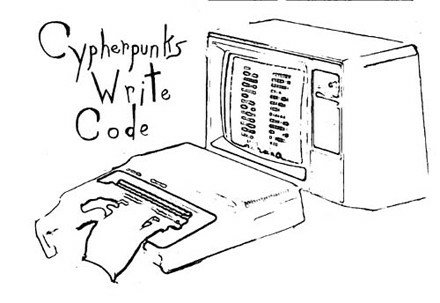
Cypherpunks write code.


We know that someone has to write software to defend privacy, and since we can’t get privacy unless we all do, we’re going to write it.

We publish our code so that our fellow Cypherpunks may practice and play with it. Our code is free for all to use, worldwide.

We don’t much care if you don’t approve of the software we write.

We know that software can’t be destroyed and that a widely dispersed system can’t be shut down.

Cypherpunks deplore regulations on cryptography, for encryption is fundamentally a private act.

The act of encryption, in fact, removes information from the public realm.

Even laws against cryptography reach only so far as a nation’s border and the arm of its violence.

Cryptography will ineluctably spread over the whole globe, and with it the anonymous transactions systems that it makes possible.

For privacy to be widespread it must be part of a social contract.

People must come and together deploy these systems for the common good. Privacy only extends so far as the cooperation of one’s fellows in society.

We the Cypherpunks seek your questions and your concerns and hope we may engage you so that we do not deceive ourselves.

We will not, however, be moved out of our course because some may disagree with our goals.

The Cypherpunks are actively engaged in making the networks safer for privacy. Let us proceed together apace.

Onward.

Eric Hughes

ย <hughes@soda.berkeley.edu>

9 March 1993


โ˜† Long Live the CypherPunks โ˜†


The world is in debt for your bright minds, even if it doesn’t know…

It’s minds like yours that always have changed the face of the earth for a better brighter future !

KUDOS TO YOU ALL !!!


BitHouse LLC


Strenght in Numbers

BitHouse LLC is a client โ€“ focused and result driven CryptoCurrency Consulting and Mining Company that provides broad โ€“ based services at an affordable fee to our clients .

We will ensure that we work hard to meet and surpass our Clientsโ€™ expectations whenever they hire our services for Consulting or mine bitcoin.

At BitHouse LLC, our Clientโ€™s best interest always come first and foremost, and everything we do is guided by our high values and professional ethics.


Services

Cryptocurrency Consulting

General cryptocurrency advice, reviews and due diligence on tokens, blockchain projects, general investment advice and trading strategy.

Security and putting processes in place to backup your crypto.

Cryptocurrency Mining & Staking

Setup and advice on Cryptocurrency mining rigs. Mining does not just include Bitcoin, there are numerous other options to mine, including other tokens, rigs that provide processing power and storage.

Masternodes

Nodes are a great way to generate cryptocurrency, similar to mining just without the expensive hardware.

Setting up and running a node is not straight forward, we can help.

Proof of Stake / Staking Wallets

 Just like mining, storing your cryptocurrency in a wallet that is connected to the blockchain can generate you more crypto of that same token.

If you own POS coins and arenโ€™t staking you are missing out on ROI.


Bitcoin – People’s Money

“Better a diamond with a flaw than a pebble without.”

Confucius

Diamond with a flaw

“Try not to become a man of success. Rather become a man of value.”

Albert Einstein

Man of Value

“If you don’t know what you want, you’ll never find it.

If you don’t know what you deserve, you’ll always settle for less.

You will wander aimlessly, uncomfortably numb in your comfort zone, wondering how life has ended up here.

Life starts now, live, love, laugh and let your light shine!”

Rob Liano

Let your light shine

“A person’s worth is measured by the worth of what he values.”

Marcus Aurelius, “Meditations”

Values

“Mathematics expresses values that reflect the cosmos, including orderliness, balance, harmony, logic, and abstract beauty.”

Deepak Chopra

Mathematics

“Every job from the heart is, ultimately, of equal value.

The nurse injects the syringe; the writer slides the pen; the farmer plows the dirt; the comedian draws the laughter.

Monetary income is the perfect deceiver of a man’s true worth.”

Criss Jami, “Killosophy”

Job from the Heart

“A person that does not value your time will not value your advice.”

Orrin Woodward

Value your time

“Once you embrace your value, talents and strengths, it neutralizes when others think less of you.”

Rob Liano

Embrace your Values

“Bad times have a scientific value. These are occasions a good learner would not miss.”

Ralph Waldo Emerson

Bad times

“I say no wealth is worth my life.”

Homer, “The Iliad”

Life

“But what’s worth more than gold?

Practically everything.

You, for example.

Gold is heavy.

Your weight in gold is not very much gold at all.

Aren’t you worth more than that?”

Terry Pratchett, “Making Money” 

You are worth more than gold

“Knowledge is like money: To be of value it must circulate, and in circulating it can increase in quantity and, hopefully, in value.”

Louis L’Amour, “Education of a Wandering Man”

Knowledge

“ร”, Sunlight! The most precious gold to be found on Earth.”

Roman Payne

Sunlight

“Knowledge is like money: To be of value it must circulate, and in circulating it can increase in quantity and, hopefully, in value.”

Louis L’Amour, “Education of a Wandering Man”

Knowledge

“If life โ€” the craving for which is the very essence of our being โ€” were possessed of any positive intrinsic value, there would be no such thing as boredom at all: mere existence would satisfy us in itself, and we should want for nothing.”

Arthur Schopenhauer, “The Vanity of Existence”

Existence

“Our sole purpose on this earth is to add value to others.

It doesnโ€™t make sense to just exist in people’s lives or to be a drain on them, does it?”

Rob Liano

Sole purpose

“Value judgments are destructive to our proper business, which is curiosity and awareness.”

John Cage

Curiosity & Awareness

“We set no special value on the possession of a virtue until we percieve that it is entirely lacking in our adversary.”

Friedrich Nietzsche, “Human, All Too Human: A Book for Free Spirits”

Virtue

“Maybe you had to come close to losing something before you could remember its value.

Maybe we enjoy the last minute struggle as it slips through our hands.”

Suraj Sani

Struggle

“Always remember that the minority dictates the prices, and the majority governs the value.”

Naved Abdali

Minority vs. Majority

“It is impossible to say whether an asset class valuation is cheap or expensive in isolation.

The valuation of an asset is relative to the valuations of all other assets.”

Naved Abdali

Valuation of an Asset

“Market quotes change every second, but business evolves steadily.

You have ample time to evaluate a business to buy or not to buy.

There is no rush.”

Naved Abdali

Evaluate

“The number one reason people lose money in investing is because they buy assets without giving any thought whatsoever to the fair value.”

Naved Abdali

Fair Value

“If investors do not know or never attempt to know the fair value, they can pay any price.

More often, the price they pay is far greater than the actual value.”

Naved Abdali

Actual Value

“Watching every tick up and every tick down is just wasting your valuable time.

Do yourself a favor, and pick up a book or two about investing each month.”

Naved Abdali

Pick up a book

“An ounce of gold will always be an ounce of gold regardless of the length of possession.

The short-term value will go up or down, but gold prices will follow the general inflation rate in the long run.”

Naved Abdali

General Inflation Rate

“A Collectibleโ€™s value is primarily based on the emotions and the perception of potential buyers.”

Naved Abdali

Emotions & Perception