FutureBit Apollo BTC

Introducing the FutureBit Apollo BTC

Six CPU Cores. 44 ASIC Cores. 500GB NVMe Based SSD Drive. Quiet. Less than 200 Watts of Power. Made in the USA. This is what the Future of Bitcoin looks like.ย 

FutureBit Apollo BTC is the world’s first verticallyย integrated platformย bringing the full power of Bitcoinย and itโ€™s mining infrastructure in a small, quiet, easy to use desktop device designed for everyday people.ย 

We have iterated and learned much from our first Apollo product. We realized early on that we focused too much on the mining aspect, and not enough on the software, applications, and services that run Bitcoin. Too many of these services have moved to online centralized websites, and many users have given up onย running the core software that powers Bitcoin.ย 

This must change, as Bitcoin will not continue to be the free, un-censorable, decentralized system it is today if only a few control the mining that powers it, and the nodes that control it.ย 

At the heart of the new Apollo BTC product is a revamped SBC (Single Board Computer), that is as powerful as any consumer grade desktop system and can run almost any Bitcoin Applicationย natively on the device 24/7. Take it out of the Box, plug it in, power it on, and you are already running a full Bitcoin node without needing to do anything.

Install a wallet of your choice, use any hardware wallet, run BTCPayServer, run a block explorer, run a Lightning Node. All of this is possible withย our six core ARM based CPU with 4GB of RAM, and a 500GB NVMe drive that can easily store a FULL non pruned Bitcoin Node. It can power through a Full Node Sync in under 48 hours, which is a record for a device of its class! This is almost an order of magnitude faster than any Raspberry Pi 4 based Node.ย 

On top of this we have taken our 6 years of experience building ASIC mining devices, andย engineeredย the only American Made TeraHash range Bitcoin mining device that can be silent on your desk, mine Bitcoin in the background 24/7, and only use the power of one light bulb to do it.ย 

We did this with ourย optimized PCB design that has carefully placed all 44 hash cores underneath our custom cold-forged aluminum induction heatsink,ย which draws up to 200 Watts of heat away from the device with our new nearly silent 25mm fan. This results in the Apollo BTC in Turbo Mode being just as quiet as the Apollo LTC in Ecoย Mode!

Like our previous products, we are super proud that we can continue manufacturing the Apollo BTC in the USA, and are now the only USA based company that delivers Bitcoin ASIC products with a supply chain whole owned in the western hemisphere (no more reliance on Chinese based ASICS, and their willingness to only sell to large farms and the highest bidder).ย 

OPTIONS

Full Apollo Package:ย This is our Full Package option that comes with everything you need in the box. The Apollo BTC Unit with our latest controller built in, and our 200W Power supply with power cable.ย 

Full Apollo Package NO Power Supply:ย We are also offering the Full Package with no power supply for people that want the plug-n-play experience but have spare 12v ATX power supply.ย 

Standard:ย This option is ONLY the Apollo ASIC Miner, with no controller or power supply. Our new hashboard has a micro USB port, and can be used as a USB device. The Full Apollo Node can control multiple standard units through its USB ports. We wanted to give our customers an option to expand their hash power in a cost effective way. If you already have a Raspberry Pi, or Linux/Windows Desktop Computer and a power supply with two PCIE power ports you can also control our Standard unit in this way with our stand alone miner software (please note this setup will be for more advanced users, and the software will be command line based on launch).ย 

Standard + Power Supply:ย Same as our Standard unit above, but comes with our 200W Power supply. This is a plug and play solution if you already have a Full Apollo Package. Take it out of the box, plug in the power supply, plug in the micro USB cable to the back of your Full Apollo BTC and it will automatically recognize the second hashboard and start mining!ย 

  • Compactย All-In-Oneย Desktop Bitcoin Systemย (4x6x4in) that mines Bitcoin and any SHA256 based crypto (Bitcoin Cash etc).
  • Powerful 6 ARM Core CPU with 4GB of LPDDR4 RAM and 500GB NVMe SSD (NOT included in the Standard or Standard + package).ย 
  • Comes Pre-Installed with a Bitcoin node, and you can install almost any Bitcoin Application
  • Very wide range of operation modes with preset ECO (quiet) mode, BALANCED, and TURBO mode.ย 
  • 2-3.8 TH/s of SHA256ย performance per miner (+/- 5%)
  • 125 Watts in ECO mode, and 200 Watts inย TURBO * +/- 10%
  • Can be used as a full Desktop computer with a monitor keyboard and mouse (not included), or through our Web UI
  • Connect almost any peripheral with our USB 3.0 ports, USB C port, HDMI, AC Wifi, and Bluetoothย 
  • Clocks and Powerย is fully customizable by user with easy to use interface
  • Hashboard now monitors both voltage and power draw for accurate measurements*
  • Custom designed cold forged hexagonal pin heatsink with leading thermal performance for the quietest ASIC miner in operation!
  • 1k-5k RPM Quietย Dual Ball Bearing Fan with automatic thermal management with onboard temperature sensor
  • Controlled via local connection on a web browser similar to antminers. You can simply set it up via smartphone browser. No crazy driver installs, hard to use miner software or scripts needed.
  • Two Six Pin PCIE power connectors for wide-range of power draw
  • Custom Designed allย Aluminum case
  • Shipsย with our own custom built 200W 94% efficientย PSU and is ready to run out of the box! (Does NOT come with Standard package).ย 

ย Requirements:

  • Router with an Ethernet cable for initial setup OR Monitor with keyboard and mouse
  • At least a 250 watt 12v power supply with two 6 Pin PCIE connector is required (unless you order our packages that come with our power supply). This is the same connector used by all modern GPUs.ย Please note evenย standard units NEED a power supply, they cant be poweredย through the USB port on the full package unit.ย 

*all power ratings posted are the miners 12v power consumption. Due to the wide range ofย ย third party 120-240v power supplies that can be used, your power draw will be slightly more depending on how efficient your PSU is.ย 

Source :

PRE-ORDER: Apollo BTC – A Bitcoin ASIC Miner and Desktop Class Computer running a Full Node and Much More! – Batch 3 – Ships Q4

All-In-Oneย Desktop Bitcoin Systemย (4x6x4in) that mines Bitcoin and any SHA256 based crypto (Bitcoin Cash etc).

As I am the owner of two devices, I took the liberty to share this great invention with all of you !

Hope jstefanop won’t mind ๐Ÿ™‚

Made with โค in Brooklin

Supported with ๐Ÿ’š by Free Spirit

โœŒ & ๐Ÿ’š

Profitability Guide

Mining Profitability Guide

To calculate mining profitability, you should follow these steps, no matter which calculator you are using:

๐Ÿ”ธ๏ธBe sure you know your GPU models and the Hash rates.

๐Ÿ”ธ๏ธBe sure you know the algorithm of the coin.

๐Ÿ”ธ๏ธChoose the exchange you plan to use for selling coins. This is necessary if you want more precise results.

๐Ÿ”ธ๏ธBe sure you know your electricity cost.


You can find a list of calculators online that are used by miners, here:

https://bithouseco.home.blog/2021/09/12/mining-calculators/


๐Ÿ”น๏ธ Be sure to keep track of whatโ€™s happening in the cryptocurrency world, if you arenโ€™t doing so already. If a coin has problems, it will definitely affect the price and mining profitability, and may even prevent you from selling mined coins.

Made with ๐Ÿ’š by Free Spirit

โœŒ & ๐Ÿ’š

Mining Calculators

How to Calculate Mining Profitability: Top 6 Mining Calculators

Before we can even start mining, we should use one of the many profitability calculators online, that should give us beforehand a better understanding if the GPU, FPGA, ASIC we choose to mine with, will be profitable or not!


๐Ÿ”น๏ธ Online Calculators ๐Ÿ”น๏ธ


๐Ÿ”ธ๏ธ WhatToMine

๐Ÿ”ธ๏ธ Rubin Mining Calculator

๐Ÿ”ธ๏ธ CoinWarz

๐Ÿ”ธ๏ธ CryptoCompare

๐Ÿ”ธ๏ธ Minerstat

๐Ÿ”ธ๏ธ Crypto-Coinz

Before even entering sites to buy hardware, Do GOOD…

Do VERY GOOD your R&D

If you think reading is for dorks,nerds, geeks and boring people … Well…

WELCOME TO THE REALM OF THOSE WHO โค TO READ !!!


Made with ๐Ÿ’š by Free Spirit

โœŒ & ๐Ÿ’š


With ๐Ÿ’š

Bitcoin is independent from “crypto”

Bitcoin vs “Crypto

@bithouseco

ย ย  The quality of Bitcoin’s monetary policy and the public’s confidence that the policy will be respected in the long-run is all what really matters.

For all of you out there, who believe that Bitcoin falls under the “crypto” umbrella, you could not be further from the truth.

“Crypto” is designated for the affinity scams that launched in Bitcoin’s shadow and attempted to leverage its pedigree and latch on to its narrative to sell useless tokens to unwitting noobs.

The scammers believe they can “beat” Bitcoin by providing a feature set and a “culture” more appealing to the masses and make individuals more likely to pick their favorite “crypto” over the best money humans have ever come in contact with.

As most people, these people couldn’t be more delusional.

The success of Bitcoin doesn’t depend on the “culture” of bitcoiners.

Bitcoin is a protocol that has no way of knowing the “culture” of its users.

If it is successful it will be used by many different people from many worldwideย  lands with very different cultures.

A cultural hold on a particular competitive landscape of social media doesn’t really impress no one at the end of the day.

What really matters is the quality of Bitcoin’s monetary policy and the public’s confidence that the policy will be respected in the long-run.

The best way to build confidence in that policy is to make the cost of attempting to change that policy, or falling out of line with the consensus rules of the network as high as possible.

Nothing in “crypto” comes close to Bitcoin in these regards, and that is because the Bitcoin network is slowly but surely integrating itself into the energy sector of the globe.

The execution risks associated with mining Bitcoin have become very high.

If a miner fucks up and falls out of consensus, they are punished materially by missing out on precious block reward payouts.

As the network becomes more integrated with the energy sector, these costs will rise and abiding by the monetary policy put forth by the network of full nodes will be paramount.

It happend in 2017 when the biggest corporate players and miners attempted to hard fork a block space increase that fell out of consensus with the full nodes on the network.

The unwillingness to follow consensus ruined reputations and lost a lot of miners a lot of money over the four years that have followed the hard fork.

This is the certainty for the people, that bitcoin is a suitable monetary good in the digital age.

All of “crypto” pretenters focused on speed, app building, and being less “energy intensive” have completely missed the plot and have relegated themselves to a hedonistic odd sand box filled with degenerate gamblers and low energy thinkers.

Bitcoin has already won because it has won the energy game.

This energy game is what will protect Bitcoin’s monetary policy in the long-run, being strongly incentivized by full nodes to do so.

Very few understand this and very few will ever understand that !!!

Bitcoin

โ‚ฟ

Bitcoinย is a decentralizedย digital currencyย that enables instant payments to anyone, anywhere in the world. Bitcoin uses peer-to-peer technology to operate with no central authority:ย transaction managementย andย money issuanceย are carried out collectively by the network.

The original Bitcoin software byย Satoshi Nakamotoย was released under the MIT license. Most client software, derived or “from scratch”, also use open source licensing.

Transactions are verified by networkย nodesย throughย cryptographyย and recorded in a publicย distributed ledgerย called aย blockchain.

Theย cryptocurrencyย was invented in 2008 by an unknown person or group of people using the nameย Satoshi Nakamoto.

The currency began use in 2009ย when its implementation was released asย open-source software.

Bitcoins are created as a reward for a process known asย mining. They can be exchanged for other currencies, products, and services, but the real-world value of the coins is extremely volatile.

Bitcoin is the first successful implementation of aย distributed crypto-currency, described in part in 1998 byย Wei Daiย on the cypherpunks mailing list. Building upon the notion that money is any object, or any sort of record, accepted as payment for goods and services and repayment of debts in a given country or socio-economic context, Bitcoin is designed around the idea of using cryptography to control the creation and transfer of money, rather than relying on central authorities.

Bitcoins have all the desirable properties of a money-like good. They are portable, durable, divisible, recognizable, fungible, scarce and difficult to counterfeit.

Bitcoin has been criticized for its use in illegal transactions, the large amount of electricity (and thusย carbon footprint) used by mining,ย 
price volatility, and thefts from exchanges.

Some economists and commentators have characterized it as aย speculative bubbleย at various times.

Bitcoin has also been used as an investment, although several regulatory agencies have issued investor alerts about bitcoin.

Research produced by theย University of Cambridgeย estimated that in 2017, there were 2.9 to 5.8 million unique users using aย cryptocurrency wallet, most of them using bitcoin.

Why?

Bitcoin is P2P electronic cash that is valuable over legacy systems because of the monetary autonomy it brings to its users.

Bitcoin seeks to address the root problem with conventional currency: all the trust that’s required to make it work — Not that justified trust is a bad thing, but trust makes systems brittle, opaque, and costly to operate.

Trust failures result in systemic collapses, trust curation creates inequality and monopoly lock-in, and naturally arising trust choke-points can be abused to deny access to due process.

Through the use of cryptographic proof, decentralized networks and open source software Bitcoin minimizes and replaces these trust costs.

Bitcoinย Transactionsย are:

  • Permissionlessย andย borderless. The software can be installed by anybody worldwide.
  • Anonymous. Bitcoin does not require any ID to use making it suitable for the unbanked, the privacy-conscious, computers or people in areas with underdeveloped financial infrastructure.
  • Private. When used with care bitcoin can supportย strong financial privacy.
  • Censorship-resistant. Nobody is able to block or freeze a transaction of any amount.
  • Fast. Transactions can be made almost as fast as data can travel over the Internet.
  • Cheap. Fees can beย very very low.Irreversibleย once settled, like cash. (butย consumer protection is still possible.)
  • Online and availableย 24 hours a day, 365 days per year.

Bitcoin can also be aย store of value, some have said it is a “swiss bank account in your pocket”.

Stored Bitcoins:

  • Cannot be printed or debased.ย Onlyย 21 million bitcoinsย will ever exist.
  • Haveย no storage costs. They take up no physical space regardless of amount.
  • Areย easy to protect and hide. Can be stored on a phone, computer, encrypted on aย paper backupย orย memorized in your head.
  • No counterparty risk. If you keep theย private keyย of a bitcoin secret and the transaction has enough confirmations, then nobody can take them from you no matter for what reason, no matter how good the excuse, no matter what.
  • Can be underย divided possessionย withย Multisignature. For example with a 2-of-3 multisig scheme there would beย threeย private keys, of whichย any twoย is enough to spend the money. Those three keys can be spread anywhere, perhaps in multiple locations or known by multiple people. No other asset does this, for example you cannot hold gold coins under multisig.

What is Bitcoin?

A. Bitcoin is a peer-to-peer currency. Peer-to-peer means that no central authority issues new money or tracks transactions. These tasks are managed collectively by theย network.

How does Bitcoin work?

A. Bitcoin usesย public-key cryptography, peer-to-peer networking, andย proof-of-workย to process and verify payments. Bitcoins are sent (or signed over) from one address to another with each user potentially having many, many addresses. Each payment transaction is broadcast to the network and included in the blockchain so that the included bitcoins cannot be spent twice. After an hour or two, each transaction is locked in time by the massive amount of processing power that continues to extend the blockchain. Using these techniques, Bitcoin provides a fast and extremely reliable payment network that anyone can use.

Shared with ๐Ÿ’š by Free Spirit

โœŒ & ๐Ÿ’š

ASIC MANUFACTURERS

ASIC MINERS MANUFACTURERS 2021

๐Ÿ”น๏ธ http://www.baikalminer.com/

๐Ÿ”น๏ธ https://bitfury.com/

๐Ÿ”น๏ธ https://bitmain.com/

๐Ÿ”น๏ธ http://www.bolonminer.com/

๐Ÿ”น๏ธ https://canaan.io/

๐Ÿ”น๏ธ http://miner.ebang.com.cn/

๐Ÿ”น๏ธ http://www.fusionsilicon.com/

๐Ÿ”น๏ธ https://www.goldshell.com/

๐Ÿ”น๏ธ https://ibelink.co/

๐Ÿ”น๏ธ https://www.innosilicon.com/

๐Ÿ”น๏ธ https://www.microbt.com/

๐Ÿ”น๏ธ https://obelisk.tech/

๐Ÿ”น๏ธ https://www.pandaminer.com/

๐Ÿ”น๏ธ https://www.spondoolies-tech.com/

๐Ÿ”น๏ธ https://strongu.com.cn/

๐Ÿ”น๏ธ http://ipollo.com/

To be updated in the future!

๐Ÿ”น๏ธ๐Ÿ”น๏ธ๐Ÿ”น๏ธ

Made with ๐Ÿ’š by Free Spirit
ย โœŒ & ๐Ÿ’š

Asic Miners Vendors List

ASIC MINERS VENDORS LIST – 2021

https://51asic.ru/ Russian

https://akminer.com/ Chinese

https://www.antminerdistribution.com/ – Holland

https://asicmarketplace.com/ – Hong Kong

https://asicminermarket.com/ – China

https://bitcoinmerch.com/ – USA

https://www.bitmart.co.za/ – Zanzibar

https://blokforge.com/ – USA

https://bt-miners.com/ – USA

https://casaminers.com/en – Italy

https://coinminer.com/ – USA

https://coinminingcentral.com/ – England

https://cryptosupply.de/ – Germany

https://cryptodrilling.com/

https://www.cryptouniverse.at/

https://www.eastshore.xyz/

https://itopshop.net/

https://www.cryptominerbros.com/

https://mineshop.eu/

https://miningwholesale.eu/

https://miningcave.com/

https://pangolinminer.com/

https://printcrypto.io/

https://mining.sesterce.com/

https://shop.unlimitedminer.com/en/home/

https://whatsminer.net/

Satoshi Nakamoto bitcoin quotes

The Times 03/Jan/2009
Wikileaks
Lost coins
Transaction fees
Anonymous vs. Pseudonymous
bitcoin’s convenience against credit cards
Scarce asset
Generate new bitcoin address
Not having bitcoin would be the net waste
Inflation vs. Deflation in bitcoin
Potential for a positive feedback loop
…gain a new territory of freedom…
E-currency based on cryptographic proof
Attractive to the libertarian viewpoint
Root problem with conventional currency

Vires In Numeris

Vires In Numeris

” It isnโ€™t obvious that the world had to work this way.

But somehow the universe smiles on encryption.โ€

Julian Assange

Nobody yet knows for sure if the universeโ€™s smile is genuine or not.

It is possible that our assumption of mathematical asymmetries is wrong and we find that P actually equals NP, or we find surprisingly quick solutions to specific problems which we currently assume to be hard.

If that should be the case, cryptography as we know it will cease to exist, and the implications would most likely change the world beyond recognition.

โ€œVires in Numerisโ€

=

โ€œStrength in Numbersโ€

epii

Vires in numeris is not only a catchy motto used by bitcoiners.

The realization that there is an unfathomable strength to be found in numbers is a profound one.

Understanding this, and the inversion of existing power balances which it enables changed my view of the world and the future which lies ahead of us.

One direct result of this is the fact that you donโ€™t have to ask anyone for permission to participate in Bitcoin.

There is no page to sign up, no company in charge, no government agency to send application forms to.

Simply generate a large number and you are pretty much good to go.

The central authority of account creation is mathematics.

And God only knows who is in charge of that.

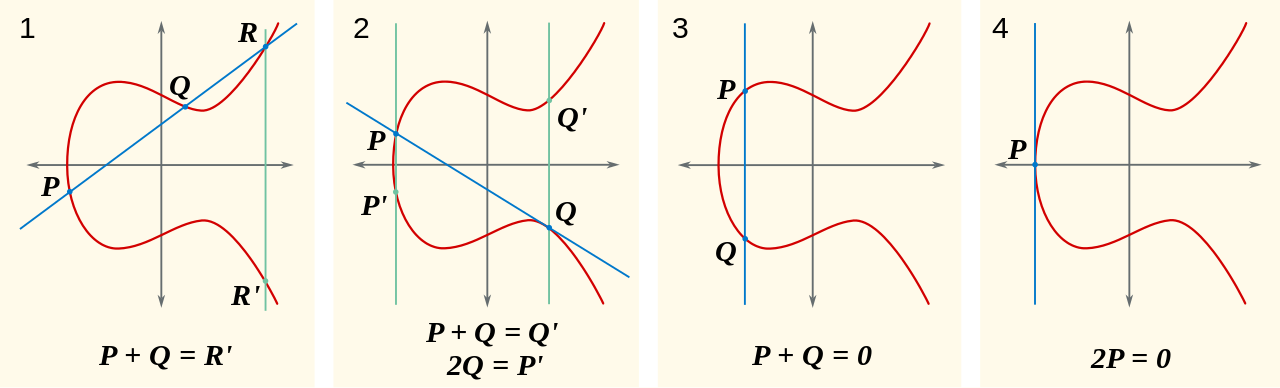
Elliptic curve examples (cc-by-sa Emmanuel Boutet)

Bitcoin is built upon our best understanding of reality.

While there are still many open problems in physics, computer science, and mathematics, we are pretty sure about some things.

That there is an asymmetry between finding solutions and validating the correctness of these solutions is one such thing.

That computation needs energy is another one.

In other words: finding a needle in a haystack is harder than checking if the pointy thing in your hand is indeed a needle or not.

And finding the needle takes work.

The vastness of Bitcoinโ€™s address space is truly mind-boggling.

The number of private keys even more so. It is fascinating how much of our modern world boils down to the improbability of finding a needle in an unfathomably large haystack.

I am now more aware of this fact than ever.

Bitcoin taught me that there is strength in numbers.

Shared with ๐Ÿ’š by Free SpiritโœŒ & ๐Ÿ’š

What is Hashrate ?

Hashrate Bitcoin network h/s
Bitcoin Hash Rate

Hashrate (Hash per secondh/s) is an SI-derived unit representing the number of double SHA-256 computations performed in one second in the bitcoin network for cryptocurrency mining.

Hashrate is also called as hashing power. It is usually symbolized as h/s (with an appropriate SI prefix).

What is hashing power or hash rate?

The hash rate is the primary measure of a Bitcoin miner‘s performance.

In 2014, a miner’s performance was generally measured in Ghash/s, or billions of hashes per second.

The hash/second unit is also part of a common measure of a Bitcoin miner’s electric efficiency in the term watts /Ghash/s, denoted as W/Ghash/s. As 1 watt is equal to 1 joule/s, this measure can also be expressed as J/Ghash, or joules per 1 billion hashes.

Bitcoin network hash rate

Bitcoin network hashrate chart

The hash/s is also used in calculations of the Bitcoin network’s overall hash rate. Because each miner or mining pool only relays a solved block to the network, the overall hash rate of the network is calculated based on the time between blocks.

While not an accurate measure of network hash rate at any given instance in time, measurements over longer periods can be considered indicative and similar calculations are used in Bitcoin’s difficulty  adjustment.

In January 2015, the network hash rate was around 300 Phash/s, or 300 quadrillion hashes per second.

If you compare a bitcoin mining device to one that is designed to mine, for example, Ethereum, you will notice a very large apparent difference in hash rates.

This is because there are many different algorithms that cryptocurrencies use. They all require different amounts of memory and computing power in order to be mined.

To put it simply, bitcoin and its SHA256 algorithm is considered by today standards to be relatively easy to compute. As a result, a mining device that is still relevant today would need to produce hashes in the terahash range and up.

If we were to compare this to Ethereum, youโ€™ll find that most modern Ethereum mining devices (typically GPUโ€™s) operate in the megahash range.

At first glance, you may think that the bitcoin mining device is significantly more powerful or more productive.

While itโ€™s true that it produces more hashes (of the SHA256 variety), this is because bitcoin hashes are easier to produce computationally.

As a consequence, the network difficulty is significantly higher for bitcoin.

To make things even more confusing, some cryptocurrencies intentionally chose algorithms that can only be mined using a basic CPU.

As a result, mining devices for this network that can produce hundreds of hashes per second are considered to be high and very competitive.

So what does all this mean?

Basically, it means that looking at the hash rate alone doesnโ€™t necessarily tell you the effectiveness of the miner.

You also need to understand the network difficulty, and what the norm is for most mining devices for that particular cryptocurrency.

How can I calculate how many hashes I generate per second?

Your problem breaks down nicely into 3 separate tasks:

  • Sharing a single count variable across threads
  • Benchmarking thread completion time
  • Calculating hashes p/sec
  • Sharing a single count variable across threads

Now that we know that not all hashes are the same we need to know how to calculate the estimated profitability of a miner based on its hash rate.

For this, will need to use a mining profitability calculators, they are available in the Internet.

public static class GlobalCounter

{
public static int Value { get; private set; }
   public static void Increment()
{
Value = GetNextValue(Value);
}
   private static int GetNextValue(int curValue)
{
return Interlocked.Increment(ref curValue);
}
   public static void Reset()
{
Value = 0;
}
}

Before you spin off the threads call GlobalCounter.

Reset and then in each thread (after each successful hash) you would call GlobalCounter.

Increment – using Interlocked.X performs atomic operations of Value in a thread-safe manner, it’s also much faster than lock.

Benchmarking thread completion time

var sw = Stopwatch.StartNew();
Parallel.ForEach(someCollection, someValue =>
{
// generate hash
GlobalCounter.Increment();
});
sw.Stop();
Parallel.ForEach will block until all threads have finished

Calculating hashes per second

...
sw.Stop();
var hashesPerSecond = GlobalCounter.Value / sw.Elapsed.Seconds;

How is the hash rate measured?

Hash rate is a unit measured in hashes per second or h/s and here are some usual denominations used to refer it.

Hash rate denominations:

  • 1 kH/s is 1,000 (one thousand) hashes per second;
  • 1 MH/s is 1,000,000 (one million) hashes per second;
  • 1 GH/s is 1,000,000,000 (one billion) hashes per second;
  • 1 TH/s is 1,000,000,000,000 (one trillion) hashes per second;
  • 1 PH/s is 1,000,000,000,000,000 (one quadrillion) hashes per second;
  • 1 EH/s is 1,000,000,000,000,000,000 (one quintillion) hashes per second.

Common Hash rate Conversions:

  • 1 MH/s = 1,000 kH/s;
  • 1 GH/s = 1,000 MH/s = 1,000,000 kH/s;
  • 1 TH/s = 1,000 GH/s = 1,000,000 MH/s = 1,000,000,000 kH/s.

Shared with ๐Ÿ’š by Free Spirit

โœŒ & ๐Ÿ’š