Bitcoin

โ‚ฟ

Bitcoinย is a decentralizedย digital currencyย that enables instant payments to anyone, anywhere in the world. Bitcoin uses peer-to-peer technology to operate with no central authority:ย transaction managementย andย money issuanceย are carried out collectively by the network.

The original Bitcoin software byย Satoshi Nakamotoย was released under the MIT license. Most client software, derived or “from scratch”, also use open source licensing.

Transactions are verified by networkย nodesย throughย cryptographyย and recorded in a publicย distributed ledgerย called aย blockchain.

Theย cryptocurrencyย was invented in 2008 by an unknown person or group of people using the nameย Satoshi Nakamoto.

The currency began use in 2009ย when its implementation was released asย open-source software.

Bitcoins are created as a reward for a process known asย mining. They can be exchanged for other currencies, products, and services, but the real-world value of the coins is extremely volatile.

Bitcoin is the first successful implementation of aย distributed crypto-currency, described in part in 1998 byย Wei Daiย on the cypherpunks mailing list. Building upon the notion that money is any object, or any sort of record, accepted as payment for goods and services and repayment of debts in a given country or socio-economic context, Bitcoin is designed around the idea of using cryptography to control the creation and transfer of money, rather than relying on central authorities.

Bitcoins have all the desirable properties of a money-like good. They are portable, durable, divisible, recognizable, fungible, scarce and difficult to counterfeit.

Bitcoin has been criticized for its use in illegal transactions, the large amount of electricity (and thusย carbon footprint) used by mining,ย 
price volatility, and thefts from exchanges.

Some economists and commentators have characterized it as aย speculative bubbleย at various times.

Bitcoin has also been used as an investment, although several regulatory agencies have issued investor alerts about bitcoin.

Research produced by theย University of Cambridgeย estimated that in 2017, there were 2.9 to 5.8 million unique users using aย cryptocurrency wallet, most of them using bitcoin.

Why?

Bitcoin is P2P electronic cash that is valuable over legacy systems because of the monetary autonomy it brings to its users.

Bitcoin seeks to address the root problem with conventional currency: all the trust that’s required to make it work — Not that justified trust is a bad thing, but trust makes systems brittle, opaque, and costly to operate.

Trust failures result in systemic collapses, trust curation creates inequality and monopoly lock-in, and naturally arising trust choke-points can be abused to deny access to due process.

Through the use of cryptographic proof, decentralized networks and open source software Bitcoin minimizes and replaces these trust costs.

Bitcoinย Transactionsย are:

  • Permissionlessย andย borderless. The software can be installed by anybody worldwide.
  • Anonymous. Bitcoin does not require any ID to use making it suitable for the unbanked, the privacy-conscious, computers or people in areas with underdeveloped financial infrastructure.
  • Private. When used with care bitcoin can supportย strong financial privacy.
  • Censorship-resistant. Nobody is able to block or freeze a transaction of any amount.
  • Fast. Transactions can be made almost as fast as data can travel over the Internet.
  • Cheap. Fees can beย very very low.Irreversibleย once settled, like cash. (butย consumer protection is still possible.)
  • Online and availableย 24 hours a day, 365 days per year.

Bitcoin can also be aย store of value, some have said it is a “swiss bank account in your pocket”.

Stored Bitcoins:

  • Cannot be printed or debased.ย Onlyย 21 million bitcoinsย will ever exist.
  • Haveย no storage costs. They take up no physical space regardless of amount.
  • Areย easy to protect and hide. Can be stored on a phone, computer, encrypted on aย paper backupย orย memorized in your head.
  • No counterparty risk. If you keep theย private keyย of a bitcoin secret and the transaction has enough confirmations, then nobody can take them from you no matter for what reason, no matter how good the excuse, no matter what.
  • Can be underย divided possessionย withย Multisignature. For example with a 2-of-3 multisig scheme there would beย threeย private keys, of whichย any twoย is enough to spend the money. Those three keys can be spread anywhere, perhaps in multiple locations or known by multiple people. No other asset does this, for example you cannot hold gold coins under multisig.

What is Bitcoin?

A. Bitcoin is a peer-to-peer currency. Peer-to-peer means that no central authority issues new money or tracks transactions. These tasks are managed collectively by theย network.

How does Bitcoin work?

A. Bitcoin usesย public-key cryptography, peer-to-peer networking, andย proof-of-workย to process and verify payments. Bitcoins are sent (or signed over) from one address to another with each user potentially having many, many addresses. Each payment transaction is broadcast to the network and included in the blockchain so that the included bitcoins cannot be spent twice. After an hour or two, each transaction is locked in time by the massive amount of processing power that continues to extend the blockchain. Using these techniques, Bitcoin provides a fast and extremely reliable payment network that anyone can use.

Shared with ๐Ÿ’š by Free Spirit

โœŒ & ๐Ÿ’š

ASIC MANUFACTURERS

ASIC MINERS MANUFACTURERS 2021

๐Ÿ”น๏ธ http://www.baikalminer.com/

๐Ÿ”น๏ธ https://bitfury.com/

๐Ÿ”น๏ธ https://bitmain.com/

๐Ÿ”น๏ธ http://www.bolonminer.com/

๐Ÿ”น๏ธ https://canaan.io/

๐Ÿ”น๏ธ http://miner.ebang.com.cn/

๐Ÿ”น๏ธ http://www.fusionsilicon.com/

๐Ÿ”น๏ธ https://www.goldshell.com/

๐Ÿ”น๏ธ https://ibelink.co/

๐Ÿ”น๏ธ https://www.innosilicon.com/

๐Ÿ”น๏ธ https://www.microbt.com/

๐Ÿ”น๏ธ https://obelisk.tech/

๐Ÿ”น๏ธ https://www.pandaminer.com/

๐Ÿ”น๏ธ https://www.spondoolies-tech.com/

๐Ÿ”น๏ธ https://strongu.com.cn/

๐Ÿ”น๏ธ http://ipollo.com/

To be updated in the future!

๐Ÿ”น๏ธ๐Ÿ”น๏ธ๐Ÿ”น๏ธ

Made with ๐Ÿ’š by Free Spirit
ย โœŒ & ๐Ÿ’š

Asic Miners Vendors List

ASIC MINERS VENDORS LIST – 2021

https://51asic.ru/ Russian

https://akminer.com/ Chinese

https://www.antminerdistribution.com/ – Holland

https://asicmarketplace.com/ – Hong Kong

https://asicminermarket.com/ – China

https://bitcoinmerch.com/ – USA

https://www.bitmart.co.za/ – Zanzibar

https://blokforge.com/ – USA

https://bt-miners.com/ – USA

https://casaminers.com/en – Italy

https://coinminer.com/ – USA

https://coinminingcentral.com/ – England

https://cryptosupply.de/ – Germany

https://cryptodrilling.com/

https://www.cryptouniverse.at/

https://www.eastshore.xyz/

https://itopshop.net/

https://www.cryptominerbros.com/

https://mineshop.eu/

https://miningwholesale.eu/

https://miningcave.com/

https://pangolinminer.com/

https://printcrypto.io/

https://mining.sesterce.com/

https://shop.unlimitedminer.com/en/home/

https://whatsminer.net/

Satoshi Nakamoto bitcoin quotes

The Times 03/Jan/2009
Wikileaks
Lost coins
Transaction fees
Anonymous vs. Pseudonymous
bitcoin’s convenience against credit cards
Scarce asset
Generate new bitcoin address
Not having bitcoin would be the net waste
Inflation vs. Deflation in bitcoin
Potential for a positive feedback loop
…gain a new territory of freedom…
E-currency based on cryptographic proof
Attractive to the libertarian viewpoint
Root problem with conventional currency

Bitcoin’s Shroud of Subtlety and Allure

A new banner of freedom

Bitcoin’s Shroud of Subtlety and Allure

Daniel Krawisz

June 29, 2014

Attacks on Bitcoin

A successful attack on Bitcoin means attacking Bitcoinโ€™s value.

There might well be a bug that could be exploited to put the network out of commission temporarily, but would soon be fixed and then the network would be up and running shortly thereafter.

To destroy Bitcoin permanently means to end the profit opportunities available with it, and that means either a malicious hashing attack on the network that makes mining impossible or such a malevolent policy against Bitcoin trade that even the black market abandons it.

Both of these require spending resources in proportion to the profits that Bitcoin enables.

In this article, I will discuss three reasons why such an attack is unlikely to succeed: antifragility, subtlety, and attacker defection.

The interplay of these three defenses makes Bitcoin into a kind of wave that rewards those who ride it and drowns those who resist it.

The first of these, antifragility, is exemplified in the fact that malicious hashing is impossible up to a certain fraction of the network.

Below the point that selfish mining becomes possible1ย additional hashes per second are almost certainly beneficial because they increase the security of the network.

Any potential attacker, therefore, must weigh in the possibility that he may end up benefiting the network instead of destroying it.

A similar risk accompanies a legal attack on Bitcoin. Bitcoin can adapt to half-hearted attacks. It would move deeper into the black market where it would become permanently strengthened.

Furthermore, a legal attack could be easily corrupted into one that brings as many bitcoins as possible to the government agents instead of one that destroys it (seeย below).

Bitcoinโ€™s Subtlety

Bitcoin adoption happens one person at a time, and this is true for potential attackers as well as the rest of us.

It takes an entrepreneurial mindset to be able to imagine what Bitcoin could become, given how comparatively small it is now.

It takes time and meditation for people to take Bitcoin seriously because most of its value is in the future.

By the time this happens, Bitcoin has become much more expensive than when they first learned of it.

Thus, Bitcoin is protected from attackers by being initially beyond their understanding.

When Bitcoin was very small, it was very stealthy and was completely unknown to the establishment.

Now they laugh at it, just as it has begun to grow bold.

Of course, we donโ€™t know who really dismisses it and who is deliberately trying to draw attention away from it.

Bitcoinโ€™s Allure

Furthermore, potential attackers are at a disadvantage for another reason.

Bitcoin tends to oppose organizations rather than people.

Even someone who stands to lose from Bitcoin by not reacting to it, such as a banker or government agent, stands to gain a great deal by buying now.

Only the very wealthiest people might reasonably expect to be worse off attempting to buy up as much as possible now than if it were gone. (This could happen if their attempt to buy caused the price to rise too fast relative to their ability to acquire additional bitcoins, to the point that they ultimately had less influence over the future Bitcoin economy than they have over the economy of today.)

Thus, the agency problem with Bitcoin affects bitcoin competitors as well as Bitcoin holders.

Nearly any government agent who begins to see bitcoin as a potential threat must also simultaneously see it as an opportunity.

He, too, can invest in Bitcoin. And why shouldnโ€™t he?

Bitcoin may be a threat to his livelihood, but it may well be making him an offer he canโ€™t refuse.

How can an organization that stands to lose by the adoption of Bitcoin provide its members with a better opportunity for staying loyal than Bitcoin provides for defection?

Even those who might resist the temptation to defect would have to think about the defection of his fellows.

How quickly is adoption happening? Is there time to mount an attack before Bitcoin becomes too powerful? How easily could the resources for such an attack be amassed, given both the ignorance and treachery of the other agents.

If such an attack would be unlikely to succeed, then buying now would be the only intelligent action.

Regardless of whether he liked Bitcoin, it would be futile to continue pursuing a doomed cause.

Potential Bitcoin attackers are in aย Prisonerโ€™s Dilemma.

In the same way that the people cannot easily rebel against the king owing to a lack of coordination on their part, governments cannot rebel against Bitcoin for the same reason.

The government puts the people in a Prisonerโ€™s Dilemma against one another, and Bitcoin does the same to government agents.

Bitcoin is likeย Invasion of the Body Snatchers.

Bitcoin attracts inside men to act as covert saboteurs. There have long been predictions from both bitcoiners and naysayers of impending government attacks, but I think there is a possibility that Bitcoin could win without suffering much resistance.

Moreover, although I said above only that any legal bitcoin attackย couldย be perverted, the considerations discussed in this section tend to make such diffusion very likely.

Bitcoin defends itself by being obscure, but once it has attracted someoneโ€™s attention, its best interest is for that person to understand the logic presented here. For then he will also understand that his best course is to deny Bitcoinโ€™s threat to his superiors and quietly to become its willing slave.


  1. Right now Bitcoin Core does not follow the proper strategy to protect against selfish mining even at very low hashing rates, but the fix would be extremely easy to implement and would make selfish mining impossible up to 25% of the hash rate. โ†ฉ

Source:

https://nakamotoinstitute.org/mempool/bitcoins-shroud-of-subtlety-and-allure/

What is Hashrate ?

Hashrate Bitcoin network h/s
Bitcoin Hash Rate

Hashrate (Hash per secondh/s) is an SI-derived unit representing the number of double SHA-256 computations performed in one second in the bitcoin network for cryptocurrency mining.

Hashrate is also called as hashing power. It is usually symbolized as h/s (with an appropriate SI prefix).

What is hashing power or hash rate?

The hash rate is the primary measure of a Bitcoin miner‘s performance.

In 2014, a miner’s performance was generally measured in Ghash/s, or billions of hashes per second.

The hash/second unit is also part of a common measure of a Bitcoin miner’s electric efficiency in the term watts /Ghash/s, denoted as W/Ghash/s. As 1 watt is equal to 1 joule/s, this measure can also be expressed as J/Ghash, or joules per 1 billion hashes.

Bitcoin network hash rate

Bitcoin network hashrate chart

The hash/s is also used in calculations of the Bitcoin network’s overall hash rate. Because each miner or mining pool only relays a solved block to the network, the overall hash rate of the network is calculated based on the time between blocks.

While not an accurate measure of network hash rate at any given instance in time, measurements over longer periods can be considered indicative and similar calculations are used in Bitcoin’s difficulty  adjustment.

In January 2015, the network hash rate was around 300 Phash/s, or 300 quadrillion hashes per second.

If you compare a bitcoin mining device to one that is designed to mine, for example, Ethereum, you will notice a very large apparent difference in hash rates.

This is because there are many different algorithms that cryptocurrencies use. They all require different amounts of memory and computing power in order to be mined.

To put it simply, bitcoin and its SHA256 algorithm is considered by today standards to be relatively easy to compute. As a result, a mining device that is still relevant today would need to produce hashes in the terahash range and up.

If we were to compare this to Ethereum, youโ€™ll find that most modern Ethereum mining devices (typically GPUโ€™s) operate in the megahash range.

At first glance, you may think that the bitcoin mining device is significantly more powerful or more productive.

While itโ€™s true that it produces more hashes (of the SHA256 variety), this is because bitcoin hashes are easier to produce computationally.

As a consequence, the network difficulty is significantly higher for bitcoin.

To make things even more confusing, some cryptocurrencies intentionally chose algorithms that can only be mined using a basic CPU.

As a result, mining devices for this network that can produce hundreds of hashes per second are considered to be high and very competitive.

So what does all this mean?

Basically, it means that looking at the hash rate alone doesnโ€™t necessarily tell you the effectiveness of the miner.

You also need to understand the network difficulty, and what the norm is for most mining devices for that particular cryptocurrency.

How can I calculate how many hashes I generate per second?

Your problem breaks down nicely into 3 separate tasks:

  • Sharing a single count variable across threads
  • Benchmarking thread completion time
  • Calculating hashes p/sec
  • Sharing a single count variable across threads

Now that we know that not all hashes are the same we need to know how to calculate the estimated profitability of a miner based on its hash rate.

For this, will need to use a mining profitability calculators, they are available in the Internet.

public static class GlobalCounter

{
public static int Value { get; private set; }
   public static void Increment()
{
Value = GetNextValue(Value);
}
   private static int GetNextValue(int curValue)
{
return Interlocked.Increment(ref curValue);
}
   public static void Reset()
{
Value = 0;
}
}

Before you spin off the threads call GlobalCounter.

Reset and then in each thread (after each successful hash) you would call GlobalCounter.

Increment – using Interlocked.X performs atomic operations of Value in a thread-safe manner, it’s also much faster than lock.

Benchmarking thread completion time

var sw = Stopwatch.StartNew();
Parallel.ForEach(someCollection, someValue =>
{
// generate hash
GlobalCounter.Increment();
});
sw.Stop();
Parallel.ForEach will block until all threads have finished

Calculating hashes per second

...
sw.Stop();
var hashesPerSecond = GlobalCounter.Value / sw.Elapsed.Seconds;

How is the hash rate measured?

Hash rate is a unit measured in hashes per second or h/s and here are some usual denominations used to refer it.

Hash rate denominations:

  • 1 kH/s is 1,000 (one thousand) hashes per second;
  • 1 MH/s is 1,000,000 (one million) hashes per second;
  • 1 GH/s is 1,000,000,000 (one billion) hashes per second;
  • 1 TH/s is 1,000,000,000,000 (one trillion) hashes per second;
  • 1 PH/s is 1,000,000,000,000,000 (one quadrillion) hashes per second;
  • 1 EH/s is 1,000,000,000,000,000,000 (one quintillion) hashes per second.

Common Hash rate Conversions:

  • 1 MH/s = 1,000 kH/s;
  • 1 GH/s = 1,000 MH/s = 1,000,000 kH/s;
  • 1 TH/s = 1,000 GH/s = 1,000,000 MH/s = 1,000,000,000 kH/s.

Shared with ๐Ÿ’š by Free Spirit

โœŒ & ๐Ÿ’š


Hoist the Waffels…

Hey Ho, Hoist the Waffels…

The TSMC and his men stoled the mighty chip out of it's bed,
And bound it on it's pcb plate.
The hasrate be ours, and by the hashrate powers,
It's where we'll roam!
Yo Ho... All you miners,
Hoist the waffels high!
Heave ho, traders and profets,
Never shall We die !
Some miners have perished and some are alive,
Others hold the hashrate high...
With the keys to their wallets...
And a pool's fee to pay,
We lay to Crypto's Creed !
Yo, ho hash together,
Hoist the waffels high!
Heave, ho, traders and profets,
Never shall We die !
Yo, Ho hash together,
Hoist the Waffels high!
The hashrate be ours,
Never shall we die !

Source of Inspiration :

“Hoist the Colours” by Hans Zimmer


$10 Million each coin ๐Ÿคฏ๐Ÿ˜ณ๐Ÿคฏ

Made with ๐Ÿ’š by Free Spirit

โœŒ & ๐Ÿ’š

Cypherpunk’s Manifesto

A Cypherpunk’s Manifesto


Eric Hughes

byย Eric Hughes

” Privacy is necessary for an open society in the electronic age.

Privacy is not secrecy.

A private matter is something one doesn’t want the whole world to know, but a secret matter is something one doesn’t want anybody to know.

Privacy is the power to selectively reveal oneself to the world.

If two parties have some sort of dealings, then each has a memory of their interaction.

Each party can speak about their own memory of this; how could anyone prevent it?

One could pass laws against it, but the freedom of speech, even more than privacy, is fundamental to an open society; we seek not to restrict any speech at all.

If many parties speak together in the same forum, each can speak to all the others and aggregate together knowledge about individuals and other parties.

The power of electronic communications has enabled such group speech, and it will not go away merely because we might want it to.

Since we desire privacy, we must ensure that each party to a transaction have knowledge only of that which is directly necessary for that transaction.

Since any information can be spoken of, we must ensure that we reveal as little as possible.

In most cases personal identity is not salient. When I purchase a magazine at a store and hand cash to the clerk, there is no need to know who I am.

When I ask my electronic mail provider to send and receive messages, my provider need not know to whom I am speaking or what I am saying or what others are saying to me; my provider only need know how to get the message there and how much I owe them in fees.

When my identity is revealed by the underlying mechanism of the transaction, I have no privacy. I cannot here selectively reveal myself; I mustย alwaysย reveal myself.

Therefore, privacy in an open society requires anonymous transaction systems.

Until now, cash has been the primary such system.

An anonymous transaction system is not a secret transaction system.

An anonymous system empowers individuals to reveal their identity when desired and only when desired; this is the essence of privacy.

Privacy in an open society also requires cryptography.

If I say something, I want it heard only by those for whom I intend it.

If the content of my speech is available to the world, I have no privacy.

To encrypt is to indicate the desire for privacy, and to encrypt with weak cryptography is to indicate not too much desire for privacy.

Furthermore, to reveal one’s identity with assurance when the default is anonymity requires the cryptographic signature.

We cannot expect governments, corporations, or other large, faceless organizations to grant us privacy out of their beneficence.

It is to their advantage to speak of us, and we should expect that they will speak.

To try to prevent their speech is to fight against the realities of information.

Information does not just want to be free, it longs to be free.

Information expands to fill the available storage space.

Information is Rumor’s younger, stronger cousin;

Information is fleeter of foot, has more eyes, knows more, and understands less than Rumor.

We must defend our own privacy if we expect to have any.

We must come together and create systems which allow anonymous transactions to take place.

People have been defending their own privacy for centuries with whispers, darkness, envelopes, closed doors, secret handshakes, and couriers.

The technologies of the past did not allow for strong privacy, but electronic technologies do.

We the Cypherpunks are dedicated to building anonymous systems.

We are defending our privacy with cryptography, with anonymous mail forwarding systems, with digital signatures, and with electronic money.


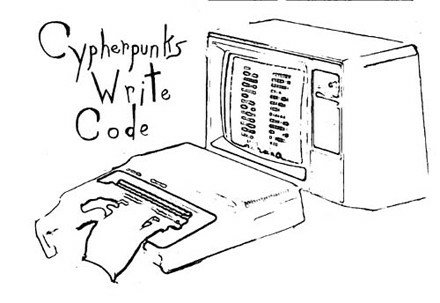
Cypherpunks write code.


We know that someone has to write software to defend privacy, and since we can’t get privacy unless we all do, we’re going to write it.

We publish our code so that our fellow Cypherpunks may practice and play with it. Our code is free for all to use, worldwide.

We don’t much care if you don’t approve of the software we write.

We know that software can’t be destroyed and that a widely dispersed system can’t be shut down.

Cypherpunks deplore regulations on cryptography, for encryption is fundamentally a private act.

The act of encryption, in fact, removes information from the public realm.

Even laws against cryptography reach only so far as a nation’s border and the arm of its violence.

Cryptography will ineluctably spread over the whole globe, and with it the anonymous transactions systems that it makes possible.

For privacy to be widespread it must be part of a social contract.

People must come and together deploy these systems for the common good. Privacy only extends so far as the cooperation of one’s fellows in society.

We the Cypherpunks seek your questions and your concerns and hope we may engage you so that we do not deceive ourselves.

We will not, however, be moved out of our course because some may disagree with our goals.

The Cypherpunks are actively engaged in making the networks safer for privacy. Let us proceed together apace.

Onward.

Eric Hughes

ย <hughes@soda.berkeley.edu>

9 March 1993


โ˜† Long Live the CypherPunks โ˜†


The world is in debt for your bright minds, even if it doesn’t know…

It’s minds like yours that always have changed the face of the earth for a better brighter future !

KUDOS TO YOU ALL !!!


The War for a Free Internet

The War for a Free Internet

David Vorick

Feb 14

” I came of age on the Internet. By the age of 13, I had more friends whose faces I would never see than I had peers in the classroom. Most of them wonโ€™t realize today who I am even if they are reading this now. Most of them didnโ€™t realize I was decades their junior.

When my father was growing up, his freedom was his bicycle. It gave him access to friends, to a job, freedom from his parents, and ultimately space to carve out a personality that he could call his own. He wanted nothing more than to pass these gifts along to me, and it was often to his dismay and frustration that I never found the same joy in my bike that he had found in his.

I was too young to realize it at the time, but I had received the same gifts as my father.

Where my fatherโ€™s freedom was his bicycle, my freedom was my keyboard.

A denizen of dozens of forums and hundreds of websites, countless hours each weekend contributed elements to my personality that raised me to be someone beyond anything I could have become in my hometown alone.

As middle school became high school, my online hours began to exceed my offline hours. By my sophomore year of college I was spending more than 80 hours per week on the Internet.

The Internet has become the keystone of modern society, a fact that has not been overlooked by our corporate giants.

As the 2010โ€™s progressed, the Internet became a massive land grab. A hundred thousand independently operated forums became one front page of the Internet.

Personal cards, handwritten letters, and cozy phonecalls turned into a single wall that wished you โ€œHappy Birthdayโ€ 1,000 times on what was often not even the right day.

What used to be an endless exploration of hand curated forums and webpages turned into a bottomless pit of AI generated filth carefully crafted by teams of PhDs with the sole intention of getting you to stare at your phone for just a little bit longer.

The modern Internet has been absolutely steamrolled by the likes of Google, Facebook, and Amazon.

As these platforms have festered, theyโ€™ve made it clear that weโ€™re here to play by their rules.

They decide which of our friends we get updates from.

They decide how large a nose ring can be before a content creator gets demonetized and loses their livelihood.

An uncomfortable percentage of our time is spent under the tyranny of whatever logic was implemented in the pursuit of higher profits next quarter.

Somewhere underneath it all, real people are living every day, taking what breaths they can between the inescapable deluge of content spawning from a clinical addiction to their devices.

The next wave of teenagers are coming of age in this environment and they are suffocating. Suicide rates are up almost 50% since 2007 for people under the age of 24.

The modern Internet is making us miserable.

Our overlords have captured our souls by bringing us gifts of amazing technology and bundling with those gifts chains and cages that capture our minds and manipulate us to maximize their bottom line.

The time has come to stand up for ourselves, for our health, and for the next generation.

The time has come to start the War for a Free Internet. “

WRITTEN BY

David Vorick

Shared with ๐Ÿ’š by Free Spirit

  • International payment using the radio waves
    In a first, Bitcoin developers have done something amazing amid the criticism over the lightning network and issues associated with it. A team of developers has made an international payment using the radio waves on the lightning network. Rodolfo Novak, the co-founder of the startup CoinKite sent out a Bitcoin transaction to Bloomberg columnist Elaine … Continue reading International payment using the radio waves
  • Happy New Year !!!!
    Happy New Year!May the coming year be full of grand adventures , peace, prosperity and opportunities.Dream big and make the most of 2024!
  • Discipline Quotes
    My inspiration for this page was given to me by my new aquired friend, a fellow Truth Seeker – Joris and to whom I dedicate this page… Wish you… as well as to all my readers, to find a sparkle of wisdom in these quotes, that shall illuminate your path/s…. Always in my heart and … Continue reading Discipline Quotes
  • Merry Christmass and A Happpy New Year to all
    To all my readers from the bottom of my heart I wish you Happy Holiday among family and friends, a jolly Merry Christmas and a Happy New Year and may 2024 bring you all what you strive and work for so hard! Yours truly, Free Spirit with Joy & Love
  • Bitcoin White Paper turn 15
    Bitcoin white paper turns 15 and the Legacy of Satoshi Nakamoto lives on. โ€œIโ€™ve been working on a new electronic cash system thatโ€™s fully peer-to-peer, with no trusted third party,โ€ Satoshi Oct. 31, 2008. The white paper was proposing a decentralized system that could facilitate peer-to-peer transactions, which could solve the โ€œdouble spendingโ€ problem often … Continue reading Bitcoin White Paper turn 15
With ๐Ÿ’š

BitHouse LLC


Strenght in Numbers

BitHouse LLC is a client โ€“ focused and result driven CryptoCurrency Consulting and Mining Company that provides broad โ€“ based services at an affordable fee to our clients .

We will ensure that we work hard to meet and surpass our Clientsโ€™ expectations whenever they hire our services for Consulting or mine bitcoin.

At BitHouse LLC, our Clientโ€™s best interest always come first and foremost, and everything we do is guided by our high values and professional ethics.


Services

Cryptocurrency Consulting

General cryptocurrency advice, reviews and due diligence on tokens, blockchain projects, general investment advice and trading strategy.

Security and putting processes in place to backup your crypto.

Cryptocurrency Mining & Staking

Setup and advice on Cryptocurrency mining rigs. Mining does not just include Bitcoin, there are numerous other options to mine, including other tokens, rigs that provide processing power and storage.

Masternodes

Nodes are a great way to generate cryptocurrency, similar to mining just without the expensive hardware.

Setting up and running a node is not straight forward, we can help.

Proof of Stake / Staking Wallets

 Just like mining, storing your cryptocurrency in a wallet that is connected to the blockchain can generate you more crypto of that same token.

If you own POS coins and arenโ€™t staking you are missing out on ROI.


Bitcoin – People’s Money

“Better a diamond with a flaw than a pebble without.”

Confucius

Diamond with a flaw

“Try not to become a man of success. Rather become a man of value.”

Albert Einstein

Man of Value

“If you don’t know what you want, you’ll never find it.

If you don’t know what you deserve, you’ll always settle for less.

You will wander aimlessly, uncomfortably numb in your comfort zone, wondering how life has ended up here.

Life starts now, live, love, laugh and let your light shine!”

Rob Liano

Let your light shine

“A person’s worth is measured by the worth of what he values.”

Marcus Aurelius, “Meditations”

Values

“Mathematics expresses values that reflect the cosmos, including orderliness, balance, harmony, logic, and abstract beauty.”

Deepak Chopra

Mathematics

“Every job from the heart is, ultimately, of equal value.

The nurse injects the syringe; the writer slides the pen; the farmer plows the dirt; the comedian draws the laughter.

Monetary income is the perfect deceiver of a man’s true worth.”

Criss Jami, “Killosophy”

Job from the Heart

“A person that does not value your time will not value your advice.”

Orrin Woodward

Value your time

“Once you embrace your value, talents and strengths, it neutralizes when others think less of you.”

Rob Liano

Embrace your Values

“Bad times have a scientific value. These are occasions a good learner would not miss.”

Ralph Waldo Emerson

Bad times

“I say no wealth is worth my life.”

Homer, “The Iliad”

Life

“But what’s worth more than gold?

Practically everything.

You, for example.

Gold is heavy.

Your weight in gold is not very much gold at all.

Aren’t you worth more than that?”

Terry Pratchett, “Making Money” 

You are worth more than gold

“Knowledge is like money: To be of value it must circulate, and in circulating it can increase in quantity and, hopefully, in value.”

Louis L’Amour, “Education of a Wandering Man”

Knowledge

“ร”, Sunlight! The most precious gold to be found on Earth.”

Roman Payne

Sunlight

“Knowledge is like money: To be of value it must circulate, and in circulating it can increase in quantity and, hopefully, in value.”

Louis L’Amour, “Education of a Wandering Man”

Knowledge

“If life โ€” the craving for which is the very essence of our being โ€” were possessed of any positive intrinsic value, there would be no such thing as boredom at all: mere existence would satisfy us in itself, and we should want for nothing.”

Arthur Schopenhauer, “The Vanity of Existence”

Existence

“Our sole purpose on this earth is to add value to others.

It doesnโ€™t make sense to just exist in people’s lives or to be a drain on them, does it?”

Rob Liano

Sole purpose

“Value judgments are destructive to our proper business, which is curiosity and awareness.”

John Cage

Curiosity & Awareness

“We set no special value on the possession of a virtue until we percieve that it is entirely lacking in our adversary.”

Friedrich Nietzsche, “Human, All Too Human: A Book for Free Spirits”

Virtue

“Maybe you had to come close to losing something before you could remember its value.

Maybe we enjoy the last minute struggle as it slips through our hands.”

Suraj Sani

Struggle

“Always remember that the minority dictates the prices, and the majority governs the value.”

Naved Abdali

Minority vs. Majority

“It is impossible to say whether an asset class valuation is cheap or expensive in isolation.

The valuation of an asset is relative to the valuations of all other assets.”

Naved Abdali

Valuation of an Asset

“Market quotes change every second, but business evolves steadily.

You have ample time to evaluate a business to buy or not to buy.

There is no rush.”

Naved Abdali

Evaluate

“The number one reason people lose money in investing is because they buy assets without giving any thought whatsoever to the fair value.”

Naved Abdali

Fair Value

“If investors do not know or never attempt to know the fair value, they can pay any price.

More often, the price they pay is far greater than the actual value.”

Naved Abdali

Actual Value

“Watching every tick up and every tick down is just wasting your valuable time.

Do yourself a favor, and pick up a book or two about investing each month.”

Naved Abdali

Pick up a book

“An ounce of gold will always be an ounce of gold regardless of the length of possession.

The short-term value will go up or down, but gold prices will follow the general inflation rate in the long run.”

Naved Abdali

General Inflation Rate

“A Collectibleโ€™s value is primarily based on the emotions and the perception of potential buyers.”

Naved Abdali

Emotions & Perception