How can I calculate how many hashes I generate per second?
I have a function which generates hashes from a string:
string GenerateHash(string plainText);
I generate as many hashes as possible with 4 threads.
How do I calculate how many hashes (or megahashes) I generate per second?
Your problem breaks down nicely into 3 separate tasks
Sharing a single count variable across threads
Benchmarking thread completion time
Calculating hashes per/second
Sharing a single count variable across threads
public static class GlobalCounter
{ public static int Value { get;
private set;
} public static void Increment()
{ Value =GetNextValue(Value);
 } private static int GetNextValue(int curValue) { returnInterlocked.Increment(ref curValue);
} public static void Reset() { Value = 0; } }
Before you spin off the threads call GlobalCounter.Reset and then in each thread (after each successful hash) you would call GlobalCounter.Increment – using Interlocked.X performs atomic operations of Value in a thread-safe manner, it’s also much faster than lock.
Parallel.ForEach will block until all threads have finished
Calculating hashes per second
... sw.Stop(); var hashesPerSecond = GlobalCounter.Value / sw.Elapsed.Seconds;
Did you find this article helpful?
If so, please consider a donation to help the evolution and development of more helpful articles in the future, and show your support for alternative articles.
In a first, Bitcoin developers have done something amazing amid the criticism over the lightning network and issues associated with it. A team of developers has made an international payment using the radio waves on the … Continue reading International payment using the radio waves→
My inspiration for this page was given to me by my new aquired friend, a fellow Truth Seeker – Joris and to whom I dedicate this page… Wish you… as well as to all my readers, … Continue reading Discipline Quotes→
Bitcoin white paper turns 15 and the Legacy of Satoshi Nakamoto lives on. “I’ve been working on a new electronic cash system that’s fully peer-to-peer, with no trusted third party,” Satoshi Oct. 31, 2008. The white … Continue reading Bitcoin White Paper turn 15→
“ It might make sense just to get some in case it catches on.
If enough people think the same way, that becomes a self fulfilling prophecy.
Once it gets bootstrapped, there are so many applications if you could effortlessly pay a few cents to a website as easily as dropping coins in a vending machine. ”
Get some in case it catches on
“ In this sense, it’s more typical of a precious metal.
Instead of the supply changing to keep the value the same, the supply is predetermined and the value changes.
As the number of users grows, the value per coin increases.
It has the potential for a positive feedback loop; as users increase, the value goes up, which could attract more users to take advantage of the increasing value. ”
Potential for a positive feedback loop
“ Maybe it could get an initial value circularly as you’ve suggested, by people foreseeing its potential usefulness for exchange. (I would definitely want some)
Maybe collectors, any random reason could spark it.
I think the traditional qualifications for money were written with the assumption that there are so many competing objects in the world that are scarce, an object with the automatic bootstrap of intrinsic value will surely win out over those without intrinsic value.
But if there were nothing in the world with intrinsic value that could be used as money, only scarce but no intrinsic value, I think people would still take up something. (I’m using the word scarce here to only mean limited potential supply) ”
“ A rational market price for something that is expected to increase in value will already reflect the present value of the expected future increases. “
Rational market price
” In your head, you do a probability estimate balancing the odds that it keeps increasing. ”
Probability
“ I’m sure that in 20 years there will either be very large transaction volume or no volume. ”
In 20 Years
“ Bitcoins have no dividend or potential future dividend, therefore not like a stock.
More like a collectible or commodity.“
Collectible vs Commodity
” [Lengthy exposition of vulnerability of a systm to use-of-force monopolies ellided.]
You will not find a solution to political problems in cryptography.
Yes, but we can win a major battle in the arms race and gain a new territory of freedom for several years.
Governments are good at cutting off the heads of a centrally controlled networks like Napster, but pure P2P networks like Gnutella and Tor seem to be holding their own. “
Pure P2P networks
” It’s very attractive to the libertarian viewpoint if we can explain it properly.
I’m better with code than with words though. “
Libertarian Viewpoint
” The proof-of-work is a Hashcash style SHA-256 collision finding.
It’s a memoryless process where you do millions of hashes a second, with a small chance of finding one each time.
The 3 or 4 fastest nodes’ dominance would only be proportional to their share of the total CPU power.
Anyone’s chance of finding a solution at any time is proportional to their CPU power.
There will be transaction fees, so nodes will have an incentive to receive and include all the transactions they can.
Nodes will eventually be compensated by transaction fees alone when the total coins created hits the pre-determined ceiling. “
Transactions Fees
” Right, it’s ECC digital signatures.
A new key pair is used for every transaction.
It’s not pseudonymous in the sense of nyms identifying people, but it is at least a little pseudonymous in that the next action on a coin can be identified as being from the owner of that coin.”
Pseudonymous
Bitcoin is a new electronic cash system that uses a peer-to-peer network to prevent double-spending.
It’s completely decentralized with no server or central authority
New electronic cash system
Total circulation will be 21,000,000 coins.
It’ll be distributed to network nodes when they make blocks, with the amount cut in half every 4 years
first 4 years: 10,500,000 coins
next 4 years: 5,250,000 coins
next 4 years: 2,625,000 coins
next 4 years: 1,312,500 coins etc…
When that runs out, the system can support transaction fees if needed.
It’s based on open market competition, and there will probably always be nodes willing to process transactions for free.
Open Market Competition
” I would be surprised if 10 years from now we’re not using electronic currency in some way, now that we know a way to do it that won’t inevitably get dumbed down when the trusted third party gets cold feet.
It could get started in a narrow niche like reward points, donation tokens, currency for a game or micropayments for adult sites.
Initially it can be used in proof-of-work applications for services that could almost be free but not quite.
POW applications
It can already be used for pay-to-send e-mail.
The send dialog is resizeable and you can enter as long of a message as you like.
It’s sent directly when it connects.
The recipient doubleclicks on the transaction to see the full message.
If someone famous is getting more e-mail than they can read, but would still like to have a way for fans to contact them, they could set up Bitcoin and give out the IP address on their website. “
Pay-to-Send Email
“Send X bitcoins to my priority hotline at this IP and I’ll read the message personally.”
Send bitcoin
You can securely control neither your land nor your digitally centralized financial assets without the help of government. Thus the locality & importance of legal ownership in these things. You can securely control your globally seamless Bitcoin without the help of government.
Nick Szabo
From the People For the People !!! Be your Own Bank !!! REVOLUTIONARYIMMUTABLE PUBLIC COLLABORATIVE OPEN RESISTANT DECENTRALIZED
Made with 💚 by Free Spirit
✌ & 💚
Did you find this article helpful?
If so, please consider a donation to help the evolution and development of more helpful articles in the future, and show your support for alternative articles.
In a first, Bitcoin developers have done something amazing amid the criticism over the lightning network and issues associated with it. A team of developers has made an international payment using the radio … Continue reading International payment using the radio waves→
My inspiration for this page was given to me by my new aquired friend, a fellow Truth Seeker – Joris and to whom I dedicate this page… Wish you… as well as to … Continue reading Discipline Quotes→
Bitcoin white paper turns 15 and the Legacy of Satoshi Nakamoto lives on. “I’ve been working on a new electronic cash system that’s fully peer-to-peer, with no trusted third party,” Satoshi Oct. 31, … Continue reading Bitcoin White Paper turn 15→
Finance, like most human inventions, is constantly evolving.
In the beginning it was basic: food was traded for livestock, and livestock for resources like wood, or maize. It progressed to precious metal, such as silver and gold. And now, the next step in financial evolution has come to light.
This new form of currency has been constantly evolving over the past decade, developed by an unknown person and maintained by a collective group of the brightest minds in technology.
It’s a new form of money that is created and held digitally, and the most important part, of course, is that no government owns it, or decides its value – the peer-to-peer network community does.
We call this new money, ‘Bitcoin’.
Historically, U.S. currency has been based on gold – you could give a dollar to the bank and receive a set amount back in gold. In contrast, Bitcoin isn’t based on silver or gold – it’s based on mathematical proofs validated by a public ledger called blockchain technology.
Bitcoin is generated through a complex sequence of mathematical formulas that run on computers; the network shares a public ledger using blockchain technologies that record, and validate, every transaction processed.
A single institution, such as the government, does not control the Bitcoin network.
The idea behind the technology has always been – and remains – one of decentralization – that is, remaining completely independent of a central authority, like a bank, a government, or a country.
Anyone can access the open-source software that makes Bitcoin work, and its those individuals interested that maintain it.
But, who invented Bitcoin? Is it a valid and legitimate currency like USD? And why did nobody think of this before?
But before we begin, let’s talk about the creator of Bitcoin – or rather, the anonymous pseudonym that first published a concept.
How Did Bitcoin Start?
There are many questions about Bitcoin, but the most common one to be asked is, “Who created it?”
That answer is not straightforward, because the identity of the creator remains a mystery. All we have is a pseudonym – Satoshi Nakamoto.
The accounts are no longer active; the coins in his wallet have never been spent.
Satoshi Nakamoto has disappeared from the world, or so it would seem.
Fast Company recently published an article suggesting that Satoshi Nakamoto could be a group of people, including Neal King, Vladimir Oksman, and Charles Bry. Apparently, these three people filed for a patent related to secure communication just two months prior to the purchase of the Bitcoin.org domain. Perhaps it’s a coincidence; perhaps it’s not.
What we do have, however, are facts:
On October 31st, 2008, “Bitcoin: A Peer-to-Peer Electronic Cash System” was posted to a cryptography mailing list, published under the name “Satoshi Nakamoto”. The whitepaper outlined the foundation of how Bitcoin would operate.
On August 18, 2008, an unknown person or entity registered the Bitcoin.org domain.
On January 8th, 2009, the first version of Bitcoin is announced, and shortly thereafter, Bitcoin mining begins.
The mystery that surrounds Satoshi Nakamoto is fitting; privacy was a key value for both Bitcoin, and its users.
Others have tried to claim his mantle – most recently an Australian man named Craig Wright, who has since withdrawn his claim.
While we may never know who first created Bitcoin, we do know that the technology he started has left ripples in the financial industry.
Bitcoin has risen to fame thanks to individuals such as the Winklevoss twins controlling and growing the market, and major events that have defined this new technology’s existence such as the Mt. Gox Ponzi scheme disaster.
The people involved and the events that occur are a constant reminder that this market is unregulated and seem to fall in line with Satoshi Nakamoto’s goal of creating a decentralized network.
What is Bitcoin Used For?
Currency must have value to ensure stability.
The most common way for a person to judge a currency’s value is what they can use it on; Bitcoin is no different, and a host of vendors and merchants now accept it alongside, or in place of, fiat money.
One early adopter of Bitcoin was the computer retailer Dell. In fact, when Dell started accepting Bitcoin, it became one of the largest companies to do so internationally.
While the digital currency may total for just a fraction of the retailer’s total transaction volume, there are other key reasons why the growth of Bitcoin could be aboon for the retailer.
Dell reported earnings of $59 billion during 2015. Traditional transaction fees range from 2 to 3 percent of the purchase price – with Bitcoin, it’s much, much lower, nearing non-existent – saving the retailer a lot of money in the future.
Other companies, such as Expedia and Cheapair, have also started accepting Bitcoin, along with technology conglomerate Microsoft : users can add funds to their accounts with Bitcoin to purchase apps, games, and other types of digital content.
The acceptance of Bitcoin is a strategic decision on the part of these companies, most of which are reaching out to solidify their position with tech-savvy audiences.
There’s a lot of benefit to Bitcoin, and a variety of reasons for its use, including :
Faster Payment: Accepting wire transfers and checks is time consuming, and it can take several days for payment to clear. Bitcoin is faster and can take a matter of minutes, rather than days to process payment.
Lower Transaction Fees: The cost to accept Bitcoins is lower compared to other payment methods, such as credit cards or Paypal.
Independent of Governments: Since Bitcoin is decentralized, you own it – no authority has the right to take away your Bitcoin. People with concerns about mainstream banking systems unravelling find this a major benefit.
Elimination of Chargebacks: Once Bitcoin is sent, that’s it – you can’t chargeback, like you would with a credit card payment, which eliminates ‘chargeback fraud’ often used by criminals and scammers.
Protection Against Inflation: With a fiat currency, the government can print as much money as it desires – this drastically decreases the value of currency, and may result in inflation. In contrast, Bitcoin has a fixed number – after they have all been ‘mined’, no more Bitcoins will be created. Scarcity is an important aspect of currency which protects it from inflation.
Ownership of Currency: With Bitcoin, you own your coins. With other forms of digital fiat – such as Paypal – your assets may be held, and your account eventually suspending, locking you out of your earnings. Bitcoin puts you in control.
Is Bitcoin a Commodity, or a Currency?
Bitcoin is both. While it can be used to purchase items from major retailers, it’s also treated as property by government jurisdictions, such as the IRS.
The IRS issued a guide on Bitcoin for tax purposes, stating it will treat virtual currencies as property for federal purposes. They go on to state that:
In some environments, virtual currency operates like “real” currency — i.e., the coin and paper money of the United States or of any other country that is designated as legal tender, circulates, and is customarily used and accepted as a medium of exchange in the country of issuance — but it does not have legal tender status in any jurisdiction.
The notice provides that virtual currency is treated as property for U.S. federal tax purposes.
Typically, property is almost always something tangible that can be held in the physical realm.
The IRS goes on to state that:
General tax principles that apply to property transactions apply to transactions using virtual currency. Among other things, this means that:
Wages paid to employees using virtual currency are taxable to the employee, must be reported by an employer on a Form W-2, and are subject to federal income tax withholding and payroll taxes.
Payments using virtual currency made to independent contractors and other service providers are taxable and self-employment tax rules generally apply. Normally, payers must issue Form 1099.
The character of gain or loss from the sale or exchange of virtual currency depends on whether the virtual currency is a capital asset in the hands of the taxpayer.
A payment made using virtual currency is subject to information reporting to the same extent as any other payment made in property.
Bitcoin has garnered a lot of attention over the past decade, despite constant declarations of its death – 99 Bitcoins keeps a running tab of ‘Bitcoin obituaries’.
Despite all of this, Bitcoin’s future has remained bright. Greater adoption rates, and an increasing number of brands accepting the currency (you can get a full list qui) means the long-term view on Bitcoin is that it will see market maturity as time progresses.
Mainstream investing vehicles, such as exchange-traded funds (ETFs) and Futures trading, including Bitcoin will be a major help to reaching that market maturity. Bitcoin Futures are already trading on the Chicago Mercantile Exchange (CME), and legislation to create a crypto ETF is in the works.
These securities will help stabilize cryptocurrency prices and mitigate volatility, which will help the public’s confidence grow in favor of Bitcoin.
It’s important to understand that, much like the early days of 1992, Bitcoin is a new technology – and new technologies can take decades to reach critical mass.
But, much like the Internet, no one wants to miss out on the ‘next big thing’ – and Bitcoin is the biggest thing yet. Constant updates are occurring to Bitcoin thanks to what is called a “hard fork”.
These constant updates ensure that digital currencies continue to experience growth through technological development.
Did you find this article helpful?
If so, please consider a donation to help the evolution and development of more helpful articles in the future, and show your support for alternative articles.
Happy New Year!May the coming year be full of grand adventures , peace, prosperity and opportunities.Dream big and make the most of … Continue reading Happy New Year !!!!→
In a first, Bitcoin developers have done something amazing amid the criticism over the lightning network and issues associated with it. A team of developers has made an international payment using the radio … Continue reading International payment using the radio waves→
My inspiration for this page was given to me by my new aquired friend, a fellow Truth Seeker – Joris and to whom I dedicate this page… Wish you… as well as to … Continue reading Discipline Quotes→
Bitcoin white paper turns 15 and the Legacy of Satoshi Nakamoto lives on. “I’ve been working on a new electronic cash system that’s fully peer-to-peer, with no trusted third party,” Satoshi Oct. 31, … Continue reading Bitcoin White Paper turn 15→
Six CPU Cores. 44 ASIC Cores. 500GB NVMe Based SSD Drive. Quiet. Less than 200 Watts of Power. Made in the USA. This is what the Future of Bitcoin looks like.
FutureBit Apollo BTC is the world’s first vertically integrated platform bringing the full power of Bitcoin and it’s mining infrastructure in a small, quiet, easy to use desktop device designed for everyday people.
We have iterated and learned much from our first Apollo product. We realized early on that we focused too much on the mining aspect, and not enough on the software, applications, and services that run Bitcoin. Too many of these services have moved to online centralized websites, and many users have given up on running the core software that powers Bitcoin.
This must change, as Bitcoin will not continue to be the free, un-censorable, decentralized system it is today if only a few control the mining that powers it, and the nodes that control it.
At the heart of the new Apollo BTC product is a revamped SBC (Single Board Computer), that is as powerful as any consumer grade desktop system and can run almost any Bitcoin Application natively on the device 24/7. Take it out of the Box, plug it in, power it on, and you are already running a full Bitcoin node without needing to do anything.
Install a wallet of your choice, use any hardware wallet, run BTCPayServer, run a block explorer, run a Lightning Node. All of this is possible with our six core ARM based CPU with 4GB of RAM, and a 500GB NVMe drive that can easily store a FULL non pruned Bitcoin Node. It can power through a Full Node Sync in under 48 hours, which is a record for a device of its class! This is almost an order of magnitude faster than any Raspberry Pi 4 based Node.
On top of this we have taken our 6 years of experience building ASIC mining devices, and engineered the only American Made TeraHash range Bitcoin mining device that can be silent on your desk, mine Bitcoin in the background 24/7, and only use the power of one light bulb to do it.
We did this with our optimized PCB design that has carefully placed all 44 hash cores underneath our custom cold-forged aluminum induction heatsink, which draws up to 200 Watts of heat away from the device with our new nearly silent 25mm fan. This results in the Apollo BTC in Turbo Mode being just as quiet as the Apollo LTC in Eco Mode!
Like our previous products, we are super proud that we can continue manufacturing the Apollo BTC in the USA, and are now the only USA based company that delivers Bitcoin ASIC products with a supply chain whole owned in the western hemisphere (no more reliance on Chinese based ASICS, and their willingness to only sell to large farms and the highest bidder).
OPTIONS
Full Apollo Package: This is our Full Package option that comes with everything you need in the box. The Apollo BTC Unit with our latest controller built in, and our 200W Power supply with power cable.
Full Apollo Package NO Power Supply: We are also offering the Full Package with no power supply for people that want the plug-n-play experience but have spare 12v ATX power supply.
Standard: This option is ONLY the Apollo ASIC Miner, with no controller or power supply. Our new hashboard has a micro USB port, and can be used as a USB device. The Full Apollo Node can control multiple standard units through its USB ports. We wanted to give our customers an option to expand their hash power in a cost effective way. If you already have a Raspberry Pi, or Linux/Windows Desktop Computer and a power supply with two PCIE power ports you can also control our Standard unit in this way with our stand alone miner software (please note this setup will be for more advanced users, and the software will be command line based on launch).
Standard + Power Supply: Same as our Standard unit above, but comes with our 200W Power supply. This is a plug and play solution if you already have a Full Apollo Package. Take it out of the box, plug in the power supply, plug in the micro USB cable to the back of your Full Apollo BTC and it will automatically recognize the second hashboard and start mining!
Compact All-In-One Desktop Bitcoin System (4x6x4in) that mines Bitcoin and any SHA256 based crypto (Bitcoin Cash etc).
Powerful 6 ARM Core CPU with 4GB of LPDDR4 RAM and 500GB NVMe SSD (NOT included in the Standard or Standard + package).
Comes Pre-Installed with a Bitcoin node, and you can install almost any Bitcoin Application
Very wide range of operation modes with preset ECO (quiet) mode, BALANCED, and TURBO mode.
2-3.8 TH/s of SHA256 performance per miner (+/- 5%)
125 Watts in ECO mode, and 200 Watts in TURBO * +/- 10%
Can be used as a full Desktop computer with a monitor keyboard and mouse (not included), or through our Web UI
Connect almost any peripheral with our USB 3.0 ports, USB C port, HDMI, AC Wifi, and Bluetooth
Clocks and Power is fully customizable by user with easy to use interface
Hashboard now monitors both voltage and power draw for accurate measurements*
Custom designed cold forged hexagonal pin heatsink with leading thermal performance for the quietest ASIC miner in operation!
1k-5k RPM Quiet Dual Ball Bearing Fan with automatic thermal management with onboard temperature sensor
Controlled via local connection on a web browser similar to antminers. You can simply set it up via smartphone browser. No crazy driver installs, hard to use miner software or scripts needed.
Two Six Pin PCIE power connectors for wide-range of power draw
Custom Designed all Aluminum case
Ships with our own custom built 200W 94% efficient PSU and is ready to run out of the box! (Does NOT come with Standard package).
Requirements:
Router with an Ethernet cable for initial setup OR Monitor with keyboard and mouse
At least a 250 watt 12v power supply with two 6 Pin PCIE connector is required (unless you order our packages that come with our power supply). This is the same connector used by all modern GPUs. Please note even standard units NEED a power supply, they cant be powered through the USB port on the full package unit.
*all power ratings posted are the miners 12v power consumption. Due to the wide range of third party 120-240v power supplies that can be used, your power draw will be slightly more depending on how efficient your PSU is.
In this post, I will tell you why Satoshi Nakamoto is an inspirational developer to me and why he should be so for all other developers. I will explain how using code, Satoshi was able to solve some of the most pressing problems of our time and how by creating the first decentralized currency, he has made the world a better place, and we as developers should strive to do the same.
” It isn’t obvious that the world had to work this way.
But somehow the universe smiles on encryption.”
Julian Assange
The universe smiles on encryption
” The innovation is that BTC is hard to shut down. […]
Designed from the ground up to survive under the most adversarial conditions. “
Hasu
Bitcoin is hard to shut down
” Bitcoin is the most successful privacy coin to date. “
Pierre Rochard
Most successful privacy coin to date
” Bitcoin is a mathematical miracle. “
Steve Wozniak (Apple Co-Founder)
Mathematical miracle
” Bitcoin is a technological innovation that happens once a species. “
Trace Mayer
Technological innovation that happens once in a species
” Bitcoin doesn’t care about who you are or what your feelings are.
Bitcoin represents equal opportunity
to participate in a system
not encumbered by
our legacy fiat structures. “
White Rabbit
Participate in a system not encumbered by FIAT
” We’re here to unfuck the money and there’s no stopping us.
Fix the money,
change the world. “
White Rabbit
Fix the Money, Change the World
” Hardly anybody actually
understands money. “
Nick Szabo
Nobody understands money
” When you have a disruptive technology,
they call it a category killer.
Bitcoin is a serial killer –
it’s going to go through
40 or 50 different industries. “
Dan Morehead
Bitcoin is a serial killer
” It’s 21 million or death.”
Robert Breedlove
21 million or death
” It might make sense just to get some in case it catches on. “
Satoshi Nakamoto
In case it catches on
” Trusted third parties
are security holes. “
Nick Szabo
Trusted third parties
” There are only going to be
21 million coins,
there are billions of people
in the world, some reasonable percentage of who might
find it interesting to
own a piece of Bitcoin.”
Adam Back
21 Million Coins
” I think it’s essential for a program of this nature to be open source. “
Satoshi Nakamoto
Open Source
” SHA-256 is very strong. It’s not like the incremental step from MD5 to SHA1.
It can last several decades unless there’s some massive breakthrough attack. “
Satoshi Nakamoto
Sha-256
” Code mixed with robust game theory is superior to hierarchical command and control. “
ℭoinsure
Code superior to hierarchical command and control
” Given that money is one half of every commercial transaction and that whole civilizations literally rise and fall based on the quality of their money, we are talking about an awesome power, one that flies under the cover of night. “
Ron Paul
Money… an awesome power
” The world has to adapt to bitcoin, not the other way round. “
Herzmeister
The world has to adapt to bitcoin
” When I first bought bitcoin it took me two years of speculation to understand what Bitcoin really was.
But once I fully had a grasp of it, it was life altering. “
Russell Okung
Bitcoin is life altering
” Many countries stand to gain from Bitcoin’s adoption as it would remove their dependence on the US dollar and provide them with a feasible alternative. “
Misir Mahmudov
Bitcoin a feasible alternative to the US $
” Bitcoin is a optimist bet on the future, a bet on human ingenuity.
Gold is a pessimist bet on the past and, often a bet the end of civilization. “
Rodolfo Novak
Bitcoin a bet on Human Ingenuity
” Everyone has got to believe in something.
Why not believe in something verifiable and unforgeable. “
Hass McCook
Believe in something verifiable and unforgeable
” Open source software is a meritocracy of ideas, not of people.
So people are always talking about “Who controls Bitcoin?”
Good ideas control Bitcoin.
Not people.”
Ben Prentice
Good ideeas control Bitcoin
“Bitcoin is a seed of hope in a society which lost vision years ago and perspective just recently. “
Kim Neunert
Bitcoin a seed of hope
” Bitcoin has an inescapable, unavoidable, and omnipotent magnetism for the brightest and most revolutionary minds on the planet.
I’ve never witnessed anything like it. “
Brandon Bridge
Bitcoin’s magnetism
” This is why proof of work needs to be expensive, if it is cheap you can roll back things easily.
You want it to be very difficult to change history.
The only way to make it difficult to change history is to make the process of writing the current history very expensive. “
Jimmy Song
Difficult to change history
” Bitcoin is like gold but with this magical ability that you
can teleport it.”
Vijay Boyapati
Bitcoin magical ability to teleport it
” Can Bitcoin be stopped?
“Not really, this thing is a beast.
As Mises wrote:
Ideas can only be overcome by other ideas. “
Trace Mayer
Bitcoin cannot be stopped
“I’m not here to fix Bitcoin.”
Michael Saylor
Fix bitcoin
” Buying bitcoin is the most powerful protest an individual can make against the current economic system. “
Luc Dossis
Buying bitcoin is the most powerful protest
” These numbers have nothing to do with the technology of the devices; they are the maximums that thermodynamics will allow.
And they strongly imply that brute-force attacks against 256-bit keys will be infeasible until computers are built from something other than matter and occupy something other than space. “
Bruce Schneier
Maximums that thermodynamics will allow
” Cryptocurrency is such a powerful concept that it can almost
overturn governments. “
Charles Lee
Cryptocurrency can almost overturn governments
” Bitcoin will do to banks what email did to the postal industry. “
Rick Falkvinge
Bitcoin is the email for the postal industry
” I do think Bitcoin is the first [encrypted money] that has the potential to do something like change the world. “
Peter Thiel
Bitcoin has the potential to change the world
” Bitcoin is the most important invention in the history of the world since the Internet. “
Roger Ver
Bitcoin the most important invention in the history since the Internet
” Gold is a great way to preserve wealth, but it is hard to move around. You do need some kind of alternative and Bitcoin fits the bill. “
Jim Rickards
Bitcoin fits the bill as a way to preserve wealth
” You can’t stop things like Bitcoin.
It will be everywhere and the world will have to readjust.
World governments will have to readjust. “
John McAfee
Bitcoin will be everywhere and the world will have to readjust
” I think the fact that within the bitcoin universe an algorithm replaces the function of the government… is actually pretty cool. “
Al Gore
An algorithm replaces the function of government
“People have made fortunes off Bitcoin, some have lost money.
It is volatile, but people make money off of volatility too.”
Richard Branson
Some lost, some won with Bitcoin
” The ability to create something which is not duplicable in the digital world has enormous value…
Lot’s of people will build businesses on top of that. “
Eric Schmidt
Create something wich is not duplicable
“PayPal had these goals of creating a new currency.
We failed at that…
I think Bitcoin has succeeded on the level of a new currency, but the payment system is lacking.”
Peter Thiel
Bitcoin succeeded as a new currency
” As people move into Bitcoin for payments and receipts they stop using US Dollars, Euros and Chinese Yuan which in the long-term devalues these currencies. “
John McAfee
Bitcoin devalues $ € ¥
” Bitcoin is the Currency of Resistance…
If Satoshi had released Bitcoin10 years earlier,9/11 would
never have happened. “
Max Keiser
Bitcoin the currency of resistance
“At its core, bitcoin is a smart currency, designed by very forward-thinking engineers. “
Peter Diamandis
Bitcoin is a smart currency
“The internet is going to be one of
the major forces for reducing
the role of government.
One thing that’s missing but that
will soon be developed,
is a reliable e-cash.”
Milton Friedman
E-Cash
” Bitcoin is a technological
tour de force. “
Bill Gates
Tour de force
” If you don’t believe it or don’t get it,
I don’t have the time
to try to convince you,
sorry. “
Satoshi Nakamoto
Don’t have the time
“WikiLeaks has kicked the hornet’s nest, and the swarm is headed towards us.”
Satoshi Nakamoto
WikiLeaks
” Lost coins only make everyone
else’s coins worth slightly more.
Think of it as a donation to everyone.”
Satoshi Nakamoto
Lost Coins
” In a few decades when the reward gets too small, the transaction fee
will become the maincompensation
for [mining] nodes.
I’m sure that in 20 years there
will either be very large transaction volume or no volume.”
Satoshi Nakamoto
Transaction fee
” As computers get faster and the total computing power applied to creating bitcoins increases, the difficulty increases proportionally to keep the total new production constant.
Thus, it is known in advance how many new bitcoins will be created every year in the future.
Coins have to get initially distributed somehow, and a constant rate seems like the best formula.”
Satoshi Nakamoto
Coins distribution at a constant rate is the best formula
” Bitcoin is the beginning of something great: a currency without
a government, something
necessary and imperative. “
Nassim Taleb
Bitcoin a currency without a government
” Those who believe in Bitcoin also believe in cleverness. “
Arif Naseem
Believe in bitcoin believe in cleverness
” Bitcoin is the most stellar and
most useful system of
mutual trustever devised. “
Arif Naseem
Bitcoin a system of mutual trust
Cryptocurrency is freedom,
Banking is slavery. “
Arif Naseem
Cryptocurrency is freedom
” Our basic thesis for bitcoin is
that it is better than gold. “
Tyler Winklevoss
Bitcoin better than gold
” I think the whole narrative
of blockchain without bitcoin
will amount to very little. “
Fred Ehrsam
Blockchain without bitcoin
” Every informed person needs to know about Bitcoin because it might be one of the world’s most important developments. “
Leon Louw
Bitcoin world’s most important developments
” Bitcoin is a very exciting development, it might lead to a world currency.
I think over the next decade it will grow to become one of the most important ways to pay for things and transfer assets. “
Kim Dotcom (CEO of MegaUpload)
Bitcoin might lead to a world currency
” Bitcoin may be the TCP/IP of money. “
Paul Buchheit (Creator of Gmail)
Bitcoin the TCP/IP of money
” We have elected to put our money and faith in a mathematical framework that is free of politics and human error. “
Tyler Winklevoss (Co-inventor of Facebook)
Mathematical framework free of politics and human error
” I really like Bitcoin.
I own Bitcoins.
It’s a store of value, a distributed ledger.
It’s a great place to put assets, especially in places like Argentina with 40 percent inflation, where $1 today is worth 60 cents in a year, and a government’s currency does not hold value.
It’s also a good investment vehicle if you have an appetite for risk.
But it won’t be a currency until volatility slows down. “
David Marcus (CEO of Paypal)
Bitcoin a store of value
” [Virtual Currencies] may hold long-term promise, particularly if the innovations promote a faster, more secure and more efficient payment system. “
Ben Bernanke (Chairman of the Federal Reserve)
Bitcoin may hold long-term promise
“There are 3 eras of currency: Commodity based, politically based, and now, math based. “
Chris Dixon (Co-founder of Hunch now owned by Ebay, Co-founder of SiteAdvisor now owned by McAfee)
Math based currency
” Bitcoin is here to stay.
There would be a hacker uproar to anyone who attempted to take credit for the patent of cryptocurrency.
And I wouldn’t want to be on the receiving end of hacker fury. “
Adam Draper
Bitcoin is here to stay
” It’s money 2.0, a huge hugehuge deal. “
Chamath Palihapitiya (Previous head of AOL instant messenger)
Money 2.0
” If there is one positive takeaway from the collapse of Mt.Gox, it is the willingness of a new generation of Bitcoin companies to work together to ensure the future of Bitcoin and the security of customer funds. “
Brian Armstrong (CEO of Coinbase)
Future of bitcoin
” Bitcoin seems to be a very promising idea.
I like the idea of basing security on the assumption that the CPU power of honest participants outweighs that of the attacker.
It is a very modern notion that exploits the power of the long tail. “
Hal Finney
Bitcoin a very promising idea…
” Bitcoin enables certain uses that are very unique.
I think it offers possibilities that no other currency allows.
For example the ability to spend a coin that only occurs when two separate parties agree to spend the coin; with a third party that couldn’t run away with the coin itself. “
Pieter Wuille
Bitcoin enables uses that are very unique
” At its core, bitcoin is a smart currency, designed by very forward-thinking engineers.
It eliminates the need for banks, gets rid of credit cardfees, currency exchange fees, money transfer fees, and reduces the need for lawyers in transitions… all good things. “
Peter Diamandis
Good things
” There is so much potential…
I am just waiting for it to be a billion dollar industry.”
In a first, Bitcoin developers have done something amazing amid the criticism over the lightning network and issues associated with it. A team of developers has made an international payment using the radio … Continue reading International payment using the radio waves→
My inspiration for this page was given to me by my new aquired friend, a fellow Truth Seeker – Joris and to whom I dedicate this page… Wish you… as well as to … Continue reading Discipline Quotes→
Bitcoin white paper turns 15 and the Legacy of Satoshi Nakamoto lives on. “I’ve been working on a new electronic cash system that’s fully peer-to-peer, with no trusted third party,” Satoshi Oct. 31, … Continue reading Bitcoin White Paper turn 15→
Bitcoin is a decentralized digital currency that enables instant payments to anyone, anywhere in the world. Bitcoin uses peer-to-peer technology to operate with no central authority: transaction management and money issuance are carried out collectively by the network.
The original Bitcoin software by Satoshi Nakamoto was released under the MIT license. Most client software, derived or “from scratch”, also use open source licensing.
The currency began use in 2009 when its implementation was released as open-source software.
Bitcoins are created as a reward for a process known as mining. They can be exchanged for other currencies, products, and services, but the real-world value of the coins is extremely volatile.
Bitcoin is the first successful implementation of a distributed crypto-currency, described in part in 1998 by Wei Dai on the cypherpunks mailing list. Building upon the notion that money is any object, or any sort of record, accepted as payment for goods and services and repayment of debts in a given country or socio-economic context, Bitcoin is designed around the idea of using cryptography to control the creation and transfer of money, rather than relying on central authorities.
Bitcoins have all the desirable properties of a money-like good. They are portable, durable, divisible, recognizable, fungible, scarce and difficult to counterfeit.
Bitcoin has been criticized for its use in illegal transactions, the large amount of electricity (and thus carbon footprint) used by mining, price volatility, and thefts from exchanges.
Some economists and commentators have characterized it as a speculative bubble at various times.
Bitcoin has also been used as an investment, although several regulatory agencies have issued investor alerts about bitcoin.
Bitcoin is P2P electronic cash that is valuable over legacy systems because of the monetary autonomy it brings to its users.
Bitcoin seeks to address the root problem with conventional currency: all the trust that’s required to make it work — Not that justified trust is a bad thing, but trust makes systems brittle, opaque, and costly to operate.
Trust failures result in systemic collapses, trust curation creates inequality and monopoly lock-in, and naturally arising trust choke-points can be abused to deny access to due process.
Through the use of cryptographic proof, decentralized networks and open source software Bitcoin minimizes and replaces these trust costs.
Permissionless and borderless. The software can be installed by anybody worldwide.
Anonymous. Bitcoin does not require any ID to use making it suitable for the unbanked, the privacy-conscious, computers or people in areas with underdeveloped financial infrastructure.
No counterparty risk. If you keep the private key of a bitcoin secret and the transaction has enough confirmations, then nobody can take them from you no matter for what reason, no matter how good the excuse, no matter what.
Can be under divided possession with Multisignature. For example with a 2-of-3 multisig scheme there would be three private keys, of which any two is enough to spend the money. Those three keys can be spread anywhere, perhaps in multiple locations or known by multiple people. No other asset does this, for example you cannot hold gold coins under multisig.
What is Bitcoin?
People’s Currency
A. Bitcoin is a peer-to-peer currency. Peer-to-peer means that no central authority issues new money or tracks transactions. These tasks are managed collectively by the network.
What is Bitcoin
How does Bitcoin work?
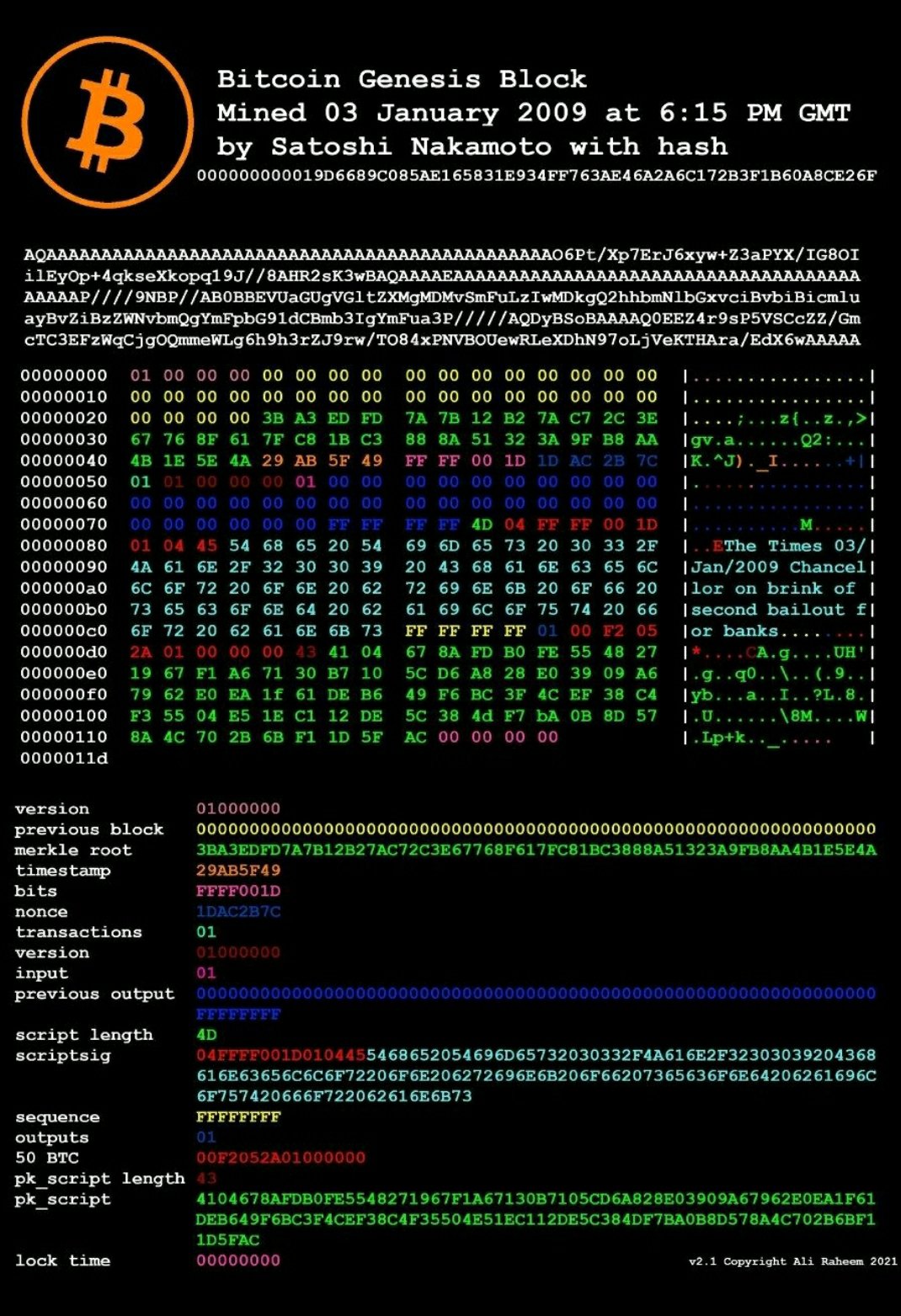
Bitcoin Genesis BlockAsics Mining Farm
A. Bitcoin uses public-key cryptography, peer-to-peer networking, and proof-of-work to process and verify payments. Bitcoins are sent (or signed over) from one address to another with each user potentially having many, many addresses. Each payment transaction is broadcast to the network and included in the blockchain so that the included bitcoins cannot be spent twice. After an hour or two, each transaction is locked in time by the massive amount of processing power that continues to extend the blockchain. Using these techniques, Bitcoin provides a fast and extremely reliable payment network that anyone can use.
In a first, Bitcoin developers have done something amazing amid the criticism over the lightning network and issues associated with it. A team of developers has made an international payment using the radio … Continue reading International payment using the radio waves→
My inspiration for this page was given to me by my new aquired friend, a fellow Truth Seeker – Joris and to whom I dedicate this page… Wish you… as well as to … Continue reading Discipline Quotes→
Bitcoin white paper turns 15 and the Legacy of Satoshi Nakamoto lives on. “I’ve been working on a new electronic cash system that’s fully peer-to-peer, with no trusted third party,” Satoshi Oct. 31, … Continue reading Bitcoin White Paper turn 15→
” It isn’t obvious that the world had to work this way.
But somehow the universe smiles on encryption.”
Julian Assange
Nobody yet knows for sure if the universe’s smile is genuine or not.
It is possible that our assumption of mathematical asymmetries is wrong and we find that P actually equals NP, or we find surprisingly quick solutions to specific problems which we currently assume to be hard.
If that should be the case, cryptography as we know it will cease to exist, and the implications would most likely change the world beyond recognition.
“Vires in Numeris”
=
“Strength in Numbers”
epii
Vires in numeris is not only a catchy motto used by bitcoiners.
The realization that there is an unfathomable strength to be found in numbers is a profound one.
Understanding this, and the inversion of existing power balances which it enables changed my view of the world and the future which lies ahead of us.
One direct result of this is the fact that you don’t have to ask anyone for permission to participate in Bitcoin.
There is no page to sign up, no company in charge, no government agency to send application forms to.
Simply generate a large number and you are pretty much good to go.
The central authority of account creation is mathematics.
Bitcoin is built upon our best understanding of reality.
While there are still many open problems in physics, computer science, and mathematics, we are pretty sure about some things.
That there is an asymmetry between finding solutions and validating the correctness of these solutions is one such thing.
That computation needs energy is another one.
In other words: finding a needle in a haystack is harder than checking if the pointy thing in your hand is indeed a needle or not.
And finding the needle takes work.
The vastness of Bitcoin’s address space is truly mind-boggling.
The number of private keys even more so. It is fascinating how much of our modern world boils down to the improbability of finding a needle in an unfathomably large haystack.
I am now more aware of this fact than ever.
Bitcoin taught me that there is strength in numbers.
Hashrate (Hash per second, h/s) is an SI-derived unit representing the number of double SHA-256 computations performed in one second in the bitcoin network for cryptocurrency mining.
Hashrate is also called as hashing power. It is usually symbolized as h/s (with an appropriate SI prefix).
What is hashing power or hash rate?
The hash rate is the primary measure of a Bitcoin miner‘s performance.
In 2014, a miner’s performance was generally measured in Ghash/s, or billions of hashes per second.
The hash/second unit is also part of a common measure of a Bitcoin miner’s electric efficiency in the term watts /Ghash/s, denoted as W/Ghash/s. As 1 watt is equal to 1 joule/s, this measure can also be expressed as J/Ghash, or joules per 1 billion hashes.
Bitcoin network hash rate
The hash/s is also used in calculations of the Bitcoin network’s overall hash rate. Because each miner or mining pool only relays a solved block to the network, the overall hash rate of the network is calculated based on the time between blocks.
While not an accurate measure of network hash rate at any given instance in time, measurements over longer periods can be considered indicative and similar calculations are used in Bitcoin’s difficulty adjustment.
In January 2015, the network hash rate was around 300 Phash/s, or 300 quadrillion hashes per second.
If you compare a bitcoin mining device to one that is designed to mine, for example, Ethereum, you will notice a very large apparent difference in hash rates.
This is because there are many different algorithms that cryptocurrencies use. They all require different amounts of memory and computing power in order to be mined.
To put it simply, bitcoin and its SHA256 algorithm is considered by today standards to be relatively easy to compute. As a result, a mining device that is still relevant today would need to produce hashes in the terahash range and up.
If we were to compare this to Ethereum, you’ll find that most modern Ethereum mining devices (typically GPU’s) operate in the megahash range.
At first glance, you may think that the bitcoin mining device is significantly more powerful or more productive.
While it’s true that it produces more hashes (of the SHA256 variety), this is because bitcoin hashes are easier to produce computationally.
As a consequence, the network difficulty is significantly higher for bitcoin.
To make things even more confusing, some cryptocurrencies intentionally chose algorithms that can only be mined using a basic CPU.
As a result, mining devices for this network that can produce hundreds of hashes per second are considered to be high and very competitive.
So what does all this mean?
Basically, it means that looking at the hash rate alone doesn’t necessarily tell you the effectiveness of the miner.
You also need to understand the network difficulty, and what the norm is for most mining devices for that particular cryptocurrency.
How can I calculate how many hashes I generate per second?
Your problem breaks down nicely into 3 separate tasks:
Sharing a single count variable across threads
Benchmarking thread completion time
Calculating hashes p/sec
Sharing a single count variable across threads
Now that we know that not all hashes are the same we need to know how to calculate the estimated profitability of a miner based on its hash rate.
For this, will need to use a mining profitability calculators, they are available in the Internet.
public static class GlobalCounter

 {
   public static int Value { get; private set; }
   public static void Increment()
   {
       Value = GetNextValue(Value);
   }
   private static int GetNextValue(int curValue)
   {
       return Interlocked.Increment(ref curValue);
   }
   public static void Reset()
   {
       Value = 0;
   }
 }
Before you spin off the threads call GlobalCounter.
Reset and then in each thread (after each successful hash) you would call GlobalCounter.
Increment – using Interlocked.X performs atomic operations of Value in a thread-safe manner, it’s also much faster than lock.
In a first, Bitcoin developers have done something amazing amid the criticism over the lightning network and issues associated with it. A team of developers has made an international payment using the radio … Continue reading International payment using the radio waves→
My inspiration for this page was given to me by my new aquired friend, a fellow Truth Seeker – Joris and to whom I dedicate this page… Wish you… as well as to … Continue reading Discipline Quotes→
Bitcoin white paper turns 15 and the Legacy of Satoshi Nakamoto lives on. “I’ve been working on a new electronic cash system that’s fully peer-to-peer, with no trusted third party,” Satoshi Oct. 31, … Continue reading Bitcoin White Paper turn 15→
March 19, 2013, 08:40:02 PM Last edit: March 25, 2013, 08:37:28 PM by Hal
#1
I thought I’d write about the last four years, an eventful time for Bitcoin and me.
For those who don’t know me, I’m Hal Finney. I got my start in crypto working on an early version of PGP, working closely with Phil Zimmermann. When Phil decided to start PGP Corporation, I was one of the first hires. I would work on PGP until my retirement.
At the same time, I got involved with the Cypherpunks. I ran the first cryptographically based anonymous remailer, among other activities.
Fast forward to late 2008 and the announcement of Bitcoin.
I’ve noticed that cryptographic graybeards (I was in my mid 50’s) tend to get cynical. I was more idealistic; I have always loved crypto, the mystery and the paradox of it.
When Satoshi announced Bitcoin on the cryptography mailing list, he got a skeptical reception at best. Cryptographers have seen too many grand schemes by clueless noobs. They tend to have a knee jerk reaction.
I was more positive. I had long been interested in cryptographic payment schemes.
Plus I was lucky enough to meet and extensively correspond with both Wei Dai and Nick Szabo, generally acknowledged to have created ideas that would be realized with Bitcoin.
I had made an attempt to create my own proof of work based currency, called RPOW. So I found Bitcoin facinating.
When Satoshi announced the first release of the software, I grabbed it right away.
I think I was the first person besides Satoshi to run bitcoin.
I mined block 70-something, and I was the recipient of the first bitcoin transaction, when Satoshi sent ten coins to me as a test.
I carried on an email conversation with Satoshi over the next few days, mostly me reporting bugs and him fixing them.
Today, Satoshi’s true identity has become a mystery. But at the time, I thought I was dealing with a young man of Japanese ancestry who was very smart and sincere.
I’ve had the good fortune to know many brilliant people over the course of my life, so I recognize the signs.
After a few days, bitcoin was running pretty stably, so I left it running.
Those were the days when difficulty was 1, and you could find blocks with a CPU, not even a GPU.
I mined several blocks over the next days. But I turned it off because it made my computer run hot, and the fan noise bothered me.
In retrospect, I wish I had kept it up longer, but on the other hand I was extraordinarily lucky to be there at the beginning.
It’s one of those glass half full half empty things.
The next I heard of Bitcoin was late 2010, when I was surprised to find that it was not only still going, bitcoins actually had monetary value.
I dusted off my old wallet, and was relieved to discover that my bitcoins were still there.
As the price climbed up to real money, I transferred the coins into an offline wallet, where hopefully they’ll be worth something to my heirs.
Speaking of heirs, I got a surprise in 2009, when I was suddenly diagnosed with a fatal disease. I was in the best shape of my life at the start of that year, I’d lost a lot of weight and taken up distance running. I’d run several half marathons, and I was starting to train for a full marathon. I worked my way up to 20+ mile runs, and I thought I was all set. That’s when everything went wrong.
My body began to fail. I slurred my speech, lost strength in my hands, and my legs were slow to recover.
In August, 2009, I was given the diagnosis of ALS, also called Lou Gehrig’s disease, after the famous baseball player who got it.
ALS is a disease that kills moter neurons, which carry signals from the brain to the muscles. It causes first weakness, then gradually increasing paralysis. It is usually fatal in 2 to 5 years.
My symptoms were mild at first and I continued to work, but fatigue and voice problems forced me to retire in early 2011. Since then the disease has continued its inexorable progression.
Today, I am essentially paralyzed. I am fed through a tube, and my breathing is assisted through another tube. I operate the computer using a commercial eyetracker system. It also has a speech synthesizer, so this is my voice now. I spend all day in my power wheelchair. I worked up an interface using an arduino so that I can adjust my wheelchair’s position using my eyes.
It has been an adjustment, but my life is not too bad. I can still read, listen to music, and watch TV and movies. I recently discovered that I can even write code. It’s very slow, probably 50 times slower than I was before. But I still love programming and it gives me goals.
Currently I’m working on something Mike Hearn suggested, using the security features of modern processors, designed to support “Trusted Computing”, to harden Bitcoin wallets. It’s almost ready to release. I just have to do the documentation.
And of course the price gyrations of bitcoins are entertaining to me. I have skin in the game. But I came by my bitcoins through luck, with little credit to me. I lived through the crash of 2011. So I’ve seen it before. Easy come, easy go.
That’s my story. I’m pretty lucky overall. Even with the ALS, my life is very satisfying. But my life expectancy is limited. Those discussions about inheriting your bitcoins are of more than academic interest.
My bitcoins are stored in our safe deposit box, and my son and daughter are tech savvy. I think they’re safe enough. I’m comfortable with my legacy. [edited slightly] “
In a first, Bitcoin developers have done something amazing amid the criticism over the lightning network and issues associated with it. A team of developers has made an international payment using the radio … Continue reading International payment using the radio waves→
My inspiration for this page was given to me by my new aquired friend, a fellow Truth Seeker – Joris and to whom I dedicate this page… Wish you… as well as to … Continue reading Discipline Quotes→
Bitcoin white paper turns 15 and the Legacy of Satoshi Nakamoto lives on. “I’ve been working on a new electronic cash system that’s fully peer-to-peer, with no trusted third party,” Satoshi Oct. 31, … Continue reading Bitcoin White Paper turn 15→







 BitHouse