BitAddress

Open Source JavaScript Client-Side Bitcoin Wallet Generator

A Bitcoin wallet is as simple as a single pairing of a Bitcoin address with its corresponding Bitcoin private key. Such a wallet has been generated for you in your web browser and is displayed above.

To safeguard this wallet you must print or otherwise record the Bitcoin address and private key. It is important to make a backup copy of the private key and store it in a safe location. This site does not have knowledge of your private key. If you are familiar with PGP you can download this all-in-one HTML page and check that you have an authentic version from the author of this site by matching the SHA256 hash of this HTML with the SHA256 hash available in the signed version history document linked on the footer of this site. If you leave/refresh the site or press the “Generate New Address” button then a new private key will be generated and the previously displayed private key will not be retrievable. Your Bitcoin private key should be kept a secret. Whomever you share the private key with has access to spend all the bitcoins associated with that address. If you print your wallet then store it in a zip lock bag to keep it safe from water. Treat a paper wallet like cash.

Add funds to this wallet by instructing others to send bitcoins to your Bitcoin address.

Check your balance by going to blockchain.info or blockexplorer.com and entering your Bitcoin address.

Spend your bitcoinsย by going to blockchain.info and sweep the full balance of your private key into your account at their website. You can also spend your funds by downloading one of the popular bitcoin p2p clients and importing your private key to the p2p client wallet. Keep in mind when you import your single key to a bitcoin p2p client and spend funds your key will be bundled with other private keys in the p2p client wallet. When you perform a transaction your change will be sent to another bitcoin address within the p2p client wallet. You must then backup the p2p client wallet and keep it safe as your remaining bitcoins will be stored there. Satoshi advised that one should never delete a wallet.

Source:

https://www.bitaddress.org/

โœŒ & ๐Ÿ’š

Vires In Numeris

Vires In Numeris

” It isnโ€™t obvious that the world had to work this way.

But somehow the universe smiles on encryption.โ€

Julian Assange

Nobody yet knows for sure if the universeโ€™s smile is genuine or not.

It is possible that our assumption of mathematical asymmetries is wrong and we find that P actually equals NP, or we find surprisingly quick solutions to specific problems which we currently assume to be hard.

If that should be the case, cryptography as we know it will cease to exist, and the implications would most likely change the world beyond recognition.

โ€œVires in Numerisโ€

=

โ€œStrength in Numbersโ€

epii

Vires in numeris is not only a catchy motto used by bitcoiners.

The realization that there is an unfathomable strength to be found in numbers is a profound one.

Understanding this, and the inversion of existing power balances which it enables changed my view of the world and the future which lies ahead of us.

One direct result of this is the fact that you donโ€™t have to ask anyone for permission to participate in Bitcoin.

There is no page to sign up, no company in charge, no government agency to send application forms to.

Simply generate a large number and you are pretty much good to go.

The central authority of account creation is mathematics.

And God only knows who is in charge of that.

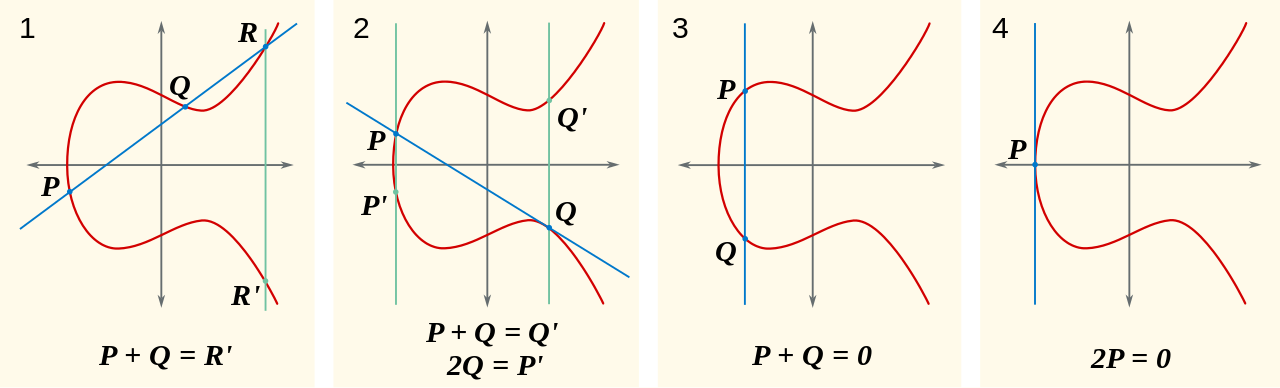
Elliptic curve examples (cc-by-sa Emmanuel Boutet)

Bitcoin is built upon our best understanding of reality.

While there are still many open problems in physics, computer science, and mathematics, we are pretty sure about some things.

That there is an asymmetry between finding solutions and validating the correctness of these solutions is one such thing.

That computation needs energy is another one.

In other words: finding a needle in a haystack is harder than checking if the pointy thing in your hand is indeed a needle or not.

And finding the needle takes work.

The vastness of Bitcoinโ€™s address space is truly mind-boggling.

The number of private keys even more so. It is fascinating how much of our modern world boils down to the improbability of finding a needle in an unfathomably large haystack.

I am now more aware of this fact than ever.

Bitcoin taught me that there is strength in numbers.

Shared with ๐Ÿ’š by Free SpiritโœŒ & ๐Ÿ’š

No, Governments Canโ€™t do a Better Job Developing Crypto

No, Governments Canโ€™t do a Better Job Developing Crypto

Would a state-backed cryptocurrency be better than its decentralized counterpart?

International media has already rolled out their opinions on the matter. Itโ€™s a YES-IT-CAN.

The opinions find theirย inspirations in comments made byย Christine Lagarde last week. The head of the International Monetary Fund (IMF) said that a government-backed cryptocurrency would eliminate the issues of trust that have clogged the decentralized cryptocurrencies like Bitcoin.

New York Times reacted to the IMF chiefโ€™s remarks, calling it โ€œa hopeful sign for digital tokens,โ€ while predicting it could โ€œhave a chilling effect on existing, nongovernmental tokens.โ€

The Guardian offered its editorial space to a long-time Bitcoin critic and economist Nouriel Roubini to furtherย his plan. He outrightย called cryptocurrencies worthless when compared to central bank digital currencies (CBDC).โ€œIf a CBDC were to be issued, it would immediately displace cryptocurrencies, which are not scalable, cheap, secure, or [actually] decentralized,โ€ Roubini claimed.

The comments mentioned above appear at a time when the cryptocurrency market cap has plunged by more than 70 percent since its all-time high.ย 

It has allowed critics to jump to the conclusion that decentralized digital currencies, mainly Bitcoin and Ethereum, have no intrinsic value, that they are highly speculative unlike central-bank issued fiat money.

Yet, critics have ignored the whys and whats that prompted the launch of decentralized assets at the first place.

They have been unable to respond to how Federal Reserve stimulus programmes, secret bailouts, and money production have destroyed the value of the US Dollar.

Their focus has turned more towards proving Bitcoin as a sugar-coated false promise of a financial revolution while ignoring the very bads of the existing financial system.

Economy believes that an assetย has value when it checks scarcity and utility.

The US Dollar lacks scarcity, for its supply is governed by a centralized body called Federal Reserve. There is no check on how many dollars would get printed, allowing insiders to manipulate a greenback-backed market on their whims.

Bitcoin, on the other hand, has a set cap of 21 million tokens. Its supply is governed by mathematical algorithms, meaning no corrupt human involvement would be able to topple it.

As far as the use-cases are concerned, Bitcoin has been constantly looked at for its potential of becoming a store-of-valueย asset like Gold, while being constantly considered for settling cross-border payments despite its price volatility.

The critics then say that bitcoin has no intrinsic value.

But even gold and paper money suffers from the same stigma.

According to the World Council, only 15 percent of the global Gold supply is used in industrial applications. The rest goes into making bars, bullions, and jewelry โ€“ mainly because people trust they have value.

Trust is the Only Factor

The launch of Bitcoin was a response to a global financial crisis in which โ€“ letโ€™s accept it โ€“ banks had f***ed up the economy.

The digital currency โ€“ more or less โ€“ follows the philosophy of the Austrian Monetary Theory.

According to it, money can be sound only when its supply is limited. It believes that money should not be controlled by the state.

These facts are missing from the reports and opinion pieces of anti-Bitcoin economists.

The Federal Reserve and central bankers believe that only they have the right to print money.

Bitcoin is only a beginning towards breaking the myth.

As long as the central banks do not innovate and protect people against currency inflation โ€“ as evident in the case of Zimbabwe and Venezuela โ€“ there is no chance they would be able to outrun crypto.

People need to trust their banks, but mainstream media and economists are avoiding a broader discussion.

The next financial crisis should bring more evidence to the theory. No rush.


Shared with ๐Ÿ’š by Free Spirit

โœŒ & ๐Ÿ’š


With ๐Ÿ’š