

When You’re Ready…


In this post, I will tell you why Satoshi Nakamoto is an inspirational developer to me and why he should be so for all other developers. I will explain how using code, Satoshi was able to solve some of the most pressing problems of our time and how by creating the first decentralized currency, he has made the world a better place, and we as developers should strive to do the same.
“I Am Satoshi Nakamoto” – How One Programmer Changed the World

” Bitcoin and me (Hal Finney)
March 19, 2013, 08:40:02 PM
Last edit: March 25, 2013, 08:37:28 PM by Hal
#1
I thought I’d write about the last four years, an eventful time for Bitcoin and me.
For those who don’t know me, I’m Hal Finney. I got my start in crypto working on an early version of PGP, working closely with Phil Zimmermann. When Phil decided to start PGP Corporation, I was one of the first hires. I would work on PGP until my retirement.
At the same time, I got involved with the Cypherpunks. I ran the first cryptographically based anonymous remailer, among other activities.
Fast forward to late 2008 and the announcement of Bitcoin.
I’ve noticed that cryptographic graybeards (I was in my mid 50’s) tend to get cynical. I was more idealistic; I have always loved crypto, the mystery and the paradox of it.
When Satoshi announced Bitcoin on the cryptography mailing list, he got a skeptical reception at best. Cryptographers have seen too many grand schemes by clueless noobs. They tend to have a knee jerk reaction.
I was more positive. I had long been interested in cryptographic payment schemes.
Plus I was lucky enough to meet and extensively correspond with both Wei Dai and Nick Szabo, generally acknowledged to have created ideas that would be realized with Bitcoin.
I had made an attempt to create my own proof of work based currency, called RPOW. So I found Bitcoin facinating.
When Satoshi announced the first release of the software, I grabbed it right away.
I think I was the first person besides Satoshi to run bitcoin.
I mined block 70-something, and I was the recipient of the first bitcoin transaction, when Satoshi sent ten coins to me as a test.
I carried on an email conversation with Satoshi over the next few days, mostly me reporting bugs and him fixing them.
Today, Satoshi’s true identity has become a mystery. But at the time, I thought I was dealing with a young man of Japanese ancestry who was very smart and sincere.
I’ve had the good fortune to know many brilliant people over the course of my life, so I recognize the signs.
After a few days, bitcoin was running pretty stably, so I left it running.
Those were the days when difficulty was 1, and you could find blocks with a CPU, not even a GPU.
I mined several blocks over the next days. But I turned it off because it made my computer run hot, and the fan noise bothered me.
In retrospect, I wish I had kept it up longer, but on the other hand I was extraordinarily lucky to be there at the beginning.
It’s one of those glass half full half empty things.
The next I heard of Bitcoin was late 2010, when I was surprised to find that it was not only still going, bitcoins actually had monetary value.
I dusted off my old wallet, and was relieved to discover that my bitcoins were still there.
As the price climbed up to real money, I transferred the coins into an offline wallet, where hopefully they’ll be worth something to my heirs.
Speaking of heirs, I got a surprise in 2009, when I was suddenly diagnosed with a fatal disease. I was in the best shape of my life at the start of that year, I’d lost a lot of weight and taken up distance running. I’d run several half marathons, and I was starting to train for a full marathon. I worked my way up to 20+ mile runs, and I thought I was all set. That’s when everything went wrong.
My body began to fail. I slurred my speech, lost strength in my hands, and my legs were slow to recover.
In August, 2009, I was given the diagnosis of ALS, also called Lou Gehrig’s disease, after the famous baseball player who got it.
ALS is a disease that kills moter neurons, which carry signals from the brain to the muscles. It causes first weakness, then gradually increasing paralysis. It is usually fatal in 2 to 5 years.
My symptoms were mild at first and I continued to work, but fatigue and voice problems forced me to retire in early 2011. Since then the disease has continued its inexorable progression.
Today, I am essentially paralyzed. I am fed through a tube, and my breathing is assisted through another tube. I operate the computer using a commercial eyetracker system. It also has a speech synthesizer, so this is my voice now. I spend all day in my power wheelchair. I worked up an interface using an arduino so that I can adjust my wheelchair’s position using my eyes.
It has been an adjustment, but my life is not too bad. I can still read, listen to music, and watch TV and movies. I recently discovered that I can even write code. It’s very slow, probably 50 times slower than I was before. But I still love programming and it gives me goals.
Currently I’m working on something Mike Hearn suggested, using the security features of modern processors, designed to support “Trusted Computing”, to harden Bitcoin wallets. It’s almost ready to release. I just have to do the documentation.
And of course the price gyrations of bitcoins are entertaining to me. I have skin in the game. But I came by my bitcoins through luck, with little credit to me. I lived through the crash of 2011. So I’ve seen it before. Easy come, easy go.
That’s my story. I’m pretty lucky overall. Even with the ALS, my life is very satisfying. But my life expectancy is limited. Those discussions about inheriting your bitcoins are of more than academic interest.
My bitcoins are stored in our safe deposit box, and my son and daughter are tech savvy. I think they’re safe enough. I’m comfortable with my legacy.
[edited slightly] “


by Eric Hughes
” Privacy is necessary for an open society in the electronic age.
Privacy is not secrecy.
A private matter is something one doesn’t want the whole world to know, but a secret matter is something one doesn’t want anybody to know.
Privacy is the power to selectively reveal oneself to the world.
If two parties have some sort of dealings, then each has a memory of their interaction.
Each party can speak about their own memory of this; how could anyone prevent it?
One could pass laws against it, but the freedom of speech, even more than privacy, is fundamental to an open society; we seek not to restrict any speech at all.
If many parties speak together in the same forum, each can speak to all the others and aggregate together knowledge about individuals and other parties.
The power of electronic communications has enabled such group speech, and it will not go away merely because we might want it to.
Since we desire privacy, we must ensure that each party to a transaction have knowledge only of that which is directly necessary for that transaction.
Since any information can be spoken of, we must ensure that we reveal as little as possible.
In most cases personal identity is not salient. When I purchase a magazine at a store and hand cash to the clerk, there is no need to know who I am.
When I ask my electronic mail provider to send and receive messages, my provider need not know to whom I am speaking or what I am saying or what others are saying to me; my provider only need know how to get the message there and how much I owe them in fees.
When my identity is revealed by the underlying mechanism of the transaction, I have no privacy. I cannot here selectively reveal myself; I must always reveal myself.
Therefore, privacy in an open society requires anonymous transaction systems.
Until now, cash has been the primary such system.
An anonymous transaction system is not a secret transaction system.
An anonymous system empowers individuals to reveal their identity when desired and only when desired; this is the essence of privacy.
Privacy in an open society also requires cryptography.
If I say something, I want it heard only by those for whom I intend it.
If the content of my speech is available to the world, I have no privacy.
To encrypt is to indicate the desire for privacy, and to encrypt with weak cryptography is to indicate not too much desire for privacy.
Furthermore, to reveal one’s identity with assurance when the default is anonymity requires the cryptographic signature.
We cannot expect governments, corporations, or other large, faceless organizations to grant us privacy out of their beneficence.
It is to their advantage to speak of us, and we should expect that they will speak.
To try to prevent their speech is to fight against the realities of information.
Information does not just want to be free, it longs to be free.
Information expands to fill the available storage space.
Information is Rumor’s younger, stronger cousin;
Information is fleeter of foot, has more eyes, knows more, and understands less than Rumor.
We must defend our own privacy if we expect to have any.
We must come together and create systems which allow anonymous transactions to take place.
People have been defending their own privacy for centuries with whispers, darkness, envelopes, closed doors, secret handshakes, and couriers.
The technologies of the past did not allow for strong privacy, but electronic technologies do.
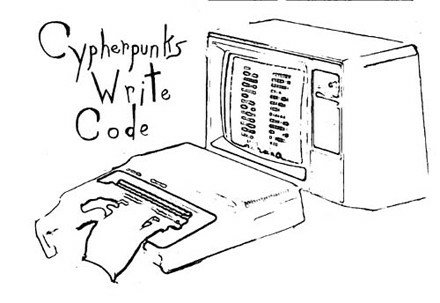
We the Cypherpunks are dedicated to building anonymous systems.
We are defending our privacy with cryptography, with anonymous mail forwarding systems, with digital signatures, and with electronic money.
We know that someone has to write software to defend privacy, and since we can’t get privacy unless we all do, we’re going to write it.
We publish our code so that our fellow Cypherpunks may practice and play with it. Our code is free for all to use, worldwide.
We don’t much care if you don’t approve of the software we write.
We know that software can’t be destroyed and that a widely dispersed system can’t be shut down.
Cypherpunks deplore regulations on cryptography, for encryption is fundamentally a private act.
The act of encryption, in fact, removes information from the public realm.
Even laws against cryptography reach only so far as a nation’s border and the arm of its violence.
Cryptography will ineluctably spread over the whole globe, and with it the anonymous transactions systems that it makes possible.
For privacy to be widespread it must be part of a social contract.
People must come and together deploy these systems for the common good. Privacy only extends so far as the cooperation of one’s fellows in society.
We the Cypherpunks seek your questions and your concerns and hope we may engage you so that we do not deceive ourselves.
We will not, however, be moved out of our course because some may disagree with our goals.
The Cypherpunks are actively engaged in making the networks safer for privacy. Let us proceed together apace.
Onward.
Eric Hughes
9 March 1993


The War for a Free Internet
David Vorick
Feb 14
” I came of age on the Internet. By the age of 13, I had more friends whose faces I would never see than I had peers in the classroom. Most of them won’t realize today who I am even if they are reading this now. Most of them didn’t realize I was decades their junior.
When my father was growing up, his freedom was his bicycle. It gave him access to friends, to a job, freedom from his parents, and ultimately space to carve out a personality that he could call his own. He wanted nothing more than to pass these gifts along to me, and it was often to his dismay and frustration that I never found the same joy in my bike that he had found in his.
I was too young to realize it at the time, but I had received the same gifts as my father.
Where my father’s freedom was his bicycle, my freedom was my keyboard.
A denizen of dozens of forums and hundreds of websites, countless hours each weekend contributed elements to my personality that raised me to be someone beyond anything I could have become in my hometown alone.
As middle school became high school, my online hours began to exceed my offline hours. By my sophomore year of college I was spending more than 80 hours per week on the Internet.
The Internet has become the keystone of modern society, a fact that has not been overlooked by our corporate giants.
As the 2010’s progressed, the Internet became a massive land grab. A hundred thousand independently operated forums became one front page of the Internet.
Personal cards, handwritten letters, and cozy phonecalls turned into a single wall that wished you “Happy Birthday” 1,000 times on what was often not even the right day.
What used to be an endless exploration of hand curated forums and webpages turned into a bottomless pit of AI generated filth carefully crafted by teams of PhDs with the sole intention of getting you to stare at your phone for just a little bit longer.
The modern Internet has been absolutely steamrolled by the likes of Google, Facebook, and Amazon.
As these platforms have festered, they’ve made it clear that we’re here to play by their rules.
They decide which of our friends we get updates from.
They decide how large a nose ring can be before a content creator gets demonetized and loses their livelihood.
An uncomfortable percentage of our time is spent under the tyranny of whatever logic was implemented in the pursuit of higher profits next quarter.
Somewhere underneath it all, real people are living every day, taking what breaths they can between the inescapable deluge of content spawning from a clinical addiction to their devices.
The next wave of teenagers are coming of age in this environment and they are suffocating. Suicide rates are up almost 50% since 2007 for people under the age of 24.
The modern Internet is making us miserable.
Our overlords have captured our souls by bringing us gifts of amazing technology and bundling with those gifts chains and cages that capture our minds and manipulate us to maximize their bottom line.
The time has come to stand up for ourselves, for our health, and for the next generation.
The time has come to start the War for a Free Internet. “
WRITTEN BY
David Vorick


CoinMarketCap.com is LYING to everyone while profiting from it
CoinMarketCap.com, the Number 1 website in the crypto-currency industry, is showing immensely fraudulent and scam information (on purpose) to its users. As a site that is used frequently for reference points by many news organisations, trading outlets, companies, informational sites and individuals, it would be in the best interest of the community to write about what has been really going on with this “trusted resource”.
The research indicates that multiple attempts to fix information by many coins on CoinMarketCap.com through contacting them through their support requests or online social media sites such as BitcoinTalk.org, reddit.com and other places has gone unanswered, ignored and/or explicitly overlooked/denied. By explicitly overlooked/denied, after contacting their support with up-to date and obviously correct information, they refuse to update the data. Many hundreds of coins on CMC are affected very negatively (or positively) by this. A lot of them have given up trying to get CMC to put correct data on their site, and have made sticky posts in their own respective forums as to this issue instead.
It is believed that there is massive insider trading going on with the employees, owners and others involved with CoinMarketCap. The research, including talking to multiple coin creators, shows anomalous buying of coins between times that the coin creators asked CMC to list their coin (through their google form) and between when it actually gets listed on the site. This could mean that CMC insiders know that certain coins will pump, and go on a buying spree to front-run the listing of the coin and the public market sentiment. This can be seen over and over again when analysing the action on coins when being listed.
Pump and dumps are also being actively allowed and managed by the team at CMC without the knowledge of the coin creators or coin communities themselves. This can be seen by the direct manipulation of the circulating supply of some coins. CMC puts the circulating supply as very high at certain points (increasing the market cap), then drops it down to a much lower number later (lowering the market cap). This moves these coins up or down their numbered list causing massive buys and sell offs at the whim of CMC. Luckily this fraud can only be made to happen once or twice with each coin as the public outcry from the coin communities (sometimes) usually puts an end to it one way or other.
There is also evidence of CoinMarketCap effectively “killing” off coins as it sees fit. How does it “kill” a coin? Well it removes it’s circulating supply to “?” or a very low number arbitrarily, and keeps it there for a prolonged period. As the coin goes lower and lower in the rankings, daily volume on the coin dies off until such a time that it is zero (even though the teams behind the coins are still active and growing their ecosystems). This leads to exchanges delisting the coin, and the ecosystem being entirely dead after a period of time. There is plenty of evidence of coin communities complaining and coin creators “begging” CMC to update their information with no luck. CMC literally decides which coin lives or dies with it’s own agendas. In defence of CMC, some coins do lose their circulating supply due to faults of the coins (the data end-points for circulating supply stop working on the servers provided initially by the coins), but many are brought down even with the objections and outcry of the coin creators and communities behind them.
Also of concern is the possible bribery of CMC officials and other nefarious behaviors that could very obviously be extrapolated from their current actions. What if one coin paid a handsome sum to CMC to make sure a “competitor” would have lower market cap? How do you make them have a lower market cap? Easy, refuse to update the circulating supply to what the real numbers are and instead show an arbitrary number of their choosing. This can also be seen on many of the coins listed on CMC. There is ample evidence of coins complaining publicly on many forums yet CMC taking it’s own numbers without any explanation or acknowledgement.
Another area of concern is the outdated/incorrect information of many of the coins listed on CMC. Official coin links being broken or unresponsive, including the main websites, wrong daily volumes (not updated in days or weeks), and hugely different circulating supplies (from those you can officially see on the respective blockchains of the coins themselves) are just some of the additional problems that ring alarm bells with us.
Because of these issues, (and many others including the pseudonymousnature of the founders and team members) we believe it is in the best interest of the entire community to get behind this initiative and make big noise until such a time that CoinMarketCap updates their site to show correct information, or another resource is created/promoted that shows correct and up-to date data on their website. Number 1 can go down to Number 0 very quickly in the space with the right community backlash.
Some may say that these issues may be due to incompetence of the team at CMC or them having limited resources. One of the parts of our analysis will take a much closer look at what kind of income CoinMarketCap really makes. You would be surprised. CMC is one of the most profitable businesses in the entire industry. The user is the product. The ads are the money maker. There are backroom deals, and much more happening beyond the scenes that the public does not know.
Most people here are concerned about centralised mining cartels, hardware producers, banks, governments, regulators and/or core developers being points of issues in this industry. We strongly believe that none of those come even close to comparing to the obvious fraud that has been going on at CoinMarketCap for many years.
The volume of money that is traded on information taken from CMC alone pales every other issue into oblivion. If traders are making buys and sells according to falsified data on CoinMarketCap.com, then they are being manipulated and lied to in one of the biggest frauds in the entire crypto-currency space.
You will be shocked at the level of incompetence, negligence, fraud, and outright lying that CMC perpetuates, but at the lack of information about this so far in this industry. For a community that prides itself on self-regulation through transparency and openness, it should be ashamed at not having blown this massive fraud into the public eye much sooner.
We owe it to the community to make sure resources (especially the Number 1 site in the industry) are not being placed in positions to freely commit fraudon this scale ever again.
This has been a very intense effort in data gathering, reporting and analysis.

Yes the profitability changes second to second with the price of bitcoin and you cant use this information to forecast…
BTC total daily payout is 6.25 BTC * 6 times per hour * 24hours…on average = 900 BTC mined every day.
That has to be spread out, on average, evenly across then ENTIRE network. Granted, luck is involved, so it isn’t exactly even, but on average, it should be.
If network is running at 17,608,758 TH/s, and every TH gets an even share of the reward, then that would be 1800BTC / 17,608,758 TH/s = .00010222 BTC/(TH/s).
You then take that figure and multiply by number of TH for miner, and then you get daily BTC revenue ; )


 BitHouse