Cryptocurrency markets are volatile enough without making simple, easily avoidable mistakes.
Investing in cryptocurrencies and digital assets is now easier than ever before. Online brokers, centralized exchanges and even decentralized exchanges give investors the flexibility to buy and sell tokens without going through a traditional financial institution and the hefty fees and commissions that come along with them.
Cryptocurrencies were designed to operate in a decentralized manner. This means that while they’re an innovative avenue for global peer-to-peer value transfers, there are no trusted authorities involved that can guarantee the security of your assets. Your losses are your responsibility once you take your digital assets into custody.
Here we’ll explore some of the more common mistakes that cryptocurrency investors and traders make and how you can protect yourself from unnecessary losses.
Losing your keys
Cryptocurrencies are built on blockchain technology, a form of distributed ledger technology that offers high levels of security for digital assets without the need for a centralized custodian. However, this puts the onus of protection on asset holders, and storing the cryptographic keys to your digital asset wallet safely is an integral part of this.
On the blockchain, digital transactions are created and signed using private keys, which act as a unique identifier to prevent unauthorized access to your cryptocurrency wallet. Unlike a password or a PIN, you cannot reset or recover your keys if you lose them. This makes it extremely important to keep your keys safe and secure, as losing them would mean losing access to all digital assets stored in that wallet.
Lost keys are among the most common mistakes that crypto investors make. According to a report from Chainalysis, of the 18.5 million Bitcoin (BTC) mined so far, over 20% has been lost to forgotten or misplaced keys.
Storing coins in online wallets
Centralized cryptocurrency exchanges are probably the easiest way for investors to get their hands on some cryptocurrencies. However, these exchanges do not give you access to the wallets holding the tokens, instead offering you a service similar to banks. While the user technically owns the coins stored on the platform, they are still held by the exchange, leaving them vulnerable to attacks on the platform and putting them at risk.
There have been many documented attacks on high-profile cryptocurrency exchanges that have led to millions of dollars worth of cryptocurrency stolen from these platforms. The most secure option to protect your assets against such risk is to store your cryptocurrencies offline, withdrawing assets to either a software or hardware wallet after purchase.
Not keeping a hard copy of your seed phrase
To generate a private key for your crypto wallet, you will be prompted to write down a seed phrase consisting of up to 24 randomly generated words in a specific order. If you ever lose access to your wallet, this seed phrase can be used to generate your private keys and access your cryptocurrencies.
Keeping a hard copy record, such as a printed document or a piece of paper with the seed phrase written on it, can help prevent needless losses from damaged hardware wallets, faulty digital storage systems, and more. Just like losing your private keys, traders have lost many a coin to crashed computers and corrupted hard drives.
Fat-finger error
A fat-finger error is when an investor accidentally enters a trade order that isn’t what they intended. One misplaced zero can lead to significant losses, and mistyping even a single decimal place can have considerable ramifications.
One instance of this fat-finger error was when the DeversiFi platform erroneously paid out a $24-million fee. Another unforgettable tale was when a highly sought-after Bored Ape nonfungible token was accidentally sold for $3,000 instead of $300,000.
Sending to the wrong address
Investors should take extreme care while sending digital assets to another person or wallet, as there is no way to retrieve them if they are sent to the wrong address. This mistake often happens when the sender isn’t paying attention while entering the wallet address. Transactions on the blockchain are irreversible, and unlike a bank, there are no customer support lines to help with the situation.
This kind of error can be fatal to an investment portfolio. Still, in a positive turn of events, Tether, the firm behind the world’s most popular stablecoin, recovered and returned $1 million worth of Tether (USDT) to a group of crypto traders who sent the funds to the wrong decentralized finance platform in 2020. However, this story is a drop in the ocean of examples where things don’t work out so well. Hodlers should be careful while dealing with digital asset transactions and take time to enter the details. Once you make a mistake, there’s no going back.
Over diversification
Diversification is crucial to building a resilient cryptocurrency portfolio, especially with the high volatility levels in the space. However, with the sheer number of options out there and the predominant thirst for outsized gains, cryptocurrency investors often end up over-diversifying their portfolios, which can have immense consequences.
Over-diversification can lead to an investor holding a large number of heavily underperforming assets, leading to significant losses. It’s vital to only diversify into cryptocurrencies where the fundamental value is clear and to have a strong understanding of the different types of assets and how they will likely perform in various market conditions.
Not setting up a stop-loss arrangement
A stop-loss is an order type that enables investors to sell a security only when the market reaches a specific price. Investors use this to prevent losing more money than they are willing to, ensuring they at least make back their initial investment.
In several cases, investors have experienced huge losses because of incorrectly setting up their stop losses before asset prices dropped. However, it’s also important to remember that stop-loss orders aren’t perfect and can sometimes fail to trigger a sale in the event of a large, sudden crash.
That being said, the importance of setting up stop losses to protect investments cannot be understated and can significantly help mitigate losses during a market downturn.
Crypto investing and trading is a risky business with no guarantees of success. Like any other form of trading, patience, caution and understanding can go a long way. Blockchain places the responsibility on the investor, so it’s crucial to take the time to figure out the various aspects of the market and learn from past mistakes before putting your money at risk.
• Individually, each of these technologies deserves all the attention they’re getting as enablers and disruptors
• But, taken together?
• Their transformative effect becomes multiplicative
• A future driven by machine connectivity, data exchange and commercial services:
IoT connects billions of machines and sensors generate unprecedented quantities of real-time data
AI enables the machines to act on data and trigger services
Blockchain functions are the transaction layer where data and service contracts are securely stored and payments for services are settled
How does blockchain support intelligent connected machines?
• Smart Contracts enable self-executing and self-enforcing contractual states
Custom financial instruments (tokens), records of ownership of an underlying physical asset (smart property), any
complex business logic that can be programmable
Can such applications be ideal for intelligent (AI) and connected (IoT) machines?
These machines are intelligent enough to negotiate contracts, but need a technology allowing them to securely sign and enforce them
• Digital currencies create new forms of money
Programmable and active
Will such money be ideal for intelligent (AI) and connected (IoT) machines?
These machines will need digital currency to pay for services assigned through the smart contracts
How will the three technologies work together?
IoT – Internet of Things
Sensors allow us to cost-effectively gather tremendous amounts of data.
Connectivity allows us to transmit/broadcast these data.
But, there is a missing element: intelligence to process these data.
AI – Artificial Intelligence
Intelligence at the very edges of the network (mini-brains).
Combine with IoT and you have the ability to recognize meaningful patterns buried in mountains of data in ways that would be impossible for most humans, or even non-AI algorithms, to do.
But, there is a missing element: a secure storage layer for data and a transaction layer for services
DLT (blockchain) – Distributed Ledger Technology
Decentralized governance, coupled with no single point of failure, disintermediation, unalterable and searchable records of events.
Digital currencies and tokenized custom financial instruments.
Combine with AI and IoT and you have a new world of autonomous systems interacting with each other, procuring services from each other and settling transactions.
The technology stack of the future
Technology Stack of the Future
Toward a world of machine commerce
A world of Machine Commerce
M2M will need SSI (self-sovereign identities) – for objects!
Human Identities types
Object identities can be SSI by default
Multi-source, multi-verifier
Digitally signed, verifiable credentials that can prove issuer, holder and status
Secure peer-to-peer connections (permanent or session-based)
Exchange full credentials, partial credentials or ZKPs derived from credentials
Next milestone: Decentralized Organizations (DOs)
DOs are good at:
Coordinating resources that do not know/trust each other (including hybrid
H/M)
Governing in a geography-agnostic, censorship-resistant manner
Enabling short-term or informal organizational structures (networks/communities)
Tracking and rewarding contribution
Challenges
Jurisdictional issues
Legislating new types of work for humans and work rules for machines
Governance modalities, including external supervision
Challenges
New/upgraded system architectures
• From legacy to blockchain/AI/IoT-native systems • Integration, interoperability, backward compatibility • ROI obvious ex post, difficult ex ante – Bootstrapping
Advanced analytics capabilities
• As devices at the edge become smarter, the smart contracts enabled by blockchain platforms will require more advanced data analytics capabilities and gateways to the physical world.
New Business Models
Disruptive innovation will dominate – but not without boom-and-bust cycles and big failures along the way.
Winners will NOT be the ones focusing on efficiency gains, but on disruptive models.
Key takeaways
• IoT, AI and DLT (blockchain) are foundational and exponentially growing technologies
When combined, they will create a new internet of connected, intelligent and commercially transacting machines
An era machine-to-machine (M2M) and human-to-machine (H2M) commerce is likely to emerge, with profound consequences on social and economic dynamics
New forms of corporations or organizational formats (code-only, autonomous) will emerge
• There are numerous challenges that must be overcome
IoT has outpaced the human internet, but is still a largely passive, insecure and privacy-vulnerable network
AI has made huge leaps, but still requires immense computational resources and is largely incompatible with edge computing
DLT is a new technology, largely untested at scale; both smart contracts and digital assets lack the regulatory clarity required for mass adoption
In a first, Bitcoin developers have done something amazing amid the criticism over the lightning network and issues associated with it. A team of developers has made an international payment using the radio … Continue reading International payment using the radio waves→
My inspiration for this page was given to me by my new aquired friend, a fellow Truth Seeker – Joris and to whom I dedicate this page… Wish you… as well as to … Continue reading Discipline Quotes→
Bitcoin white paper turns 15 and the Legacy of Satoshi Nakamoto lives on. “I’ve been working on a new electronic cash system that’s fully peer-to-peer, with no trusted third party,” Satoshi Oct. 31, … Continue reading Bitcoin White Paper turn 15→
The Great Pyramid of Giza (also known as the Pyramid of Khufu or the Pyramid of Cheops) is the oldest and largest of the pyramids in the Giza pyramid complex bordering present-day Giza in Greater Cairo, Egypt.
Egyptologists conclude that the pyramid was built as a tomb for the Fourth Dynasty Egyptian pharaoh Khufu and estimate that it was built in the 26th century BC during a period of around 27 years.
Initially standing at 146.5 metres (481 feet), the Great Pyramid was the tallest man-made structure in the world for more than 3,800 years.
Over time, most of the smooth white limestone casing was removed, which lowered the pyramid’s height to the present 138.5 metres (454.4 ft).
What is seen today is the underlying core structure. The base was measured to be about 230.3 metres (755.6 ft) square, giving a volume of roughly 2.6 million cubic metres (92 million cubic feet), which includes an internal hillock.
The dimensions of the pyramid were 280 royal cubits (146.7 m; 481.4 ft) high, a base length of 440 cubits (230.6 m; 756.4 ft), with a seked of 5+1/2 palms (a slope of 51°50’40”).
The Great Pyramid was built by quarrying an estimated 2.3 million large blocks weighing 6 million tonnes total.
The majority of stones are not uniform in size or shape and are only roughly dressed.The outside layers were bound together by mortar.
Primarily local limestone from the Giza Plateau was used. Other blocks were imported by boat down the Nile: White limestone from Tura for the casing, and granite blocks from Aswan, weighing up to 80 tonnes, for the King’s Chamber structure.
There are three known chambers inside the Great Pyramid. The lowest was cut into the bedrock, upon which the pyramid was built, but remained unfinished. The so-called Queen’s Chamber and King’s Chamber, that contains a granite sarcophagus, are higher up, within the pyramid structure. Khufu’s vizier, Hemiunu (also called Hemon), is believed by some to be the architect of the Great Pyramid.
Many varying scientific and alternative hypotheses attempt to explain the exact construction techniques.
The funerary complex around the pyramid consisted of two mortuary temples connected by a causeway (one close to the pyramid and one near the Nile), tombs for the immediate family and court of Khufu, including three smaller pyramids for Khufu’s wives, an even smaller “satellite pyramid” and five buried solar barges.
Flavian Amphitheatre a.k.a Colloseum Rome – Italy
The Colosseum (Colosseo[kolosˈsɛːo]) is an oval amphitheatre in the centre of the city of Rome, Italy, just east of the Roman Forum.
It is the largest ancient amphitheatre ever built, and is still the largest standing amphitheatre in the world today, despite its age.
Construction began under the emperor Vespasian (r. 69–79 AD) in 72 and was completed in 80 AD under his successor and heir, Titus (r. 79–81).
Further modifications were made during the reign of Domitian (r. 81–96).
The three emperors that were patrons of the work are known as the Flavian dynasty, and the amphitheatre was named the Flavian Amphitheatre (Latin: Amphitheatrum Flavium; Italian: Anfiteatro Flavio[aɱfiteˈaːtro ˈflaːvjo]) by later classicists and archaeologists for its association with their family name (Flavius).
The Colosseum is built of travertine limestone, tuff (volcanic rock), and brick-faced concrete.
The Colosseum could hold an estimated 50,000 to 80,000 spectators at various points in its history having an average audience of some 65,000; it was used for gladiatorial contests and public spectacles including animal hunts, executions, re-enactments of famous battles, and dramas based on Roman mythology, and briefly mock sea battles.
The building ceased to be used for entertainment in the early medieval era.
It was later reused for such purposes as housing, workshops, quarters for a religious order, a fortress, a quarry, and a Christian shrine.
Although substantially ruined because of earthquakes and stone-robbers (for spolia), the Colosseum is still an iconic symbol of Imperial Rome and was listed as one of the New 7 Wonders of the World.
It is one of Rome’s most popular tourist attractions and also has links to the Roman Catholic Church, as each Good Friday the Pope leads a torchlit “Way of the Cross” procession that starts in the area around the Colosseum.
The Colosseum is also depicted on the Italian version of the five-cent euro coin.
Several walls were built from as early as the 7th century BC,with selective stretches later joined together by Qin Shi Huang (220–206 BC), the first emperor of China.
Little of the Qin wall remains. Later on, many successive dynasties built and maintained multiple stretches of border walls. The best-known sections of the wall were built by the Ming dynasty (1368–1644).
Apart from defense, other purposes of the Great Wall have included border controls, allowing the imposition of duties on goods transported along the Silk Road, regulation or encouragement of trade and the control of immigration and emigration.
Furthermore, the defensive characteristics of the Great Wall were enhanced by the construction of watchtowers, troop barracks, garrison stations, signaling capabilities through the means of smoke or fire, and the fact that the path of the Great Wall also served as a transportation corridor.
The frontier walls built by different dynasties have multiple courses. Collectively, they stretch from Liaodong in the east to Lop Lake in the west, from the present-day Sino–Russian border in the north to Tao River (Taohe) in the south; along an arc that roughly delineates the edge of the Mongolian steppe; spanning 21,196.18 km (13,170.70 mi) in total.
Today, the defensive system of the Great Wall is generally recognized as one of the most impressive architectural feats in history.
As history has left behind, monumental architectural constructions that we can admire and reamain in awe as we look at them, after thousands of years since the first stone was put, in today’s world our digital PoW can be seen and admired the same as the Great Wall of China or the Piramid of Giza !!!
Wich brings us to the question, what is Free talking about ?!?
Long Live the CypherPunksCypherPunks Write CodeGenesisBitcoin Genesis Block Mined 03 January 2009The Times January 3, 2009Bitcoin – Proof Of Work
Bitcoin-type Proof Of Work
In 2009, the Bitcoin network went online. Bitcoin is a proof-of-work digital currency that, like Finney’s RPoW, is also based on the Hashcash PoW.
But in Bitcoin, double-spend protection is provided by a decentralized P2P protocol for tracking transfers of coins, rather than the hardware trusted computing function used by RPoW.
Bitcoin has better trustworthiness because it is protected by computation. Bitcoins are “mined” using the Hashcash proof-of-work function by individual miners and verified by the decentralized nodes in the P2P bitcoin network.
The difficulty is periodically adjusted to keep the block time around a target time.
Since the creation of Bitcoin, proof-of-work has been the predominant design of peer-to-peer cryptocurrency. Studies have estimated the total energy consumption of cryptocurrency mining.
The PoW mechanism requires a vast amount of computing resources, which consume a significant amount of electricity. Recent estimates from the University of Cambridge put Bitcoin’s energy consumption as equal to that of Switzerland.
History modification
Each block that is added to the blockchain, starting with the block containing a given transaction, is called a confirmation of that transaction.
Ideally, merchants and services that receive payment in the cryptocurrency should wait for at least one confirmation to be distributed over the network, before assuming that the payment was done.
The more confirmations that the merchant waits for, the more difficult it is for an attacker to successfully reverse the transaction in a blockchain—unless the attacker controls more than half the total network power, in which case it is called a 51% attack.
2ASICs and mining pools
Within the Bitcoin community there are groups working together in mining pools.
Some miners use application-specific integrated circuits (ASICs) for PoW. This trend toward mining pools and specialized ASICs has made mining some cryptocurrencies economically infeasible for most players without access to the latest ASICs, nearby sources of inexpensive energy, or other special advantages.
Some PoWs claim to be ASIC-resistant, i.e. to limit the efficiency gain that an ASIC can have over commodity hardware, like a GPU, to be well under an order of magnitude.
ASIC resistance has the advantage of keeping mining economically feasible on commodity hardware, but also contributes to the corresponding risk that an attacker can briefly rent access to a large amount of unspecialized commodity processing power to launch a 51% attack against a cryptocurrency.
Plant the Seed The choice is YoursChoose Wisely The Choice is Yours
In a first, Bitcoin developers have done something amazing amid the criticism over the lightning network and issues associated with it. A team of developers has made an international payment using the radio … Continue reading International payment using the radio waves→
My inspiration for this page was given to me by my new aquired friend, a fellow Truth Seeker – Joris and to whom I dedicate this page… Wish you… as well as to … Continue reading Discipline Quotes→
Bitcoin white paper turns 15 and the Legacy of Satoshi Nakamoto lives on. “I’ve been working on a new electronic cash system that’s fully peer-to-peer, with no trusted third party,” Satoshi Oct. 31, … Continue reading Bitcoin White Paper turn 15→
R&D, wisdom, knowledge, curiosities, answers and many more questions 🙂🤣🙃
You have a Choice !!!Power to the People !!! Wake the F… Up !!! No more excuses, you have a choice now !!!WHO as in WORLD HEALTH ORGANISATIONP F I Z E R InsiderPoem of the LegacyBeing Curious…Of course it doesn’t comply…The Problem with centralized Social-Media10 Principles of Strategic LeadershipGlobal Reserve CurrencyPsychology of a Market CycleSuccessSuccessTriangle of SuccessDon’t plan for travelling when old…😋😳😋Be like a Tree…If anyone understands this please enlighten me too 😊🤭🤗http://www.revelationtimelinedecoded.comESGFor those that think WE are the Center of the Universe 🤣😅😂Confident vs. Insecure PeopleDay by day…Managing Complex ChangeThe Cone of LearningThe Hero’s JourneyElectromagnetic Field of the HeartI-ChingLanguage creates RealitySex Organs of the Machine WorldPhilosopher’s StoneIsaac NewtonAbracadabraSingularityMulti-Mind Thought Control Process APPLE INC.RetrocausalityCERNEGOSYSCOIN ECOSYSTEMJagSteinSysCoinBitcoin might bury FIAT 🙂 🤭 🙃DEFI Ecosystem on EthereumDeFi StackBitcoin Mining Ecosystem Map…the other 6 BillionbitcoinThis is about the other 6 Billion…Top NFT ProjectsBusiness CyclesCentral’s Bank’s 3 StrategiesGlobal DebtDefender of the FlowerFlower of LifeSacred GeometrySeed & Flower of LifeKnowledge – An Antidote to FearJOIN THE REVOLUTION 😋 🤣 😋Emotion – Judgement – Action…violent recolution inevitable.E S B IEvery generation…LOVE YOUR RAGE NOT YOUR CAGERevolutionThe Times – January 3, 2009REVOLUTIONBitcoin Genesis Block – 03 January 2009Introduction to BitcoinIntroduction to Decentralized FinanceIntroduction to Digital CurrenciesAll Metals We MinedMap to Multiplication Nikola TeslaTop VC’s Investing in BlockChain CompaniesAthmospheres of the Solar SystemGlobal GDP 2021Map of CyberSecurity Domains21 QuestionsSix Innovation ModelsWhat May Happen in the next 100 YearsAbstract – “…to pull the body out of dimension so that the person can walk through solid objects such as wooden doors.” Okay 🤯 😳 🤯 ?¿?China’s Social Credit SystemBlockchain Platforms Comparison (BCP)ARISE
In a first, Bitcoin developers have done something amazing amid the criticism over the lightning network and issues associated with it. A team of developers has made an international payment using the radio … Continue reading International payment using the radio waves→
My inspiration for this page was given to me by my new aquired friend, a fellow Truth Seeker – Joris and to whom I dedicate this page… Wish you… as well as to … Continue reading Discipline Quotes→
Bitcoin white paper turns 15 and the Legacy of Satoshi Nakamoto lives on. “I’ve been working on a new electronic cash system that’s fully peer-to-peer, with no trusted third party,” Satoshi Oct. 31, … Continue reading Bitcoin White Paper turn 15→
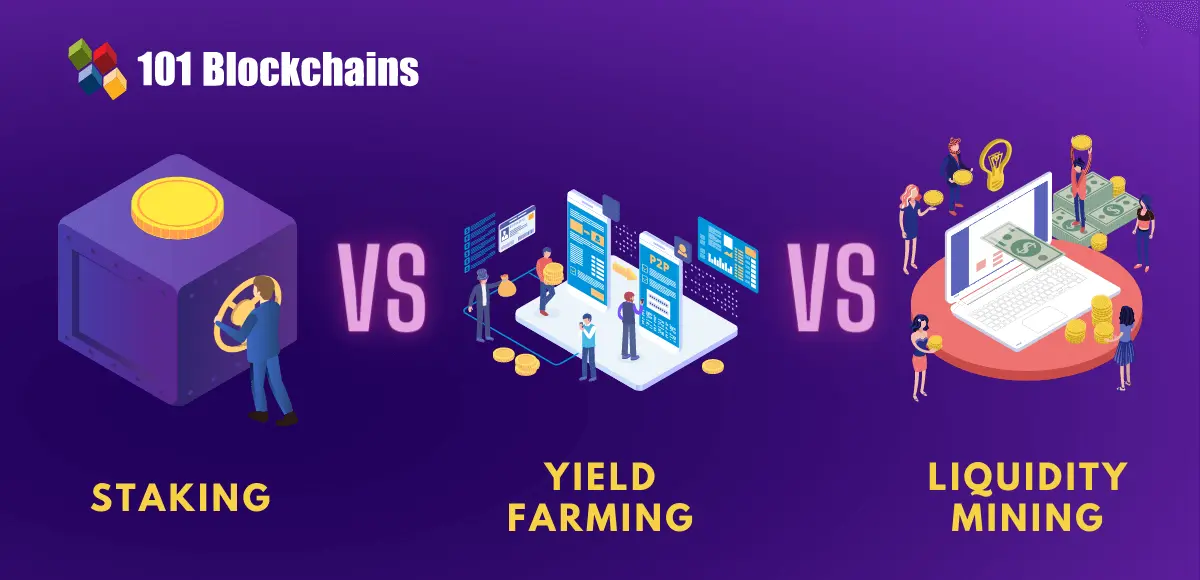
Staking Vs. Yield Farming Vs. Liquidity Mining – Key Differences
The DeFi space is growing, and there is no reason to deny it. Enterprises and individuals want to capitalize on the benefits of decentralized finance with the newly emerging solutions. Decentralized finance has not only opened up the possibilities for improved financial inclusion throughout the world but also strengthened the possibilities for using and managing digital assets.
The most notable factor which comes up in discussions about DeFi trading would refer to the staking vs. yield farming vs. liquidity mining differences.
All three of them are popular solutions in the domain of DeFi for obtaining plausible returns on crypto assets.
The three approaches differ in the way participants have to pledge their crypto assets in decentralized protocols or applications.
In addition, the underlying technologies also provide further indications of differences between staking and the other two approaches.
Understanding Yield Farming
The first thing that you should take into account about yield farming is its definition. Yield generation is a popular approach for obtaining returns on crypto assets.
Basically, it offers a flexible approach for earning passive income through depositing crypto assets in a liquidity pool.
The liquidity pools in the case of yield farming could refer to bank accounts in the conventional sense.
Yield generation is the practice that involves investors locking in their crypto assets in liquidity pools based on smart contracts.
The assets locked in the liquidity pools are available for other users to borrow in the same protocol.
Yield farming is a crucial aspect of the DeFi ecosystem as it supports the foundation of DeFi protocols for enabling exchange and lending services.
It is also essential for maintaining the liquidity of crypto assets on different decentralized exchanges or DEXs.
Yield farmers could also earn rewards in the form of APY.
Working of Yield Generation
In order to develop a better impression of yield generation in staking vs. yield farming vs. liquidity mining, it is important to understand how to yield generation works. First of all, it is important to note that Automated Market Makers or AMMs are responsible for yield farming.
AMMs are just smart contracts that leverage mathematical algorithms for enabling digital asset trading.
Automated Market Makers play a highly critical role in yield farming for maintaining consistent liquidity as the transactions do not need any counterparties for the transaction.
You could find two distinct components in AMMs such as liquidity pools and liquidity providers.
Liquidity pools are basically the smart contracts that drive the DeFi ecosystem. The pools include digital assets which can help users in purchasing, selling, borrowing, lending, and swapping tokens.
Liquidity providers are the users or investors who have locked their assets in the liquidity pool.
Yield farming also offers a plausible foundation for easier trading of tokens with low trading volume in the open market.
Risks in Yield Farming
The understanding of staking vs. yield farming vs. liquidity mining can only get better with an awareness of risks with each.
It is important to note that yield generation offers high risk and high reward ventures for investment.
The notable risks with yield farming include impermanent loss, smart contract risk, composability risk, and liquidation risk.
Understanding Staking
The second important entry in a debate on staking vs. yield farming vs. liquidity mining would obviously bring another notable and common consensus algorithm. Staking is basically an interesting way of pledging crypto assets as collateral in the case of blockchain networks leveraging the Proof-of-Stake algorithm. Just like miners use computational power for achieving consensus in Proof-of-Work blockchains, users with the highest stakes are selected for validating transactions on the PoS blockchains.
Working of the Proof of Stake Consensus
You might be wondering about the potential rewards for staking your crypto assets in a PoS blockchain-based DeFi protocol. First of all, you are investing in a highly scalable blockchain consensus algorithm with staking, which also ensures improved energy efficiency. Proof-of-Stake algorithms also create new avenues of opportunities for earning rewards.
With higher stakes in the protocol, investors could get better rewards from the network. It is important to note that rewards in the case of staking are allocated on-chain. Therefore, new tokens of the cryptocurrency are minted and distributed as staking rewards for the validation of each block. PoS blockchain does not imply the need for expensive computational equipment, thereby providing better usability.
Risks in Staking
The risks associated with Proof-of-Stake protocols are also another highlight in discussions on staking vs. yield farming vs. liquidity mining.
Interestingly, the aspect of risk is considerably lower in the case of staking when compared to other approaches for passive investment. You should note that the safety of the staked tokens depends directly on the safety of the protocol.
At the same time, you would still notice some prominent risks in staking cryptocurrencies, such as slashing, volatility risks, validator risks, and server risks. In addition, you might have to encounter issues of loss or theft of funds, waiting periods for rewards, project failure, liquidity risks, minimum holdings, and extended lock-up periods.
Understanding Liquidity Mining
The final entry in the staking vs. yield farming vs. liquidity mining also deserves adequate attention when it comes to discussions on DeFi. As a matter of fact, liquidity mining serves as the core highlight in any DeFi project. Furthermore, it also focuses on offering improved liquidity in the DeFi protocols.
Participants have to offer their crypto assets to liquidity pools in DeFi protocols for the purpose of crypto trading. However, it is important to note that participants do not offer crypto assets into liquidity pools for crypto lending and borrowing in the case of liquidity mining. Investors place their crypto assets in trading pairs such as ETH/USDT, and the protocol offers a Liquidity Provider or LP token to them.
Working of Liquidity Mining
A deeper understanding of how liquidity mining works can help in anticipating its differences with the other strategies for crypto investment.
The investors would receive rewards from the protocol for the tokens they place in the liquidity pool.
The rewards in liquidity mining are in the form of native governance tokens, which are mined at every block.
In addition, investors also have the LP token from the first stage of locking their crypto assets into the liquidity pool.
It is important to note that the reward in liquidity mining depends profoundly on the share in total pool liquidity.
Furthermore, the newly minted tokens could also offer access to governance of a project alongside prospects for exchanging to obtain other cryptocurrencies or better rewards.
Risks in Liquidity Mining
The understanding of staking vs. yield farming vs. liquidity mining would be complete with an impression of their risks.
Just like the other two approaches, liquidity mining also presents some notable risks such as impermanent loss, smart contract risks, and project risks. In addition, liquidity miners are also vulnerable to the rug pull effect in their projects.
Staking vs. Yield Farming vs. Liquidity Mining – Key Differences
Staking vs Yield Farming vs Liquidity Mining
The differences between the three players in staking vs. yield farming vs. liquidity mining would refer directly to some key pointers. Here are some of them outlined in brief for your understanding.
Yield farming is a proven approach for investing your crypto assets in liquidity pools of protocols.
Staking involves locking your crypto assets in the protocol in return for privileges to validate transactions on the protocol.
Liquidity mining involves locking in crypto assets in protocols in return for governance privileges in the protocol.
In terms of objectives, yield farming aims to offer you the highest possible returns on the crypto assets of users. On the other hand, liquidity mining focuses on improving liquidity of a DeFi protocol. Furthermore, staking emphasizes maintaining the security of a blockchain network.
Bottom Line
On a concluding note, it is quite clear that staking as well as yield generation and liquidity miners provide distinct approaches for investing crypto assets.
The growing attention towards crypto assets is undoubtedly opening up many new opportunities for investors.
However, investors need to understand the strategies they need to follow for the type of returns they are expecting.
Therefore, a clear impression of staking vs. yield farming vs. liquidity mining differences could help in making a plausible decision.
Yield generation, liquidity mining, and Proof-of-Stake blockchains also have some setbacks you should look for.
Start discovering more about yield farming and the other two crypto investment strategies now.
*Disclaimer: The article should not be taken as, and is not intended to provide any investment advice. Claims made in this article do not constitute investment advice and should not be taken as such. 101 Blockchains shall not be responsible for any loss sustained by any person who relies on this article. Do your own research!
In a first, Bitcoin developers have done something amazing amid the criticism over the lightning network and issues associated with it. A team of developers has made an international payment using the radio … Continue reading International payment using the radio waves→
My inspiration for this page was given to me by my new aquired friend, a fellow Truth Seeker – Joris and to whom I dedicate this page… Wish you… as well as to … Continue reading Discipline Quotes→
Bitcoin white paper turns 15 and the Legacy of Satoshi Nakamoto lives on. “I’ve been working on a new electronic cash system that’s fully peer-to-peer, with no trusted third party,” Satoshi Oct. 31, … Continue reading Bitcoin White Paper turn 15→
CoinMarketCap.com is LYING to everyone while profiting from it
CoinMarketCap.com, the Number 1 website in the crypto-currency industry, is showing immensely fraudulent and scam information (on purpose) to its users. As a site that is used frequently for reference points by many news organisations, trading outlets, companies, informational sites and individuals, it would be in the best interest of the community to write about what has been really going on with this “trusted resource”.
The research indicates that multiple attempts to fix information by many coins on CoinMarketCap.com through contacting them through their support requests or online social media sites such as BitcoinTalk.org, reddit.com and other places has gone unanswered, ignored and/or explicitly overlooked/denied. By explicitly overlooked/denied, after contacting their support with up-to date and obviously correct information, they refuse to update the data. Many hundreds of coins on CMC are affected very negatively (or positively) by this. A lot of them have given up trying to get CMC to put correct data on their site, and have made sticky posts in their own respective forums as to this issue instead.
It is believed that there is massive insider trading going on with the employees, owners and others involved with CoinMarketCap. The research, including talking to multiple coin creators, shows anomalous buying of coins between times that the coin creators asked CMC to list their coin (through their google form) and between when it actually gets listed on the site. This could mean that CMC insiders know that certain coins will pump, and go on a buying spree to front-run the listing of the coin and the public market sentiment. This can be seen over and over again when analysing the action on coins when being listed.
Pump and dumps are also being actively allowed and managed by the team at CMC without the knowledge of the coin creators or coin communities themselves. This can be seen by the direct manipulation of the circulating supply of some coins. CMC puts the circulating supply as very high at certain points (increasing the market cap), then drops it down to a much lower number later (lowering the market cap). This moves these coins up or down their numbered list causing massive buys and sell offs at the whim of CMC. Luckily this fraud can only be made to happen once or twice with each coin as the public outcry from the coin communities (sometimes) usually puts an end to it one way or other.
There is also evidence of CoinMarketCap effectively “killing” off coins as it sees fit. How does it “kill” a coin? Well it removes it’s circulating supply to “?” or a very low number arbitrarily, and keeps it there for a prolonged period. As the coin goes lower and lower in the rankings, daily volume on the coin dies off until such a time that it is zero (even though the teams behind the coins are still active and growing their ecosystems). This leads to exchanges delisting the coin, and the ecosystem being entirely dead after a period of time. There is plenty of evidence of coin communities complaining and coin creators “begging” CMC to update their information with no luck. CMC literally decides which coin lives or dies with it’s own agendas. In defence of CMC, some coins do lose their circulating supply due to faults of the coins (the data end-points for circulating supply stop working on the servers provided initially by the coins), but many are brought down even with the objections and outcry of the coin creators and communities behind them.
Also of concern is the possible bribery of CMC officials and other nefarious behaviors that could very obviously be extrapolated from their current actions. What if one coin paid a handsome sum to CMC to make sure a “competitor” would have lower market cap? How do you make them have a lower market cap? Easy, refuse to update the circulating supply to what the real numbers are and instead show an arbitrary number of their choosing. This can also be seen on many of the coins listed on CMC. There is ample evidence of coins complaining publicly on many forums yet CMC taking it’s own numbers without any explanation or acknowledgement.
Another area of concern is the outdated/incorrect information of many of the coins listed on CMC. Official coin links being broken or unresponsive, including the main websites, wrong daily volumes (not updated in days or weeks), and hugely different circulating supplies (from those you can officially see on the respective blockchains of the coins themselves) are just some of the additional problems that ring alarm bells with us.
Because of these issues, (and many others including the pseudonymousnature of the founders and team members) we believe it is in the best interest of the entire community to get behind this initiative and make big noise until such a time that CoinMarketCap updates their site to show correct information, or another resource is created/promoted that shows correct and up-to date data on their website. Number 1 can go down to Number 0 very quickly in the space with the right community backlash.
Some may say that these issues may be due to incompetence of the team at CMC or them having limited resources. One of the parts of our analysis will take a much closer look at what kind of income CoinMarketCap really makes. You would be surprised. CMC is one of the most profitable businesses in the entire industry. The user is the product. The ads are the money maker. There are backroom deals, and much more happening beyond the scenes that the public does not know.
Most people here are concerned about centralised mining cartels, hardware producers, banks, governments, regulators and/or core developers being points of issues in this industry. We strongly believe that none of those come even close to comparing to the obvious fraud that has been going on at CoinMarketCap for many years.
The volume of money that is traded on information taken from CMC alone pales every other issue into oblivion. If traders are making buys and sells according to falsified data on CoinMarketCap.com, then they are being manipulated and lied to in one of the biggest frauds in the entire crypto-currency space.
You will be shocked at the level of incompetence, negligence, fraud, and outright lying that CMC perpetuates, but at the lack of information about this so far in this industry. For a community that prides itself on self-regulation through transparency and openness, it should be ashamed at not having blown this massive fraud into the public eye much sooner.
We owe it to the community to make sure resources (especially the Number 1 site in the industry) are not being placed in positions to freely commit fraudon this scale ever again.
This has been a very intense effort in data gathering, reporting and analysis.







 BitHouse