


THE CYPHERPUNK MOVEMENT
Let’s make a journey back in time to see where blockchain technology and cryptocurrencies came from. It will take us back to the CypherPunk Movement starting in the 1970’s.
Cryptography for the People
Encryption was primarily used for military purposes before the 1970s. People at that time were living in an analog world. Few had computers and even fewer could imagine a technology that would connect almost every human being on the planet – the internet.
Two publications brought cryptography into the open, namely the “Data Encryption Standard” published by the US Government, and a paper called “New Directions in Cryptography” by Dr. Whitfield Diffie and Dr. Martin Hellman, published in 1976.
Dr. David Chaum started writing on topics such as anonymous digital cash and pseudonymous reputation systems in the 1980s, such as the ones described in “Security without Identification: Transaction Systems to make Big Brother Obsolete”. This was the first step toward the digital currencies we see today.
The Cypherpunks

Hughes, May, Back, Finney, Gilmore, Szabo
It wasn’t until 1992 that a group of cryptographers in the San Francisco Bay area started meeting up on a regular basis to discuss their work and related ideas. They built a basis for years of cryptographic research to come.
Besides their regular meetings, they also started the Cypherpunk mailing list in which they discussed many ideas including those which led to the birth of Bitcoin.
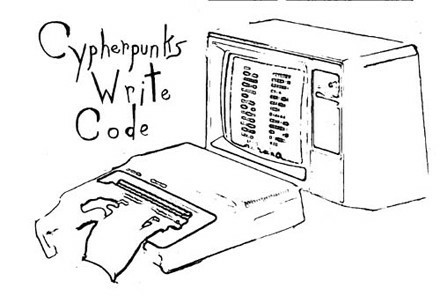
In late 1992 Eric Hughes, one of the first cypherpunks, wrote “A Cypherpunk’s Manifesto” laying out the ideals and vision of the movement.
Note: We encourage you to read A Cypherpunk’s Manifesto. The Manifesto is just as relevant today as it was in 1992. This short read takes only a few minutes of your time. It’s astonishing to see how much foresight the early members had when most people didn’t even think about computers yet.
A Cypherpunks’s Manifesto
An excerpt from the Manifesto:
“Privacy is necessary for an open society in the electronic age.
Privacy is not secrecy.
A private matter is something one doesn’t want the whole world to know, but a secret matter is something one doesn’t want anybody to know.
Privacy is the power to selectively reveal oneself to the world.”
“Privacy in an open society also requires cryptography.
If I say something, I want it heard only by those for whom I intend it.
If the content of my speech is available to the world, I have no privacy.
To encrypt is to indicate the desire for privacy, and to encrypt with weak cryptography is to indicate not too much desire for privacy.”
“We must defend our own privacy if we expect to have any.
We must come together and create systems which allow anonymous transactions to take place.
People have been defending their own privacy for centuries with whispers, darkness, envelopes, closed doors, secret handshakes, and couriers.
The technologies of the past did not allow for strong privacy, but electronic technologies do.”
“We the Cypherpunks are dedicated to building anonymous systems.
We are defending our privacy with cryptography, with anonymous mail forwarding systems, with digital signatures, and with electronic money.”
Electronic Cash
Although you might have just heard about this movement for the first time, you have most definitely benefitted from the efforts of some of their members in building Tor, BitTorrent, SSL, and PGP encryption. It should not surprise you that many concepts and ideas that originated from this group led to the emergence of cryptocurrencies.
In 1997, Dr. Adam Back created HashCash, which he proposed as a measure against spam. A little later, in 1998, Wei Dai published his idea for b-money and conceived the ideas of Proof-of-Work and Proof-of-Stake to achieve consensus across a distributed network. In 2005 Nick Szabo published a proposal for Bit Gold. There was no cap on the maximum supply but he introduced the idea to value each unit of Bit Gold by the amount of computational work that went into producing it. Although this is not how cryptocurrencies are valued, the price of production (comprised of hardware and electricity cost) plays a role in the pricing of these digital assets.
In 2008, Satoshi Nakamoto released the Bitcoin white paper, citing and building upon HashCash and b-money. Citations from his early communications and parts of his white paper, such as the following on privacy, suggest Nakamoto was close to the cypherpunk movement.
“The traditional banking model achieves a level of privacy by limiting access to information to the parties involved and the trusted third party. The necessity to announce all transactions publicly precludes this method, but privacy can still be maintained by breaking the flow of information in another place: by keeping public keys anonymous. The public can see that someone is sending an amount to someone else, but without information linking the transaction to anyone. This is similar to the level of information released by stock exchanges, where the time and size of individual trades, the ‘tape’, is made public, but without telling who the parties were.”
Technology did not enable strong privacy prior to the 20th century, but neither did it enable affordable mass surveillance. We believe in the human right to privacy and work towards enabling anyone who wishes to claim his or her privacy to do so. We see a cryptocurrency with selective privacy as a good step in the right direction of reclaiming our privacy.

- International payment using the radio waves
 In a first, Bitcoin developers have done something amazing amid the criticism over the lightning network and issues associated with it. A team of developers has made an international payment using the radio … Continue reading International payment using the radio waves
 - Happy New Year !!!!Happy New Year!May the coming year be full of grand adventures , peace, prosperity and opportunities.Dream big and make the most of 2024!
- Discipline Quotes
 My inspiration for this page was given to me by my new aquired friend, a fellow Truth Seeker – Joris and to whom I dedicate this page… Wish you… as well as to … Continue reading Discipline Quotes
 - Merry Christmass and A Happpy New Year to all
 To all my readers from the bottom of my heart I wish you Happy Holiday among family and friends, a jolly Merry Christmas and a Happy New Year and may 2024 bring you … Continue reading Merry Christmass and A Happpy New Year to all
 - Bitcoin White Paper turn 15
 Bitcoin white paper turns 15 and the Legacy of Satoshi Nakamoto lives on. “I’ve been working on a new electronic cash system that’s fully peer-to-peer, with no trusted third party,” Satoshi Oct. 31, … Continue reading Bitcoin White Paper turn 15




 BitHouse