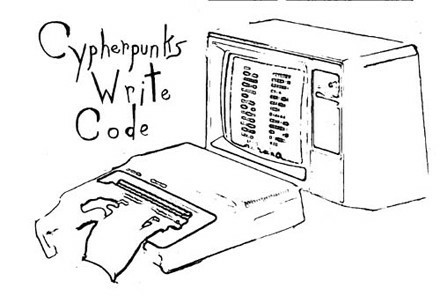
CypherPunk Movement

THE CYPHERPUNK MOVEMENT

Let’s make a journey back in time to see where blockchain technology and cryptocurrencies came from. It will take us back to the CypherPunk Movement starting in the 1970’s.

Cryptography for the People

Encryption was primarily used for military purposes before the 1970s. People at that time were living in an analog world. Few had computers and even fewer could imagine a technology that would connect almost every human being on the planet – the internet.

Two publications brought cryptography into the open, namely the “Data Encryption Standard” published by the US Government, and a paper called “New Directions in Cryptography” by Dr. Whitfield Diffie and Dr. Martin Hellman, published in 1976.

Dr. David Chaum started writing on topics such as anonymous digital cash and pseudonymous reputation systems in the 1980s, such as the ones described in “Security without Identification: Transaction Systems to make Big Brother Obsolete”. This was the first step toward the digital currencies we see today.

The Cypherpunks

We walk on shoulders of Giants!
Hughes, May, Back, Finney, Gilmore, Szabo

It wasn’t until 1992 that a group of cryptographers in the San Francisco Bay area started meeting up on a regular basis to discuss their work and related ideas. They built a basis for years of cryptographic research to come.

Besides their regular meetings, they also started the Cypherpunk mailing list in which they discussed many ideas including those which led to the birth of Bitcoin.

In late 1992 Eric Hughes, one of the first cypherpunks, wrote “A Cypherpunk’s Manifesto” laying out the ideals and vision of the movement.

Note: We encourage you to read A Cypherpunk’s Manifesto. The Manifesto is just as relevant today as it was in 1992. This short read takes only a few minutes of your time. It’s astonishing to see how much foresight the early members had when most people didn’t even think about computers yet.


A Cypherpunks’s Manifesto

An excerpt from the Manifesto:

“Privacy is necessary for an open society in the electronic age.

Privacy is not secrecy.

A private matter is something one doesn’t want the whole world to know, but a secret matter is something one doesn’t want anybody to know.

Privacy is the power to selectively reveal oneself to the world.”

“Privacy in an open society also requires cryptography.

If I say something, I want it heard only by those for whom I intend it.

If the content of my speech is available to the world, I have no privacy.

To encrypt is to indicate the desire for privacy, and to encrypt with weak cryptography is to indicate not too much desire for privacy.”

“We must defend our own privacy if we expect to have any.

We must come together and create systems which allow anonymous transactions to take place.

People have been defending their own privacy for centuries with whispers, darkness, envelopes, closed doors, secret handshakes, and couriers.

The technologies of the past did not allow for strong privacy, but electronic technologies do.”

“We the Cypherpunks are dedicated to building anonymous systems.

We are defending our privacy with cryptography, with anonymous mail forwarding systems, with digital signatures, and with electronic money.”


Electronic Cash

Although you might have just heard about this movement for the first time, you have most definitely benefitted from the efforts of some of their members in building Tor, BitTorrent, SSL, and PGP encryption. It should not surprise you that many concepts and ideas that originated from this group led to the emergence of cryptocurrencies.

In 1997, Dr. Adam Back created HashCash, which he proposed as a measure against spam. A little later, in 1998, Wei Dai published his idea for b-money and conceived the ideas of Proof-of-Work and Proof-of-Stake to achieve consensus across a distributed network. In 2005 Nick Szabo published a proposal for Bit Gold. There was no cap on the maximum supply but he introduced the idea to value each unit of Bit Gold by the amount of computational work that went into producing it. Although this is not how cryptocurrencies are valued, the price of production (comprised of hardware and electricity cost) plays a role in the pricing of these digital assets.

In 2008, Satoshi Nakamoto released the Bitcoin white paper, citing and building upon HashCash and b-money. Citations from his early communications and parts of his white paper, such as the following on privacy, suggest Nakamoto was close to the cypherpunk movement.

“The traditional banking model achieves a level of privacy by limiting access to information to the parties involved and the trusted third party. The necessity to announce all transactions publicly precludes this method, but privacy can still be maintained by breaking the flow of information in another place: by keeping public keys anonymous. The public can see that someone is sending an amount to someone else, but without information linking the transaction to anyone. This is similar to the level of information released by stock exchanges, where the time and size of individual trades, the ‘tape’, is made public, but without telling who the parties were.”

Technology did not enable strong privacy prior to the 20th century, but neither did it enable affordable mass surveillance. We believe in the human right to privacy and work towards enabling anyone who wishes to claim his or her privacy to do so. We see a cryptocurrency with selective privacy as a good step in the right direction of reclaiming our privacy.


Beware of Scams !!!

Beware !!!

Just as the crypto industry is expanding and getting local adoption from individuals, co-operations, organisations and few countries  the same rate at which we have crypto enthusiast increasing in number which i see so worrisome and also a call for major concern.

Reason been that as more people get involved in the crypto business the more scammers are likely to increase their technique and the more scammers get recruited.

To avoid walking on scammers path, requires to be well informed of every new technique they can ever deploy against their potential victim.


To stay off scammers path users must:


  • Avoid phishing links.
  • Make sure to pay attention to the spelling of the website, as well as their URL as this can reveal whether it is a phishing site or not.
  • Never invest in a project without a well structured community
  • Pay close attention to the engagement within the community for suspicious activities
  • Ensure you assets are off CEX
  • Be more smart and less greedy
  • Don’t jump into a project/coin only based on the hype from advertisers (especially twitter)
  • Avoid any “too good to be true” investment
  • Avoid send me 1$ and I’ll send back 2$ scams, no matter how reputable is the account calling for that
  • Protect your coins (keep your coins on your wallet, use hardware wallet where possible, never give out wallet’s seed, keep backup seed offline)
  • Don’t be greedy and/or illiterate.
  • Be sure to feed yourself with necessary knowledge, if you want to invest.
  • Knowledge from experience is good but you can also take legitimate one from other people.
  • Not everything that is being offered to you is true. Do not be deceived.
  • Be careful who you are trusting.
  • Always be skeptical !!!
  • Enable Two-factor authentication for all your accounts.
  • Using of firewalls.
  • Installing an up to date anti virus software.
  • Use strong passwords and yet easily accessible ones for your convenience.
  • Stay away from malicious links or attachments you come across on the web.
  • Make sure your private keys are well stored and in hard wallet
  • Make sure your passwords are not vulnerable online to attacks i.e don’t store passwords online or any website
  • Whenever a stranger message you first for a business or an investment, it is a Red flag.
  • Someone who doesn’t know you would want you to make big money, another Red flag.
  • Whenever they introduce a” business opportunity” to you and then hasten you in order make you take a hasty decision it’s not  genuine, they are trying their best to make you take a fast decision without telling your loved ones and friends who will discourage you.
  • It is safer to  assume anyone you don’t know, communicating with you is a scammer until it is proven otherwise.
  • Read the whitepaper and research well of the company where you are going to invest because many scams are done by this method.
  • Check whether it is genuine or fake.
  • Scammers are constantly upgrading their scam methods and anyone can be the next target.
  • Loss doesn’t just happen due to an internal or intentional mistake, and when it does happen everyone has a similar sense of remorse and risks that are absolute consequences.
  • You’ll be fooled many times by those scammers that have maintained a well structured fake community.
  • They can hire those PRs and people talking inside their community to make it look like they’re a legit community.
  • As for their workers, they’ll just tell that they need engagement but the purpose of it, they’re not talking about it because that’s what the main purpose it.
  • And that’s to make it look genuine that they have real people inside the community. But in reality, it’s all fake people that they’ve hired just to make discussions all over their place.
  • It’s safe to say as well that it’s not just the crypto industry that is not safe for newbies, everything that talks about money is not safe for everyone.
  • Crypto is the latest thing and in the last 5 years it become so successful that scammers make this as their paradise as there are a lot of naive investors in the market.
  • Do your investigations, and don’t listen to influencers and believe them.
  • Think that this is your hard earn money so you need to be careful where you are going to invest it.
  • Don’t be Greedy.
  • Don’t jump on it like a hungry cow.
  • Don’t trust the sweet words they offer you. Most of them are too good to be true but they will always sound inviting to invest with.
  • Make a wall to not fully support them unless they have proven themselves worthy of that kind of respect.
  • Always be in doubt. That will be the shield that will protect you from being scammed.
  • Must simply assume that our coins are never really safe despite our best efforts, so it is important to always be on alert and protect our coins to the best of our ability.
  • Improve the security of your coins by an important margin by buying a hardware wallet, since they are very secure devices and they are relatively cheap, instead of risking storing our coins in our computers or at an exchange.
  • Always good to know how to make technical and fundamental analysis so that you can get specific information what is the situation of the projects you want to invest
  • Many projects are delivering a good testament, but they always ended into a scam , so we need to be smart enough and have a lot of preparation before investing or trading


Controlled Supply

Bitcoin

“A fixed money supply, or a supply altered only in accord with objective and calculable criteria, is a necessary condition to a meaningful just price of money.”

Fr. Bernard W. Dempsey, S.J. (1903-1960)

In a centralized economy, currency is issued by a central bank at a rate that is supposed to match the growth of the amount of goods that are exchanged so that these goods can be traded with stable prices. The monetary base is controlled by a central bank. In the United States, the Fed increases the monetary base by issuing currency, increasing the amount banks have on reserve or by a process called Quantitative Easing.

In a fully decentralized monetary system, there is no central authority that regulates the monetary base. Instead, currency is created by the nodes of a peer-to-peer network.

The Bitcoin generation algorithm defines, in advance, how currency will be created and at what rate. Any currency that is generated by a malicious user that does not follow the rules will be rejected by the network and thus is worthless.


Currency with Finite Supply


Block reward halving
Controlled supply

Bitcoins are created each time a user discovers a new block. The rate of block creation is adjusted every 2016 blocks to aim for a constant two week adjustment period (equivalent to 6 per hour.)

The number of bitcoins generated per block is set to decrease geometrically, with a 50% reduction every 210,000 blocks, or approximately four years. The result is that the number of bitcoins in existence will not exceed slightly less than 21 million.

Speculated justifications for the unintuitive value “21 million” are that it matches a 4-year reward halving schedule; or the ultimate total number of Satoshis that will be mined is close to the maximum capacity of a 64-bit floating point number. Satoshi has never really justified or explained many of these constants.

Cumulated bitcoin supply

This decreasing-supply algorithm was chosen because it approximates the rate at which commodities like gold are mined. Users who use their computers to perform calculations to try and discover a block are thus called Miners.


Motivation Formula

Motivation = (Expectancy X Value) / (Impulsiveness X Delay)
  • Expectancy : How likely you feel you’ll succeed
  • Value : What you’ll gain from succeeding
  • Impulsiveness : Your natural inclination to put things off
  • Delay : How much time you have to complete the task

Add it up, and the result is your current level of motivation. 

The less confident you are, the less exciting the outcome, the longer you have to get it done … the more likely you are to put it off.


21M or Death


21 Million or Death
Arise…

The supply of Bitcoin is fixed at 21 million BTC, and as a hard coded monetary policy of the protocol, the fixed supply of the dominant cryptocurrency cannot be altered.

Former Google Product Director Steve Lee stated that only 1 percent of the world’s population can own more than 0.28 BTC, due to the fixed supply of Bitcoin.

In late 2017, Chainalysis, a blockchain forensics company that monitors and investigates cryptocurrency transactions, revealed in a research paper that up to four million BTC are permanently lost on the blockchain as a result of theft, loss of wallets and private keys, and the dormant wallet of Bitcoin creator Satoshi Nakamoto, which experts have said is no longer accessible.

Kim Grauer, Senior Economist at Chainalysis, said at the time, that the lost supply of BTC is not taken into consideration by the market cap.That means, the real price of BTC could be substantially higher, as 4 to 6 million BTC are estimated to be lost.

Based on the estimate that the supply of Bitcoin is around 17 million, only 0.8 percent of the world population can own more than 0.28 BTC and less than 0.2 of the world population can own more than 1 BTC.

The 0.28 BTC figure introduced by Lee assumes the supply of Bitcoin to be 21 million, as it divides 21 million by 0.28 and divides the outcome of that by the world population that is 7.442 billion. If the research of Chainalysis is accurate and that 4 to 6 million BTC are lost on the blockchain, the supply of Bitcoin should be closer to around 16 to 17 million

The fact that any investor in the global market can be within the 1 percent of the world population with a $1,830 investment demonstrates that the cryptocurrency market is still at its early phase, and in terms of adoption, market development, infrastructure, and regulation, the sector can still grow significantly in the mid to long-term.


Hal Finney

There is no “Whole Coin”