The monetary properties of Bitcoin


bitcoin vs gold

bitcoin vs fiat

Bitcoin is a monetary good โ€” a new form of money. As Bitcoin is a money, it must be compared to other monies to consider the comparative advantages of Bitcoin and from that consider further the probabilities of Bitcoin winning ground or not in the competition between monies.

Brief summarization of the monetary properties

Summarization of the monetary properties of Bitcoin compared to precious metals and fiat currencies

As the exhibit above showcases, Bitcoin offers many different distinct and compelling competitive advantages to the alternatives.

These include, but are not limited to:

1. Bitcoin is the first asset in the human history to provide any holder a very sure case of unseizability and censorship- and judgment-resistance for their funds.

โ—ฆ Unseizability: With precious metals and fiat currencies, the custodianship is mostly in the hands of trusted custodians that is subject to any intervention by a government or authority.

Bitcoin, with self-custody being orders of magnitude easier than with precious metals and fiat currencies, and access to the corresponding private key of funds being the sole way to access and move funds, no one can seize your bitcoins.

โ—ฆ Censorship- and judgment resistance: With precious metals and fiat currencies, the payment clearing for small value transactions can with not much hassle be somewhat censorship resistant if the involved parties are willing to transact in the physical units of precious metals and fiat currencies and to self-custody the funds going forward.

However, with non-small value transactions it is exceedingly inconvenient and costly for transactions of precious metals and fiat currencies to happen in the offline, with physical units and self-custody going forward, leaving the centralized intermediaries as the only option and these are subject to any intervention by a government or authority.

Bitcoin, with the payment clearing involving no centralized intermediaries but instead a decentralized and distributed setup requiring no AML/KYC, the result is that of a the payment clearing process being permissionless, allowing anyone with cryptographic access to funds to move them at their will.

2. Bitcoin provides an inherently apolitical global monetary unit. It is truly border-less, with no recognition of any jurisdictional rules and laws, allowing the jurisdiction of a counterpart in any transaction to be of no relevance.

โ—ฆ Fiat currencies are highly political and precious metals are less political than fiat currencies, but still much more political than Bitcoin.

โ—ฆ Bitcoin is truly border-less: any bitcoin funds can be accessed anywhere on the planet by having access to information that can even be stored inside a human brain and reliably retrieved at small effort โ€” and, crucially, with no intermediary and no permission required the bitcoin funds can be moved to anywhere in the world with final settlement in the next block.

3. Bitcoin provides scarcity and salability through time characteristics vastly superior to any other monetary options, including fiat currencies and precious metals.

โ—ฆ The non-discretionary monetary policy of the bitcoin networking allowing for the asymptotic money supply* of 21 million BTC is built into the literal definition of the protocol. This is a drastic contrast to the arbitrary scarcity of fiat currencies governed by politics.

The scarcity of precious metals is much better than fiat currencies, but Bitcoin with the strictly fixed money supply outperforms any precious metal.

Bitcoin provides any holder a reassurance stronger than any other asset in the world that their ownership stake in the total quantity of Bitcoin on the market will never diluted.

One BTC of 21 million will always be one BTC of 21 million.

โ—ฆ Bitcoins are infinitely durable, impossible to counterfeit or dilute, can be stored at no cost and at no degradation.


* By inventing Bitcoin, Satoshi Nakamoto created the first example of a digital good (in this case, monetary good) that is impossible to reproduce ad infinitum, thereby creating the first instance of human history of digital scarcity.

Less talked about it, but perhaps more important, Satoshi Nakamoto with Bitcoin also created the first example of a good being absolute scarce.

Previously, any consideration of scarcity of a good was relative. Any physical good is never absolutely scarce, onlyrelatively scarce when compared to other goods โ€” simply because any limit on a physical goods is a function of the time and human effort put towards producing the good.

Bitcoin, with the asymptotic monetary supply built into the protocol, is therefore the first example of absolute scarcity in a liquid commodity and good that cannot have its fixed quantity of supply increased.


People’s Money

Power to the People

The seed has been planted
Make it Thrive !!!

Choose

Veritas non Auctoritas …

Choose Wisely


Sapere Aude


Etymology

It is from the epithet of a parable, explaining that a fool waits for the stream to stop before crossing, while a wise man forgoes comfort and crosses anyway.

The original use seems to be in Epistle II  of  Horace‘s Epistularum liber primus:

“Dimidium facti qui coepit habet: sapere aude” (“He who has begun is half done: dare to know!”).


Phrase

sapere audฤ“

  1. Have the courage to think for yourself
  2. Have courage to use your own reason“, in the context of committing to tasks that need to be embarked upon, however unpleasant or awkward.
  3. “Dare to be wise”, the motto of the Enlightenment.

Usage notes

Kant answers the question in the first sentence of the essay: “Enlightenment is man’s emergence from his self-incurred immaturity (Unmรผndigkeit).”

He argues that the immaturity is self-inflicted not from a lack of understanding, but from the lack of courage to use one’s reason, intellect, and wisdom without the guidance of another.

Kant argued that using one’s reason is considered dangerous by most men and all women.

He exclaims that the motto of the Enlightenment is “Sapere aude“! โ€“ Dare to be wise!

“Enlightenment is man’s release from his self-incurred tutelage.

Tutelage is man’s inability to make use of his understanding without direction from another.

Self-incurred is this tutelage when its cause lies not in lack of reason but in lack of resolution and courage to use it without direction from another.

Sapere Aude!

‘Have courage to use your own reason!’- that is the motto of enlightenment.”

Immanuel Kant


Source:

https://wikipedia.org/


Knowledge is…


Knowledge is Power !!!


WRONG !!!

Knowledge is Power
When Applied !!!


Apollo BTC – A Bitcoin ASIC Miner and Desktop Class Computer running a Full Node

Introducing the FutureBit Apollo BTC

Six CPU Cores. 44 ASIC Cores. 1TB NVMe Based SSD Drive. Quiet. Less than 200 Watts of Power. Made in the USA. This is what the Future of Bitcoin looks like. 

FutureBit Apollo BTC is the world’s first vertically integrated platform bringing the full power of Bitcoin and itโ€™s mining infrastructure in a small, quiet, easy to use desktop device designed for everyday people. 

We have iterated and learned much from our first Apollo product. We realized early on that we focused too much on the mining aspect, and not enough on the software, applications, and services that run Bitcoin. Too many of these services have moved to online centralized websites, and many users have given up on running the core software that powers Bitcoin. 

This must change, as Bitcoin will not continue to be the free, un-censorable, decentralized system it is today if only a few control the mining that powers it, and the nodes that control it. 

At the heart of the new Apollo BTC product is a revamped SBC (Single Board Computer), that is as powerful as any consumer grade desktop system and can run almost any Bitcoin Application natively on the device 24/7. Take it out of the Box, plug it in, power it on, and you are already running a full Bitcoin node without needing to do anything.

Install a wallet of your choice, use any hardware wallet, run BTCPayServer, run a block explorer, run a Lightning Node. All of this is possible with our six core ARM based CPU with 4GB of RAM, and a 1TB NVMe drive that can easily store a FULL non pruned Bitcoin Node. It can power through a Full Node Sync in under 48 hours, which is a record for a device of its class! This is almost an order of magnitude faster than any Raspberry Pi 4 based Node. 

On top of this we have taken our 6 years of experience building ASIC mining devices, and engineered the only American Made TeraHash range Bitcoin mining device that can be silent on your desk, mine Bitcoin in the background 24/7, and only use the power of one light bulb to do it. 

We did this with our optimized PCB design that has carefully placed all 44 hash cores underneath our custom cold-forged aluminum induction heatsink, which draws up to 200 Watts of heat away from the device with our new nearly silent 25mm fan. This results in the Apollo BTC in Turbo Mode being just as quiet as the Apollo LTC in Eco Mode!

Like our previous products, we are super proud that we can continue manufacturing the Apollo BTC in the USA, and are now the only USA based company that delivers Bitcoin ASIC products with a supply chain whole owned in the western hemisphere (no more reliance on Chinese based ASICS, and their willingness to only sell to large farms and the highest bidder). 

OPTIONS

Full Apollo Package: This is our Full Package option that comes with everything you need in the box. The Apollo BTC Unit with our latest controller built in, and our 200W Power supply with power cable. 

Full Apollo Package NO Power Supply: We are also offering the Full Package with no power supply for people that want the plug-n-play experience but have spare 12v ATX power supply. 

Standard: This option is ONLY the Apollo ASIC Miner, with no controller or power supply. Our new hashboard has a micro USB port, and can be used as a USB device. The Full Apollo Node can control multiple standard units through its USB ports. We wanted to give our customers an option to expand their hash power in a cost effective way. If you already have a Raspberry Pi, or Linux/Windows Desktop Computer and a power supply with two PCIE power ports you can also control our Standard unit in this way with our stand alone miner software (please note this setup will be for more advanced users, and the software will be command line based on launch). 

Standard + Power Supply: Same as our Standard unit above, but comes with our 200W Power supply. This is a plug and play solution if you already have a Full Apollo Package. Take it out of the box, plug in the power supply, plug in the micro USB cable to the back of your Full Apollo BTC and it will automatically recognize the second hashboard and start mining! 

  • Compact All-In-One Desktop Bitcoin System (4x6x4in) that mines Bitcoin and any SHA256 based crypto (Bitcoin Cash etc). 
  • Powerful 6 ARM Core CPU with 4GB of LPDDR4 RAM and 1TB NVMe SSD (NOT included in the Standard or Standard + package). 
  • Comes Pre-Installed with a Bitcoin node, and you can install almost any Bitcoin Application
  • Very wide range of operation modes with preset ECO (quiet) mode, BALANCED, and TURBO mode. 
  • 2-3.8 TH/s of SHA256 performance per miner (+/- 5%)
  • 125 Watts in ECO mode, and 200 Watts in TURBO * +/- 10%
  • Can be used as a full Desktop computer with a monitor keyboard and mouse (not included), or through our Web UI
  • Connect almost any peripheral with our USB 3.0 ports, USB C port, HDMI, AC Wifi, and Bluetooth 
  • Clocks and Power is fully customizable by user with easy to use interface
  • Hashboard now monitors both voltage and power draw for accurate measurements*
  • Custom designed cold forged hexagonal pin heatsink with leading thermal performance for the quietest ASIC miner in operation!
  • 1k-5k RPM Quiet Dual Ball Bearing Fan with automatic thermal management with onboard temperature sensor
  • Controlled via local connection on a web browser similar to antminers. You can simply set it up via smartphone browser. No crazy driver installs, hard to use miner software or scripts needed.
  • Two Six Pin PCIE power connectors for wide-range of power draw
  • Custom Designed all Aluminum case
  • Ships with our own custom built 200W 94% efficient PSU and is ready to run out of the box! (Does NOT come with Standard package). 

 Requirements:

  • Router with an Ethernet cable for initial setup OR Monitor with keyboard and mouse
  • At least a 250 watt 12v power supply with two 6 Pin PCIE connector is required (unless you order our packages that come with our power supply). This is the same connector used by all modern GPUs. Please note even standard units NEED a power supply, they cant be powered through the USB port on the full package unit. 

As I am the owner of two of these beauties, that I have on my office as you saw in the photo above, I took the liberty to make Free-Publicity for the FutureBit Apollo Btc Miner.


Kudos to jstefanop


Source:

https://www.futurebit.io/


With ๐Ÿ’š

Convergence of blockchain with AI and IOT


IoT and AI are growing exponentially

Internet of Things – IoT

A future of transacting intelligent machines


โ€ข Individually, each of these technologies deserves all the attention they’re getting as enablers and disruptors

โ€ข But, taken together?

โ€ข Their transformative effect becomes multiplicative

โ€ข A future driven by machine connectivity, data exchange and commercial services:

  • IoT connects billions of machines and sensors generate unprecedented quantities of real-time data
  • AI enables the machines to act on data and trigger services
  • Blockchain functions are the transaction layer where data and service contracts are securely stored and payments for services are settled

How does blockchain support intelligent connected machines?


โ€ข Smart Contracts enable self-executing and self-enforcing contractual states

  • Custom financial instruments (tokens), records of ownership of an underlying physical asset (smart property), any
  • complex business logic that can be programmable
  • Can such applications be ideal for intelligent (AI) and connected (IoT) machines?
  • These machines are intelligent enough to negotiate contracts, but need a technology allowing them to securely sign and enforce them

โ€ข Digital currencies create new forms of money

  • Programmable and active
  • Will such money be ideal for intelligent (AI) and connected (IoT) machines?
  • These machines will need digital currency to pay for services assigned through the smart contracts

How will the three technologies work together?


IoT – Internet of Things

  • Sensors allow us to cost-effectively gather tremendous amounts of data.
  • Connectivity allows us to transmit/broadcast these data.
  • But, there is a missing element: intelligence to process these data.

AI – Artificial Intelligence

  • Intelligence at the very edges of the network (mini-brains).
  • Combine with IoT and you have the ability to recognize meaningful patterns buried in mountains of data in ways that would be impossible for most humans, or even non-AI algorithms, to do.
  • But, there is a missing element: a secure storage layer for data and a transaction layer for services

DLT (blockchain) – Distributed Ledger Technology

  • Decentralized governance, coupled with no single point of failure, disintermediation, unalterable and searchable records of events.
  • Digital currencies and tokenized custom financial instruments.
  • Combine with AI and IoT and you have a new world of autonomous systems interacting with each other, procuring services from each other and settling transactions.

The technology stack of the future


Technology Stack of the Future

Toward a world of machine commerce


A world of Machine Commerce

M2M will need SSI (self-sovereign identities) – for objects!


Human Identities types

Object identities can be SSI by default

  • Multi-source, multi-verifier
  • Digitally signed, verifiable credentials that can prove issuer, holder and status
  • Secure peer-to-peer connections (permanent or session-based)
  • Exchange full credentials, partial credentials or ZKPs derived from credentials

Next milestone: Decentralized Organizations (DOs)


DOs are good at:

  • Coordinating resources that do not know/trust each other (including hybrid
  • H/M)
  • Governing in a geography-agnostic, censorship-resistant manner
  • Enabling short-term or informal organizational structures  (networks/communities)
  • Tracking and rewarding contribution

Challenges

  • Jurisdictional issues
  • Legislating new types of work for humans and work rules for machines
  • Governance modalities, including external supervision


Challenges


New/upgraded system architectures

โ€ข From legacy to blockchain/AI/IoT-native systems
โ€ข Integration, interoperability, backward compatibility
โ€ข ROI obvious ex post, difficult ex ante โ€“ Bootstrapping

Advanced analytics capabilities

โ€ข As devices at the edge become smarter, the smart contracts enabled by blockchain platforms will require more advanced data analytics capabilities and gateways to the physical world.

New Business Models

  • Disruptive innovation will dominate โ€“ but not without boom-and-bust cycles and big failures along the way.
  • Winners will NOT be the ones focusing on efficiency gains, but on disruptive models.

Key takeaways

โ€ข IoT, AI and DLT (blockchain) are foundational and exponentially growing technologies

  • When combined, they will create a new internet of connected, intelligent and commercially transacting machines
  • An era machine-to-machine (M2M) and human-to-machine (H2M) commerce is likely to emerge, with profound consequences on social and economic dynamics
  • New forms of corporations or organizational formats (code-only, autonomous) will emerge

โ€ข There are numerous challenges that must be overcome

  • IoT has outpaced the human internet, but is still a largely passive, insecure and privacy-vulnerable network
  • AI has made huge leaps, but still requires immense computational resources and is largely incompatible with edge computing
  • DLT is a new technology, largely untested at scale; both smart contracts and digital assets lack the regulatory clarity required for mass adoption

This work is available under a Creative Commons Attribution-Non-Commercial-No Derivatives license
ยฉ University of Nicosia,
Institute for the Future, unic.ac.cy/blockchain


With ๐Ÿ’š

Bitcoin surges after accidentally released Treasury statement


Bitcoin surges after accidentally released Treasury statement


Prices of Bitcoin and other cryptocurrencies have soared following the apparent accidental release of a U.S. Treasury statement on Bidenโ€™s expected executive order on digital assets.

The premature statement by Treasury Secretary Yellen, which was dated March 9, hasย since been removed.

โ€œPresident Bidenโ€™s historic executive order calls for a coordinated and comprehensive approach to digital asset policy.ย  This approach will support responsible innovation that could result in substantial benefits for the nation, consumers, and businesses.ย 

It will also address risks related to illicit finance, protecting consumers and investors, and preventing threats to the financial system and broader economy.โ€

Quote from the now deleted statement

At the time of writing, Bitcoin is up nearly 8% in the last 24 hours.

Bidenโ€™s executive order aims to regulate the crypto market while also reaping the benefits of digital currencies.

So far, like most countries in the world, the US has tended to react to developments and has limited itself to pointing to a political-economic approach that is yet to be developed.


Statement by Secretary of the Treasury Janet L. Yellen on President Biden’s Executive Order on Digital Assets


March 9, 2022

WASHINGTON –ย  U.S. Secretary of the Treasury Janet L. Yellen released the following statement on President Biden’s executive order on digital assets.ย 

“President Bidenโ€™s historic executive order calls for a coordinated and comprehensive approach to digital asset policy.ย  This approach will support responsible innovation that could result in substantial benefits for the nation, consumers, and businesses.ย  It will also address risks related to illicit finance, protecting consumers and investors, and preventing threats to the financial system and broader economy.

Under the executive order, Treasury will partner with interagency colleagues to produce a report on the future of money and payment systems. Weโ€™ll also convene the Financial Stability Oversight Council to evaluate the potential financial stability risks of digital assets and assess whether appropriate safeguards are in place. And, because the questions raised by digital assets often have important cross-border dimensions, weโ€™ll work with our international partners to promote robust standards and a level playing field.

This work will complement ongoing efforts by Treasury. Already, the Department has worked with the Presidentโ€™s Working Group on Financial Markets, the FDIC, and OCC to study one particular kind of digital asset โ€“ stablecoinsโ€“ and to make recommendations. Under the executive order, Treasury and interagency partners will build upon the recently published National Risk Assessments, which identify key illicit financing risks associated with digital assets.ย 

As we take on this important work, weโ€™ll be guided by consumer and investor protection groups, market participants, and other leading experts. ย Treasury will work to promote a fairer, more inclusive, and more efficient financial system, while building on our ongoing work to counter illicit finance, and prevent risks to financial stability and national security.”


Sources:

https://forbes.com/

https://disclose.tv/

https://bloomberg.com/

https://web.archive.org/web/20220309014601/https://home.treasury.gov/news/press-releases/jy0643


With ๐Ÿ’š

P.O.W In Human History


Proof Of Work

in the

History of Humankind


Great Pyramid of Giza (a.k.a)
Pyramid of Khu
Egypt

The Great Pyramid of Giza (also known as the Pyramid of Khufu or the Pyramid of Cheops) is the oldest and largest of the  pyramids in the Giza pyramid complex  bordering present-day Giza  in Greater Cairo, Egypt.

It is the oldest of the Seven Wonders of the Ancient World, and the only one to remain largely intact.

Egyptologists conclude that the pyramid was built as a tomb for the Fourth Dynasty  Egyptian pharaoh Khufu and estimate that it was built in the 26th century BC during a period of around 27 years.

Initially standing at 146.5 metres (481 feet), the Great Pyramid was the tallest man-made structure in the world for more than 3,800 years.

Over time, most of the smooth white limestone casing was removed, which lowered the pyramid’s height to the present 138.5 metres (454.4 ft).

What is seen today is the underlying core structure. The base was measured to be about 230.3 metres (755.6 ft) square, giving a volume of roughly 2.6 million cubic metres (92 million cubic feet), which includes an internal hillock.

The dimensions of the pyramid were 280 royal cubits (146.7 m; 481.4 ft) high, a base length of 440 cubits (230.6 m; 756.4 ft), with a seked of 5+1/2 palms (a slope of 51ยฐ50’40”).

The Great Pyramid was built by quarrying an estimated 2.3 million large blocks weighing 6 million tonnes total.

The majority of stones are not uniform in size or shape and are only roughly dressed.The outside layers were bound together by mortar.

Primarily local limestone from the Giza Plateau was used. Other blocks were imported by boat down the Nile: White limestone from Tura for the casing, and granite blocks from Aswan, weighing up to 80 tonnes, for the King’s Chamber structure.

There are three known chambers inside the Great Pyramid. The lowest was cut into the bedrock, upon which the pyramid was built, but remained unfinished. The so-called Queen’s Chamber and King’s Chamber, that contains a granite sarcophagus, are higher up, within the pyramid structure. Khufu’s vizier, Hemiunu (also called Hemon), is believed by some to be the architect of the Great Pyramid.

Many varying scientific and alternative hypotheses attempt to explain the exact construction techniques.

The funerary complex around the pyramid consisted of two mortuary temples  connected by a causeway (one close to the pyramid and one near the Nile), tombs for the immediate family and court of Khufu, including three smaller pyramids for Khufu’s wives, an even smaller “satellite pyramid” and five buried solar barges.


Flavian Amphitheatre
a.k.a Colloseum
Rome – Italy

The Colosseum (Colosseo[kolosหˆsษ›หo]) is an oval amphitheatre in the centre of the city of Rome, Italy, just east of the Roman Forum.

It is the largest ancient amphitheatre ever built, and is still the largest standing amphitheatre in the world today, despite its age.

Construction began under the emperor Vespasian (r. 69โ€“79 AD) in 72 and was completed in 80 AD under his successor and heir, Titus (r. 79โ€“81).

Further modifications were made during the reign of Domitian (r. 81โ€“96).

The three emperors that were patrons of the work are known as the Flavian dynasty, and the amphitheatre was named the Flavian Amphitheatre (Latin: Amphitheatrum Flavium; Italian: Anfiteatro Flavio[aษฑfiteหˆaหtro หˆflaหvjo]) by later classicists and  archaeologists for its association with their family name (Flavius).

The Colosseum is built of travertine limestone, tuff (volcanic rock), and brick-faced concrete.

The Colosseum could hold an estimated 50,000 to 80,000 spectators at various points in its history  having an average audience of some 65,000; it was used for gladiatorial  contests and  public spectacles including  animal hunts, executions, re-enactments of famous battles, and dramas based on Roman mythology, and briefly mock sea battles.

The building ceased to be used for entertainment in the early medieval era.

It was later reused for such purposes as housing, workshops, quarters for a religious order, a fortress, a quarry, and a Christian shrine.

Although substantially ruined because of earthquakes and stone-robbers (for spolia), the Colosseum is still an iconic symbol of Imperial Rome and was listed as one of the New 7 Wonders of the World.

It is one of Rome’s most popular tourist attractions and also has links to the Roman Catholic Church, as each Good Friday  the Pope leads a torchlit “Way of the Cross” procession that starts in the area around the Colosseum.

The Colosseum is also depicted on the Italian version of the five-cent euro coin.


The Ming dynasty
Great Wall
at Jinshanling

The Great Wall of China (traditional Chinese: ่ฌ้‡Œ้•ทๅŸŽ; simplified Chinese: ไธ‡้‡Œ้•ฟๅŸŽ; pinyinWร nlว Chรกngchรฉng) is a series of fortifications that were built across the historical northern borders of ancient Chinese states and Imperial China as protection against various nomadic groups from the Eurasian Steppe.

Several walls were built from as early as the 7th century BC,with selective stretches later joined together by Qin Shi Huang  (220โ€“206 BC), the first emperor of China.

Little of the Qin wall remains. Later on, many successive dynasties built and maintained multiple stretches of border walls. The best-known sections of the wall were built by the Ming dynasty (1368โ€“1644).

Apart from defense, other purposes of the Great Wall have included border controls, allowing the imposition of duties on goods transported along the Silk Road, regulation or encouragement of trade and the control of immigration and emigration.

Furthermore, the defensive characteristics of the Great Wall were enhanced by the construction of watchtowers, troop barracks, garrison stations, signaling capabilities through the means of smoke or fire, and the fact that the path of the Great Wall also served as a transportation corridor.

The frontier walls built by different dynasties have multiple courses. Collectively, they stretch from Liaodong in the east to Lop Lake in the west, from the present-day Sinoโ€“Russian border in the north to Tao River (Taohe) in the south; along an arc that roughly delineates the edge of the Mongolian steppe; spanning 21,196.18 km (13,170.70 mi) in total.

Today, the defensive system of the Great Wall is generally recognized as one of the most impressive architectural feats in history.


As history has left behind, monumental architectural constructions that we can admire and reamain in awe as we look at them, after thousands of years since the first stone was put, in today’s world our digital PoW can be seen and admired the same as the Great Wall of China or the Piramid of Giza !!!

Wich brings us to the question, what is Free talking about ?!?


Long Live the CypherPunks

CypherPunks Write Code

Genesis

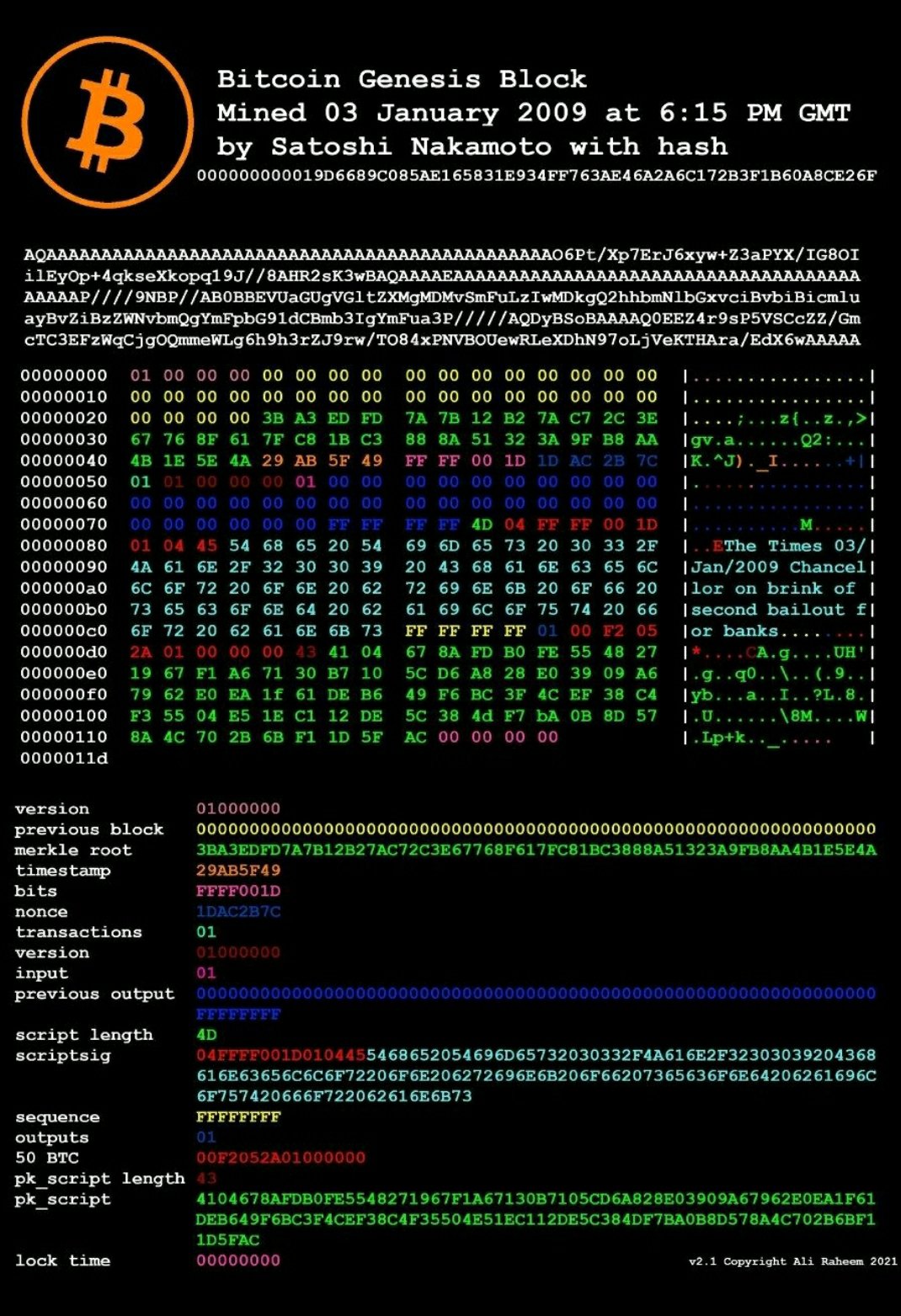
Bitcoin Genesis Block
Mined 03 January 2009

The Times
January 3, 2009

Bitcoin – Proof Of Work


Bitcoin-type Proof Of Work


In 2009, the Bitcoin network went online. Bitcoin is a proof-of-work digital currency that, like Finney’s RPoW, is also based on the Hashcash PoW.

But in Bitcoin, double-spend protection is provided by a decentralized P2P protocol for tracking transfers of coins, rather than the hardware trusted computing function used by RPoW.

Bitcoin has better trustworthiness because it is protected by computation. Bitcoins are “mined” using the Hashcash proof-of-work function by individual miners and verified by the decentralized nodes in the P2P bitcoin network.

The difficulty is periodically adjusted to keep the block time around a target time.

Since the creation of Bitcoin, proof-of-work has been the predominant design of peer-to-peer cryptocurrency. Studies have estimated the total energy consumption of cryptocurrency mining.

The PoW mechanism requires a vast amount of computing resources, which consume a significant amount of electricity. Recent estimates from the University of Cambridge put Bitcoinโ€™s energy consumption as equal to that of Switzerland.

History modification

Each block that is added to the blockchain, starting with the block containing a given transaction, is called a confirmation of that transaction.

Ideally, merchants and services that receive payment in the cryptocurrency should wait for at least one confirmation to be distributed over the network, before assuming that the payment was done.

The more confirmations that the merchant waits for, the more difficult it is for an attacker to successfully reverse the transaction in a blockchainโ€”unless the attacker controls more than half the total network power, in which case it is called a 51% attack.

2ASICs and mining pools

Within the Bitcoin community there are groups working together in mining pools.

Some miners use application-specific integrated circuits (ASICs) for PoW. This trend toward mining pools and specialized ASICs has made mining some cryptocurrencies economically infeasible for most players without access to the latest ASICs, nearby sources of inexpensive energy, or other special advantages.

Some PoWs claim to be ASIC-resistant,  i.e. to limit the efficiency gain that an ASIC can have over commodity hardware, like a GPU, to be well under an order of magnitude.

ASIC resistance has the advantage of keeping mining economically feasible on commodity hardware, but also contributes to the corresponding risk that an attacker can briefly rent access to a large amount of unspecialized commodity processing power to launch a 51% attack against a cryptocurrency.


Plant the Seed
The choice is Yours

Choose Wisely
The Choice is Yours


With ๐Ÿ’š


Bitcoin Mining – Where the Profitable Future Lies


The Times – January 3, 2009

Bitcoin Genesis Block
Mined 03 January 2009

Cypherpunks Write Code

CODE IS LAW
THE SOONER HUMANKIND ACCEPTS IT,
THE SOONER IT CAN BUILD AROUND IT

Yeah.. I wonder Why ๐Ÿ˜‚


Bitcoin made easy

How a Bitcoin transaction works

A humble Miner


How Bitcoin Mining Works

Mining Difficulty

Bitcoin Halving

Bitcoin Previous Halvings

Pools

Bitcoin Wallets

Bitcoin Stakeholders

Bitcoin Facts

Power to the People

Totalitarian Governments can kiss my 256-bit key

Bitcoin – People’s Money

Bitcoin cannot be Shut Down


The power of the long tail…


Central Bank’s 3 Strategies

F**k them, Enough !!!


Upcoming Smart Contracts Networks

Bitcoin Yearly Candles

Bitcoin Price History – Log Scale

Bitcoin Mining Ecosystem Map

Defi Ecosystem in Ethereum

DeFi Stack: Product& Application View

Syscoin Ecosystem


Syscoin

BSC Ecosystem

Popular Cryptocurrency

Crpto Ecosystem

Public Companies that own Bitcoin

Top Banks investing in Crypto

Bitcoin Inflation vs. Time

When you’re Ready…


Choose Wisely

Make bitcoin thrive, let fiat become humus…


Veritas non Auctoritas
Facit Legem

Most people misunderstand what bitcoin miners actually do, and as a result they don’t fully grasp the level of security provided by bitcoin’s hashrate.

In this article, we’ll explain proof of work in a non-technical way so that youโ€™ll be able to counter the misinformation about supercomputers and quantum computers attacking the Bitcoin network in the future. 

Simply put, mining is a lottery to create new blocks in the Bitcoin blockchain. There are two main purposes for mining:

  1. To permanently add transactions to the blockchain without the permission of any entity.
  2. To fairly distribute the 21 million bitcoin supply by rewarding new coins to miners who spend real world resources (i.e. electricity) to secure the network.

To understand what is actually happening in this lottery system, let’s look at a simple analogy where every Bitcoin hash is equivalent to a dice roll.


Luck, Gambling, and SHA-256


Imagine that miners in the Bitcoin Network are all individuals gambling at a casino. In this example, each of these gamblers have a 1000 sided dice. They roll their die as quickly as possible, trying to get a number less than 10. Statistically, this may take a very long time, but as more gamblers join the game, the time it takes to hit a number less than 10 gets reduced. In short, more gamblers equals quicker rounds.

Once somebody successfully rolls a number less than 10, all gamblers at the table can look down and verify the number. This lucky gambler takes the prize money and the next round begins.

Ultimately, the process of mining bitcoin is very similar. All miners on the network are using Application Specific Integrated Circuits (ASICs), which are specialized computers designed to compute hashes as quickly as possible.

To โ€œcompute a hashโ€ simply means plugging any random input into a mathematical function and producing an output.

More hashes per second (i.e. higher hashrate) is equivalent to more dice rolls per second, and thus a greater probability of success.

Miners propose a potential Bitcoin block of transactions, and use this for an input. The block is plugged into the SHA256 hash function which yields a fixed-sized output, known as a hash. A single hash can be computed in less than a millisecond, as it involves no complex math.

If the hash value is lower than the Bitcoin Network difficulty, then the miner who proposed the block wins. If not, then the miner continues trying by computing more hashes.

The successful minerโ€™s block is then added to the blockchain, the miner is rewarded with newly issued bitcoin for their work, and the โ€œnext roundโ€ begins.


Sources :

https://wikipedia.com/

https://braiins.com/

https://blockdata.com/

https://coin98analytics.com/

https://scoopwhoop.com/

https://stakingrewards.com/

https://syscoin.org/

https://galaxydigitalresearch.com/

https://surveycrest.com/

The Times

The Economist

"Internet of Money" - Andreas Antonopoulus

Hal Finney Quotes

Timothy C. May Quote

Free Spirit Digital Art

!ยฐ! If I forgot someone, sorry ! Do tell and I'll add you as a source of inspiration on the list !!! Thanks for understanding !!!


Questions, opinions, critics and requests always welcomed and as time allows will be accomodated !!! ๐Ÿค“ ๐Ÿ™‚ ๐Ÿ˜‰


Did you find this article helpful?

If so, please consider a donation to help the evolution and development of more helpful articles in the future, and show your support for alternative articles.

Your generosity is ๐Ÿ’š ly appreciated

You can donate in any crypto your ๐Ÿ’š desires ๐Ÿ˜Š

Thank you all for your time !!!

โœŒ & ๐Ÿ’š


Bitcoin (BTC) :

1P1tTNFGRZabK65RhqQxVmcMDHQeRX9dJJ


LiteCoin(LTC) :

LYAdiSpsTJ36EWCJ5HF9EGy9iWGCwoLhed


Ethereum(ETH) :

0x602e8Ca3984943cef57850BBD58b5D0A6677D856


EthereumClassic(ETC) :

0x602e8Ca3984943cef57850BBD58b5D0A6677D856


Cardano(ADA) :

addr1q88c5cccnrqy6xesszzvf7rd4tcz87klt0m0h6uvltywqe8txwmsrrqdnpq27594tyn9vz59zv0n8367lvyc2atvrzvqlvdm9d


BinanceCoin(BNB) :

bnb1wwfnkzs34knsrv2g026t458l0mwp5a3tykeylx


BitcoinCash (BCH)

1P1tTNFGRZabK65RhqQxVmcMDHQeRX9dJJ


Bitcoin SV (BSV)

1P1tTNFGRZabK65RhqQxVmcMDHQeRX9dJJ


ZCash(ZEC) :

t1fSSQX4gEhove9ngcvFafQaMPq5dtNNsNF


Dash(DASH) :

XcWmbFw1VmxEPxvF9CWdjzKXwPyDTrbMwj


Shiba(SHIB) :

0x602e8Ca3984943cef57850BBD58b5D0A6677D856


Tron(TRX) :

TCsJJkqt9xk1QZWQ8HqZHnqexR15TEowk8


Stellar(XLM) :

GBL4UKPHP2SXZ6Y3PRF3VRI5TLBL6XFUABZCZC7S7KWNSBKCIBGQ2Y54


A world where anything is possible…
The choice is yours People !!!


With ๐Ÿ’š

The other 6 Billion

Why bitcoin matters

Why Bitcoin Matters ?


โ€œA mysterious new technology emerges, seemingly out of nowhere, but actually the result of two decades of intense
research and development by nearly anonymous researchers.

Political idealists project visions of liberation and revolution onto it; establishment elites heap contempt and scorn on it.

On the other hand, technologists โ€“ nerds โ€“ are transfixed by it.

They see within it enormous potential and spend their nights and weekends tinkering with it.

Eventually mainstream products, companies and industries emerge to commercialize it; its effects become profound; and later, many people

wonder why its powerful promise wasnโ€™t more obvious from the start.

What technology am I talking about?

Personal computers in 1975, the Internet in 1993, and โ€“ I believe โ€“ Bitcoin in 2014โ€ฆ.

The practical consequence of solving this problem is that Bitcoin gives us, for the first time, a way for one Internet user to transfer a unique piece of digital property to another Internet user, such that the transfer is guaranteed to be safe and secure, everyone knows that the transfer has taken place, and nobody can challenge the legitimacy of the transfer.

The consequences of this breakthrough are hard to overstate.

What kinds of digital property might be transferred in this way?

Think about digital signatures, digital contracts, digital keys (to physical locks, or to online lockers), digital ownership of physical assets such as cars and houses, digital stocks and bonds โ€ฆ

and digital moneyโ€.

โ€“ Marc Andreessen, Founder of Netscape & well-known venture capitalist, 2014

Marc Lowell Andreessen

(/รฆnหˆdriหsษ™n/ann-DREE-sษ™n;

born July 9, 1971) is an American entrepreneurinvestor, and software engineer.

He is the co-author of Mosaic, the first widely used web browser; co-founder of Netscape; and co-founder and general partner of Silicon Valleyventure capital firm Andreessen Horowitz.

He co-founded and later sold the software company Opsware to Hewlett-Packard.

Andreessen is also a co-founder of Ning, a company that provides a platform for social networking websites.

He sits on the board of directors of Meta Platforms.

Andreessen was one of six inductees in the World Wide Web Hall of Fame announced at the First International Conference on the World-Wide Web in 1994.

Shared with ๐Ÿ’š by Free Spirit

โœŒ & ๐Ÿ’š

BitHouse with ๐Ÿ’š

DEX Aggregators 2022

Top DEX Aggregators

Decentralized exchange (DEX) aggregators, also known as liquidity aggregators, compile the exchange rates of numerous DEX platforms and show you a list of platforms offering the best value for your crypto trades.

Moreover, you can access a deeper pool of liquidity by trading on multiple DEXs using a single trading dashboard. Think of them as the search engines of the DeFi landscape, scouring DEXs for the best deals so that you can swap your crypto assets with the lowest fees.

1Inch

Although it is a DEX in its own right, 1Inchโ€™s main USP is its position as a top DEX aggregator across multiple blockchains. The network supports trades across major ecosystems like Ethereum and Binance and smaller networks like Polygon, Arbitrum, and Optimism.

As an aggregator, 1Inch gives you access to over 120 liquidity sources, with 68 on Ethereum, 39 on Binance, and 24 on Polygon. With daily trading volumes averaging close to $300 million from 300,000+ active users, it is one of the most active DEX aggregators in 2021.

The native token of the 1Inch DEX is also called 1INCH. It functions as both a utility token and a governance token for the protocol. 1INCH is a multi-chain token available on the Ethereum and Binance Smart Chain.

1Inch is one of the best DEX aggregators for crypto rookies, with detailed documentation and a well-developed Help Center filled with starter guides, FAQs, and more.


Slingshot

Slingshot grew out of DEX.AG, a DEX aggregator platform created in late 2018 as part of a hackathon event. At its launch, it supported seven major DEX, including Uniswap, Kyber, and DDEX.

After million-dollar funding rounds, DEX.AG was rebranded as Slingshot in November 2020. Slingshot works on Ethereum-based protocols โ€“ Polygon (formerly MATIC) and Arbitrum One. Across the two, you get access to over 326 exchanges/liquidity sources.

Slingshot is a very popular choice among experienced cryptocurrency traders due to its relative simplicity and advanced functionality. The average daily volumes touching over half a billion dollars is a testament to the platformโ€™s popularity.

However, due to a threadbare interface and lack of easily accessible website FAQs, guides, and documentation, Slingshot is not a very beginner-friendly DEX platform.


Totle Swap

Totle is a DEX aggregator that also dips into synthetic asset providers, allowing traders to engage with tokenized assets of many shapes and sizes. Unfortunately, the platform seems to be dormant, with no updates since mid-2021 and a lack of stats on any major crypto platform.


ParaSwap

ParaSwap is a versatile DEX aggregator supporting Ethereum, Binance, Polygon, and Avalanche blockchains. In addition, it has a native token for liquidity and governance purposes called the PSP.

While it is one of the more feature-packed and beginner-friendly DEX aggregators, ParaSwap is still in the growth phase. In 2021, the platform reported 1.4 million total users over time, with daily transaction volumes peaking around $150 million.

ParaSwap allows you access to swap and payment options across 75 DEX platforms, focusing on better market rates and cheaper gas fees. In addition, decentralized applications (dApps) can also integrate with ParaSwap to better streamline token swaps.


Matcha

Like 1Inch and Slingshot, Matcha is both a DEX aggregator and a decentralized exchange in itself. Powered by 0x Labs, the platform focuses on transparency, lower fees, smart order routing, and easier access.

Thanks to a recent partnership with MoonPay, Matcha can now accept payments in fiat currencies, a first for DEX platforms. This could be very useful for newcomers โ€“ you can directly purchase cryptos using regular currency on Matcha and start trading immediately.

Matcha provides access to over 50 liquidity sources and DEX platforms across three blockchain systems โ€“ Ethereum, Binance, and Polygon. Despite being one of the younger platforms on this list (launched in 2020), Matcha boasts over 2.5k daily traders. Its daily volumes are close to $150 million.


Uniswap V3

Uniswap is a DEX platform based on the Automated Marker Maker (AMM) model. After its launch in November 2018, the DEX has seen a meteoric rise among crypto circles. As of Q4 2021, it routinely tops the charts of DEX platforms with the largest daily volumes with $5.5 billion.

The platform is currently in its third iteration โ€“ Uniswap V3. Based on the Ethereum Blockchain, Uniswap gives you access to over 50 liquidity pools, with 285 cryptocurrencies across more than 350 markets. The USDC-ETH pair alone accounts for over $1.8 billion worth of trades each day.

While not a DEX aggregator per se, Uniswap is still a great option to consider due to its sheer size and reach. Most of the other aggregators on this list have Uniswap as a major partner and source of trading options.


PancakeSwap

PancakeSwap launched in 2020 to work like Uniswap, but on the Binance Smart Chain instead of Ethereum. Like Uniswap, PancakeSwap is a DEX platform with an AMM operating model, with an additional focus on yield farming based on the native CAKE token.

Regardless of the sweet and syrupy โ€œcakeโ€ theme, PancakeSwap is a major force on the DeFi scene, thanks to the sheer size of the Binance blockchain. It easily slots into the top three most active DEX platforms, with daily volumes exceeding $2.6 billion.

The platform is user-friendly, with detailed community guides, troubleshooting articles, and customer support. In addition, you can trade in over 30 major cryptos backed by an equal number of high-quality liquidity pools.


SushiSwap

Is based directly on Uniswap, with a fork in the original code created by its anonymous developer who goes by the pseudonym Chef Nomi.

Right from the outset, SushiSwap has courted controversy. To generate liquidity, its founder encouraged users to deposit in Uniswap tokens, leeching away almost $810 million from Uniswap in a โ€œvampire attack.โ€

Chef Nomi then proceeded to withdraw his liquidity from the project, generating a massive controversy. Ultimately, he backtracked and returned all funds, relinquishing his control over the project to a new team.

Since these early missteps, SushiSwap has maintained healthy growth rates in the crowded arena of Ethereum-based DEX/AMM platforms. It currently ranks in the top ten list, with daily volumes of close to $800 million across 400+ markets.


dYdX

dYdX is a major DEX platform with a heavy focus on reducing the inflated gas prices on Ethereum. It is one of the few platforms to offer gasless deposits to new users who deposit above a certain threshold. The platform has plans to make this a permanent feature.

dYdX is also working closely with StarkWare to deploy a Layer 2 scalability engine designed to reduce gas costs and trading fees further. Using Ethereum Smart Contracts, dYdX enables traders to invest in the crypto-equivalent of futures trading and other derivatives.

Due to its unique position on the Ethereum ecosystem, dYdX has managed to gain ground on other more popular DEX platforms like Uniswap. As a result, at the end of 2021, dYdX is ranked second on the list of the most active DEX platforms, with daily volumes of $5.4 billion.


Raydium

Instead of Ethereum or Binance, the Raydium platform operates on the highly promising Solana blockchain. As a result, the Ethereum-competitor has a vibrant developer ecosystem, and its cryptocurrency has grown at least 16,000% since January 2021.

The increased interest in the Solana blockchain has also helped Raydium, an AMM platform based on the Serum DEX.

The platform gives access to over 430 trading pairs, with Solana-USDT being the most popular.

The native token, also called Raydium, is the foundation of all future apps and projects on the Solana and Serum ecosystems.

The projectโ€™s primary focus is to function as the engine of DeFi on Solana. However, with current daily volumes already reaching $300 million, Raydium shows a lot of promise for future growth.


TraderJoe

Launched in 2020 as a less expensive, more efficient alternative to Ethereum,  Avalanche blockchain focuses on decentralized apps.

Its AVAX token has hit all-time high demands in late 2021, thanks to positive media coverage and high-profile partnerships with entities like Deloitte.

This surge has also propelled TraderJoe, the major DEX platform based around Avalanche blockchain, to the top of the DEX pile in recent times. Its pole position in the blockchain ecosystem has helped drive TraderJoeโ€™s daily trades close to $1 billion.

You can trade major cryptos, stake and gain the native JOE token as rewards, lend other cryptos and farm yields on the TraderJoe platform. With low fees and over 170 markets, TraderJoe is a top target for anyone interested in the Avalanche ecosystem.


Top Pick: Uniswap

The Top pick isย Uniswap, for its deep liquidity pools, its user-friendliness, and its commitment to continuous innovation.

As the various DeFi ecosystems continue to grow and expand, the importance of DEX aggregators and AMM platforms will increase further.

These platforms serve a vital purpose, finding liquidity and facilitating transactional activity across multiple blockchains.

To say that the future of DeFi, and by extension, the future of finance as we know it, hinges on DEX aggregators would not be an overstatement.


Shared with ๐Ÿ’š by Free Spirit

โœŒ & ๐Ÿ’š


Merry X-Mass – Crypto Style

Shared with ๐Ÿ’š by Free Spirit

โœŒ & ๐Ÿ’š

Kudos to @ChessurKot

I ๐Ÿ’š it so much i had to share it !!!

Amazing poster and imagination !!!

Shared with ๐Ÿ’š by Free Spirit

โœŒ & ๐Ÿ’š

Calculate Hashes/s

How can I calculate how many hashes I generate per second?

I have a function which generates hashes from a string:

string GenerateHash(string plainText);

I generate as many hashes as possible with 4 threads.

How do I calculate how many hashes (or megahashes) I generate per second?

Your problem breaks down nicely into 3 separate tasks

  1. Sharing a single count variable across threads
  2. Benchmarking thread completion time
  3. Calculating hashes per/second

Sharing a single count variable across threads

public static class GlobalCounter
{ public static int Value { get;
private set;
} public static void Increment()
{ Value =GetNextValue(Value);
} private static int GetNextValue(int curValue) { returnInterlocked.Increment(ref curValue);
} public static void Reset() { Value = 0; } }

Before you spin off the threads call GlobalCounter.Reset and then in each thread (after each successful hash) you would call GlobalCounter.Increment – using Interlocked.X performs atomic operations of Value in a thread-safe manner, it’s also much faster than lock.

Benchmarking thread completion time

var sw = Stopwatch.StartNew(); Parallel.ForEach(someCollection, someValue => 
{ // generate hash GlobalCounter.Increment();
}); sw.Stop();

Parallel.ForEach will block until all threads have finished

Calculating hashes per second

... sw.Stop(); var hashesPerSecond = GlobalCounter.Value / sw.Elapsed.Seconds;

Did you find this article helpful?

If so, please consider a donation to help the evolution and development of more helpful articles in the future, and show your support for alternative articles.

Your generosity is ๐Ÿ’š ly appreciated

You can donate in any crypto your ๐Ÿ’š desires ๐Ÿ˜Š

Thank you all for your time !!!

โœŒ & ๐Ÿ’š

Bitcoin (BTC) :
1P1tTNFGRZabK65RhqQxVmcMDHQeRX9dJJ

LiteCoin(LTC) :
LYAdiSpsTJ36EWCJ5HF9EGy9iWGCwoLhed

Ethereum(ETH) :
0x602e8Ca3984943cef57850BBD58b5D0A6677D856

EthereumClassic(ETC) :
0x602e8Ca3984943cef57850BBD58b5D0A6677D856

Cardano(ADA)
addr1q88c5cccnrqy6xesszzvf7rd4tcz87klt0m0h6uvltywqe8txwmsrrqdnpq27594tyn9vz59zv0n8367lvyc2atvrzvqlvdm9d

BinanceCoin(BNB)
bnb1wwfnkzs34knsrv2g026t458l0mwp5a3tykeylx

BitcoinCash (BCH)
1P1tTNFGRZabK65RhqQxVmcMDHQeRX9dJJ

BitcoinSV(BSV)
1P1tTNFGRZabK65RhqQxVmcMDHQeRX9dJJ

ZCash(ZEC)
t1fSSQX4gEhove9ngcvFafQaMPq5dtNNsNF

Dash(DASH)
XcWmbFw1VmxEPxvF9CWdjzKXwPyDTrbMwj

Shiba(SHIB)
0x602e8Ca3984943cef57850BBD58b5D0A6677D856

Tron(TRX)
TCsJJkqt9xk1QZWQ8HqZHnqexR15TEowk8

Stellar(XLM)
GBL4UKPHP2SXZ6Y3PRF3VRI5TLBL6XFUABZCZC7S7KWNSBKCIBGQ2Y54

Made with ๐Ÿ’š by Free Spirit

โœŒ & ๐Ÿ’š

Bitcoin and it’s History

Finance, like most human inventions, is constantly evolving.

In the beginning it was basic: food was traded for livestock, and livestock for resources like wood, or maize. It progressed to precious metal, such as silver and gold. And now, the next step in financial evolution has come to light.

This new form of currency has been constantly evolving over the past decade, developed by an unknown person and maintained by a collective group of the brightest minds in technology.

Itโ€™s a new form of money that is created and held digitally, and the most important part, of course, is that no government owns it, or decides its value – the peer-to-peer network community does.

We call this new money, โ€˜Bitcoinโ€™.

Historically, U.S. currency has been based on gold – you could give a dollar to the bank and receive a set amount back in gold. In contrast, Bitcoin isnโ€™t based on silver or gold – itโ€™s based on mathematical proofs validated by a public ledger called blockchain technology.

Bitcoin is generated through a complex sequence of mathematical formulas that run on computers; the network shares a public ledger using blockchain technologies that record, and validate, every transaction processed.

A single institution, such as the government, does not control the Bitcoin network.

The idea behind the technology has always been – and remains – one of decentralization – that is, remaining completely independent of a central authority, like a bank, a government, or a country.

Anyone can access the open-source software that makes Bitcoin work, and its those individuals interested that maintain it.

But, who invented Bitcoin? Is it a valid and legitimate currency like USD? And why did nobody think of this before?

But before we begin, letโ€™s talk about the creator of Bitcoin – or rather, the anonymous pseudonym that first published a concept.

How Did Bitcoin Start?

There are many questions about Bitcoin, but the most common one to be asked is, โ€œWho created it?โ€

That answer is not straightforward, because the identity of the creator remains a mystery. All we have is a pseudonym – Satoshi Nakamoto.

The accounts are no longer active; the coins in his wallet have never been spent.

Satoshi Nakamoto has disappeared from the world, or so it would seem.

Fast Company recently published an article suggesting that Satoshi Nakamoto could be a group of people, including Neal King, Vladimir Oksman, and Charles Bry. Apparently, these three people filed for a patent related to secure communication just two months prior to the purchase of the Bitcoin.org domain. Perhaps itโ€™s a coincidence; perhaps itโ€™s not.

What we do have, however, are facts:

  • On October 31st, 2008, โ€œBitcoin: A Peer-to-Peer Electronic Cash Systemโ€ was posted to a cryptography mailing list, published under the name โ€œSatoshi Nakamotoโ€. The whitepaper outlined the foundation of how Bitcoin would operate.
  • On August 18, 2008, an unknown person or entity registered the Bitcoin.org domain.
  • On January 8th, 2009, the first version of Bitcoin is announced, and shortly thereafter, Bitcoin mining begins.

The mystery that surrounds Satoshi Nakamoto is fitting; privacy was a key value for both Bitcoin, and its users.

Others have tried to claim his mantle – most recently an Australian man named Craig Wright, who has since withdrawn his claim.

While we may never know who first created Bitcoin, we do know that the technology he started has left ripples in the financial industry.

Bitcoin has risen to fame thanks to individuals such as the Winklevoss twins controlling and growing the market, and major events that have defined this new technologyโ€™s existence such as the Mt. Gox Ponzi scheme disaster.

The people involved and the events that occur are a constant reminder that this market is unregulated and seem to fall in line with Satoshi Nakamotoโ€™s goal of creating a decentralized network.

What is Bitcoin Used For?

Currency must have value to ensure stability.

The most common way for a person to judge a currencyโ€™s value is what they can use it on; Bitcoin is no different, and a host of vendors and merchants now accept it alongside, or in place of, fiat money.

One early adopter of Bitcoin was the computer retailer Dell. In fact, when Dell started accepting Bitcoin, it became one of the largest companies to do so internationally.

While the digital currency may total for just a fraction of the retailerโ€™s total transaction volume, there are other key reasons why the growth of Bitcoin could be aboon for the retailer.

Dell reported earnings of $59 billion during 2015. Traditional transaction fees range from 2 to 3 percent of the purchase price – with Bitcoin, itโ€™s much, much lower, nearing non-existent – saving the retailer a lot of money in the future.

Other companies, such as Expedia and Cheapair, have also started accepting Bitcoin, along with technology conglomerate Microsoft : users can add funds to their accounts with Bitcoin to purchase apps, games, and other types of digital content.

The acceptance of Bitcoin is a strategic decision on the part of these companies, most of which are reaching out to solidify their position with tech-savvy audiences.

Thereโ€™s a lot of benefit to Bitcoin, and a variety of reasons for its use, including :

  • Faster Payment: Accepting wire transfers and checks is time consuming, and it can take several days for payment to clear. Bitcoin is faster and can take a matter of minutes, rather than days to process payment.
  • Lower Transaction Fees: The cost to accept Bitcoins is lower compared to other payment methods, such as credit cards or Paypal.
  • Independent of Governments: Since Bitcoin is decentralized, you own it – no authority has the right to take away your Bitcoin. People with concerns about mainstream banking systems unravelling find this a major benefit.
  • Elimination of Chargebacks: Once Bitcoin is sent, thatโ€™s it – you canโ€™t chargeback, like you would with a credit card payment, which eliminates โ€˜chargeback fraudโ€™ often used by criminals and scammers.
  • Protection Against Inflation: With a fiat currency, the government can print as much money as it desires – this drastically decreases the value of currency, and may result in inflation. In contrast, Bitcoin has a fixed number – after they have all been โ€˜minedโ€™, no more Bitcoins will be created. Scarcity is an important aspect of currency which protects it from inflation.
  • Ownership of Currency: With Bitcoin, you own your coins. With other forms of digital fiat – such as Paypal – your assets may be held, and your account eventually suspending, locking you out of your earnings. Bitcoin puts you in control.

Is Bitcoin a Commodity, or a Currency?

Bitcoin is both. While it can be used to purchase items from major retailers, itโ€™s also treated as property by government jurisdictions, such as the IRS.

The IRS issued a guide on Bitcoin for tax purposes, stating it will treat virtual currencies as property for federal purposes. They go on to state that:

In some environments, virtual currency operates like โ€œrealโ€ currency โ€” i.e., the coin and paper money of the United States or of any other country that is designated as legal tender, circulates, and is customarily used and accepted as a medium of exchange in the country of issuance โ€” but it does not have legal tender status in any jurisdiction.

The notice provides that virtual currency is treated as property for U.S. federal tax purposes.

Typically, property is almost always something tangible that can be held in the physical realm.

The IRS goes on to state that:

General tax principles that apply to property transactions apply to transactions using virtual currency. Among other things, this means that:

  • Wages paid to employees using virtual currency are taxable to the employee, must be reported by an employer on a Form W-2, and are subject to federal income tax withholding and payroll taxes.
  • Payments using virtual currency made to independent contractors and other service providers are taxable and self-employment tax rules generally apply. Normally, payers must issue Form 1099.
  • The character of gain or loss from the sale or exchange of virtual currency depends on whether the virtual currency is a capital asset in the hands of the taxpayer.
  • A payment made using virtual currency is subject to information reporting to the same extent as any other payment made in property.

In addition to the IRSโ€™s guidance, the United States Commodities Futures Trading Commission in 2015 that Bitcoin is, in fact, a commodity.

The Future of Currency

Bitcoin has garnered a lot of attention over the past decade, despite constant declarations of its death – 99 Bitcoins keeps a running tab of โ€˜Bitcoin obituariesโ€™.

Despite all of this, Bitcoinโ€™s future has remained bright. Greater adoption rates, and an increasing number of brands accepting the currency (you can get a full list qui) means the long-term view on Bitcoin is that it will see market maturity as time progresses.

Mainstream investing vehicles, such as exchange-traded funds (ETFs) and Futures trading, including Bitcoin will be a major help to reaching that market maturity. Bitcoin Futures are already trading on the Chicago Mercantile Exchange (CME), and legislation to create a crypto ETF is in the works.

These securities will help stabilize cryptocurrency prices and mitigate volatility, which will help the publicโ€™s confidence grow in favor of Bitcoin.

Itโ€™s important to understand that, much like the early days of 1992, Bitcoin is a new technology – and new technologies can take decades to reach critical mass.

But, much like the Internet, no one wants to miss out on the โ€˜next big thingโ€™ – and Bitcoin is the biggest thing yet. Constant updates are occurring to Bitcoin thanks to what is called a “hard fork”.

These constant updates ensure that digital currencies continue to experience growth through technological development.


Did you find this article helpful?

If so, please consider a donation to help the evolution and development of more helpful articles in the future, and show your support for alternative articles.

Your generosity is ๐Ÿ’š ly appreciated

You can donate in any crypto your ๐Ÿ’š desires ๐Ÿ˜Š

Thank you all for your time !!!

โœŒ & ๐Ÿ’š


Bitcoin (BTC) :

1P1tTNFGRZabK65RhqQxVmcMDHQeRX9dJJ

LiteCoin(LTC) :

LYAdiSpsTJ36EWCJ5HF9EGy9iWGCwoLhed

Ethereum(ETH) :

0x602e8Ca3984943cef57850BBD58b5D0A6677D856

EthereumClassic(ETC) :

0x602e8Ca3984943cef57850BBD58b5D0A6677D856

Cardano(ADA) :

addr1q88c5cccnrqy6xesszzvf7rd4tcz87klt0m0h6uvltywqe8txwmsrrqdnpq27594tyn9vz59zv0n8367lvyc2atvrzvqlvdm9d

BinanceCoin(BNB) :

bnb1wwfnkzs34knsrv2g026t458l0mwp5a3tykeylx

BitcoinCash(BCH)

1P1tTNFGRZabK65RhqQxVmcMDHQeRX9dJJ

BitcoinSV(BSV)

1P1tTNFGRZabK65RhqQxVmcMDHQeRX9dJJ

ZCash(ZEC) :

t1fSSQX4gEhove9ngcvFafQaMPq5dtNNsNF

Dash(DASH) :

XcWmbFw1VmxEPxvF9CWdjzKXwPyDTrbMwj

Shiba(SHIB) :

0x602e8Ca3984943cef57850BBD58b5D0A6677D856

Tron(TRX) :

TCsJJkqt9xk1QZWQ8HqZHnqexR15TEowk8

Stellar(XLM) :

GBL4UKPHP2SXZ6Y3PRF3VRI5TLBL6XFUABZCZC7S7KWNSBKCIBGQ2Y54

Shared with ๐Ÿ’š by Free Spirit

โœŒ & ๐Ÿ’š